
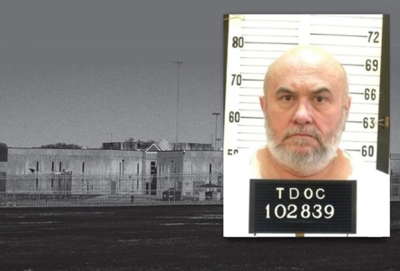

Edmund Zagorski, the man set to be executed by the state of Tennessee in less than 36 hours, has filed a legal challenge in federal court arguing that if the state is going to kill him tomorrow, they must honor his request that they do so using the electric chair.
Tennessee prisoners who were sentenced to death before Jan 1. 1999 — when the state moved away from the chair and made lethal injection its primary method of execution — are allowed to choose the method of their execution. Zagorski, who was sentenced to death in 1984 for the murders of two men who had met him to buy drugs, is one of those prisoners. And on Monday evening, he signed a document indicating that he preferred to be executed by electrocution, rather than with the state's three-drug lethal injection protocol. Dozens of death row prisoners, including Zagorski, have been arguing that the protocol amounts to torture (and medical experts have agreed with them). A Nashville judge and the Tennessee Supreme Court have upheld the protocol as constitutional, and the inmates are now seeking to bring their challenge before the Supreme Court of the United States.
In the affidavit stating his preference for the electric chair, Zagorski said that he believes the electric chair and Tennessee's lethal injection protocol amount to cruel and unusual punishment. However, if he was forced to choose, he said he chose electrocution. His attorney, Kelley Henry, told the Scene that the chair was "the lesser of two evils."
Soon after Henry submitted the affidavit, though, state officials said it was too late for Zagorski to choose the electric chair. In a letter sent to Henry yesterday, the Tennessee Department of Correction's general counsel, Debra Inglis, says that the department must receive such an affidavit two weeks prior to an execution. She cites a 2015 Tennessee Supreme Court ruling that indicates the department can't undertake any "last-minute switch from lethal injection to electrocution."
"As a result," Inglis writes, "please be advised that ... Mr. Zagorski's execution scheduled for Thursday, Oct. 11, 2018, will be carried out using a three-drug combination consisting of Midazolam, Vecuronium Bromide, and Potassium Chloride."
In a motion filed in federal court today, Henry writes: "Secrecy, evasiveness, and a rush to execute on the part of State actors have forced Edmund Zagorski to make a terrible choice: either allow the state to subject him to an execution by lethal injection where the evidence establishes the last 10-18 minutes of his life will be spent in utter terror and agony, or request to be electrocuted which will end his life by burning his organs causing his body to be mutilated and experiencing excruciating pain for (likely) 15-30 seconds. Trite literary metaphors like "Catch-22," "Hobson's Choice," or "between a rock and a hard place" are inadequate to capture the horribleness of the position the State has placed him in."
Henry goes on to argue that Zagorski "has an absolute right to choose electrocution" and that the state "can easily conduct and execution by electric chair."
"The prison practices the electrocution protocol every month," Henry writes. "The electric chair is examined by an electrician every year. The idea that the chamber requires two weeks for reconfiguration is ludicrous. Unless the prison loses power, they can carry out an electrocution. It is simply one final indignity to force Mr. Zagorski to submit to 10-18 minutes of torture."
Along with asking the U.S. Supreme Court to hear the case against Tennessee's lethal injection protocol, Zagorski is also seeking a stay of execution from the high court. Gov. Bill Haslam has said he will not intervene to stop the execution.
The TDOC announced this afternoon that Zagorski has decided to forego his final meal.
According to a media release: "Should he change his mind and want to have dinner, his meal will be the same as the one provided to the other inmates at Riverbend Maximum Security Institution. This dinner will consist of sloppy joes, a wheat roll, pinto beans, cole slaw, a sugar cookie, and iced tea."
You can read more of our coverage of Zagorski and his case here:
— Edmund Zagorski's Case Illustrates 'Tennessee's Death Penalty Lottery'
— Edmund Zagorski's Plea for Mercy
— Zagorski Jurors Want Mercy for the Man They Sentenced to Death



Post a comment as anonymous
Report
Watch this discussion.
(0) comments
Welcome to the discussion.
Log In
Welcome to the discussion.
Keep it clean. Please avoid obscene, vulgar, lewd, racist or otherwise abusive language. Comments featuring hate speech or threatening or violent content will not be tolerated.
PLEASE TURN OFF YOUR CAPS LOCK.
Be truthful. Don't knowingly lie or mislead.
Be proactive. Use the “report” link on any comment that violates our comment policy.
Share with us. We'd love to hear your feedback.