
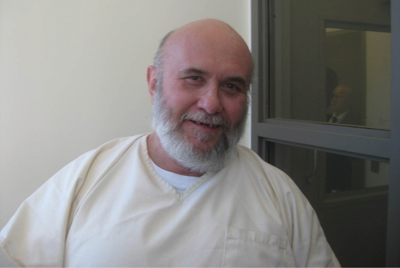


Edmund Zagorski
Edmund Zagorski’s plea for mercy is short and simple.
“Dear Governor Haslam,” he writes. “Thank you for your time. I just wanted to let you know that I regret everything that happened. I feel really bad for victims’ families and the vast impact it caused. I knew their lives would have been so much better in so many ways and not a day has gone by I haven’t thought about it. If you spare me I will continue doing my best.”
In 1984, Zagorski was convicted of murdering two men who were meeting him to buy drugs. He was said to have shot the men, slit their throats and robbed them. Now, 34 years later, the state of Tennessee plans to put him to death by lethal injection on Oct. 11.
Zagorski’s short note to the governor is included in his application for executive clemency — an official request for the governor to spare his life, submitted by his attorneys at the end of August. Attorneys representing Zagorski in his clemency effort shared the application with the Scene. Specifically, they are asking Haslam to commute Zagorski’s sentence to life without parole.
The scheduled execution of Zagorski would be the state’s second execution this year. Haslam denied a clemency request from Billy Ray Irick in August, allowing his execution (to which this reporter was an official media witness) to proceed despite Irick’s history of mental illness and an ongoing legal fight over the state’s lethal injection protocol. Few observers expected Haslam to grant clemency to Irick, if only because of the heinous nature of his crime — he was convicted of the rape and murder of a 7-year-old girl. But advocates for Zagorski believe he has a strong argument for clemency, from the circumstances surrounding his conviction and sentencing to the life he has lived in prison since.
Earlier this month, the Scene reported on court filings that argue that Zagorski’s case perfectly illustrates the arbitrary nature of Tennessee’s death penalty. Citing a report called “Tennessee’s Death Penalty Lottery,” authored by attorneys Bradley MacLean and H.E. Miller Jr., Zagorski’s attorneys highlight the fact that of more than 2,500 people convicted of first-degree murder in Tennessee over the past 40 years, only 86 received death sentences, and only six were executed. Citing the report, they further note that while Zagorski was sentenced to death for the drug-related killing of two men, other people convicted of killing four, five or even six people in drug-related homicides have received life sentences instead of the death penalty.
In Zagorski’s clemency application, attorney Robert Hutton makes a related argument about the circumstances of Zagorski’s sentencing. Today, every death penalty state has an option for jurors of life without parole. But when Zagorski was sentenced in 1984, his jury did not have that option. They could sentence him to life with the possibility of parole, or death. They chose death at the time. But six of the jurors from his trial have since signed sworn declarations that they would have voted for a life-without-parole sentence if it had been available to them. (Four jurors have died, and one declined to speak with the attorneys.) Their statements are included in Zagorski’s clemency application.
“We really did not want to give him the death penalty,” says the foreman of the jury from Zagorski’s trial. “If life without parole would have been an option the sentence would have been different.”
Another juror says: “If life without parole had been an option at the time of trial, I would have voted for life without parole instead of death.”
And another: “I would like Mr. Zagorski’s sentence of death to be changed to a sentence of life imprisonment without a chance of parole. That would have been my choice at the time of trial, and that is my preference today.”
Hutton writes in the application: “Under all sentencing statutes in effect now, a single juror wanting LWOP [life without parole] would preclude the jury from imposing a sentence of death. If LWOP had been available in 1984 as it is now, Ed would have received a sentence of life without possibility of parole.”
Studies have shown that the predicament jurors in the Zagorski case found themselves in is not an uncommon one. In an article published in December 2004 by the Tulane Law Review, Steven Mulroy of the University of Memphis law faculty wrote about the concept of “death by default.”
“The empirical evidence overwhelmingly shows that the lack of an LWOP option skews the sentencing decision towards death sentences that would otherwise not be imposed,” Mulroy writes. “A substantial body of research shows that jurors consistently overestimate the likelihood that defendants will be released on parole, and that concern over a defendant’s premature release, or any release at all, is a major factor motivating jurors to vote for the death penalty.”
Although it was not specifically part of his research, Mulroy tells the Scene that on top of erroneous beliefs about how soon people sentenced to life in prison would get out on parole, the lack of recent executions might also have been a factor in the Zagorski jury’s deliberations.
“I think it’s highly relevant that in the 1980s, when this capital-sentencing jury had to deliberate, there hadn’t been an execution in Tennessee for decades,” says Mulroy.
A footnote in Zagorski’s clemency application notes that Marsha Dotson — wife of Dale Dotson, one of the men Zagorski murdered — also does not oppose clemency.
“Even though Zagorski ruined my life and those years have been hard,” Dotson says, according to the application, “it would be OK with me if he wasn’t executed and spent the rest of his life locked up in prison.”
In fact, a significant part of Zagorski’s argument for clemency rests on the way he lives his life in prison. Hutton writes that “Ed has lived a truly extraordinary life in prison” and notes that “Ed has not received a single disciplinary write-up, not even a minor one, in the entire 34 years he has been in custody.”
Remarkably, a number of current and former prison staff members, including a former warden, voiced their support for clemency in Zagorski’s case, citing their personal experiences with him on death row.
“I remember one time when a couple of inmates had gotten into a fight,” says a correctional officer in a statement included in the clemency application. “I was the corporal in charge that day and was called to help break up this fight. Ed was in the room, but he was not involved in the fight. One inmate had taken the mop ringer [sic] off of the mop bucket and was going to use it as a weapon to attack another inmate. I was able to get the ringer out of the inmate’s hand and hand it back to Ed. When I handed it to Ed, I did not have to say anything to him about what to do. I trusted him to know to get the ringer from my hands and take it out of the room so it would not be within reach of the two men fighting, which is exactly what he did. He even removed the mop too, so it could not be used as a weapon.”
A counselor from the prison says Zagorski is “one of only three men for which I would support clemency.” A supervisor from the Tennessee Rehabilitative Initiative in Correction, which provides occupational and life-skills training for prisoners, says, “Having people around like Ed made me not afraid to work there.” Still another correctional officer recalls Zagorski breaking up a bloody fight between two inmates, and a former warden says, “Ed is a perfect example of how a man can change for the better over the years.”
With Zagorski’s scheduled execution two weeks away, Haslam and his legal staff are reviewing his request for clemency.
In the request, Hutton writes: “Governors possess clemency powers to prevent miscarriages of justice, and to grant grace where merited. Ed Zagorski’s life should be spared.”



Post a comment as anonymous
Report
Watch this discussion.
(0) comments
Welcome to the discussion.
Log In
Welcome to the discussion.
Keep it clean. Please avoid obscene, vulgar, lewd, racist or otherwise abusive language. Comments featuring hate speech or threatening or violent content will not be tolerated.
PLEASE TURN OFF YOUR CAPS LOCK.
Be truthful. Don't knowingly lie or mislead.
Be proactive. Use the “report” link on any comment that violates our comment policy.
Share with us. We'd love to hear your feedback.