
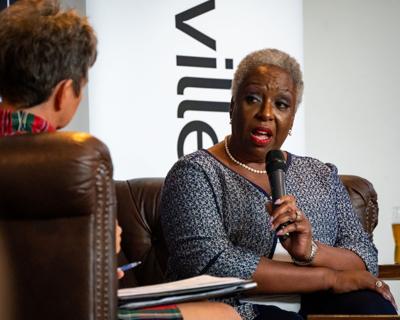


Sharon Hurt
At-Large Metro Councilmember Sharon Hurt’s two-plus decades running the Jefferson Street United Merchants Partnership (J.U.M.P.) is a big part of her pitch as she runs for mayor this year.
“When I was there at J.U.M.P., I basically transformed that community,” Hurt, who retired from the role in 2021, told the Post after a recent mayoral forum. “When I first started there, people wouldn't come down the street. It was completely and totally neglected.”
The organization worked on beautification, community development, affordable housing and workforce development, among other priorities in North Nashville.
But several years ago, the Metro government she now seeks to lead stopped providing funding to the nonprofit community group she was leading at the time.
Metro’s Office of Financial Accountability issued a report in 2016 identifying issues with J.U.M.P.’s handling of government funds. The report focused on $300,000 granted to J.U.M.P. for use during the 2014-15 fiscal year.
Metro officials interviewed J.U.M.P. staff and reviewed financial records and determined that the partnership did not spend all of the grant money on eligible expenses and did not properly report its spending. Specifically, Metro determined that J.U.M.P. did not adequately keep Metro funds and other funds separate. The group also “did not incur enough allowable and eligible expenses to fully earn the grant funds.”
The aim of the grant was to connect individuals to construction and hospitality jobs, conduct beautification work on 25 blocks in North Nashville and install seasonal decorations in the neighborhood. Metro found that J.U.M.P. conducted all of that work.
Still, the city concluded that J.U.M.P. had $57,864.23 in unearned grant funds that must either be resolved or returned to Metro. A Metro Finance official told the Post that no further grants were awarded to J.U.M.P. after the findings were published.
Hurt appeared to refer to the experience during a Metro Audit Committee meeting last year, when the committee was debating auditing the Community Foundation of Middle Tennessee.
“Considering I have been in a place where I’ve had a Metro contract and there was auditing done, I understand,” she said. “I believe in full transparency and accountability. Having full disclosure would be appropriate. … I’ve seen Metro audit some organizations for not even 1 percent of what the Community Foundation has received. When I say truly audited — combed through it very finely.”
In the recent interview, Hurt chalked the situation up to a misunderstanding.
“We were able to purchase a bus and we used it for some workforce development to get people back and forth. But we also used it for our shuttle service,” she said. “The money we got was for workforce development, period. We had not used all of that money because it was particularly for some specific things.
“I wrote Metro and asked them if we could reallocate the money and help pay for the bus. I got the answer back that we could. We bought the bus, then I got another email saying the person that told me I could use the money didn't really have the authority. I told them what we were doing and I never heard from them, so I thought everything was OK.
"When they came back and did the audit, then they said it wasn't for the workforce development program exclusively. They knew where every dime was spent. I requested for there to be a reallocation. I got permission to reallocate the money. I don't think it was totally on us, and it wasn't totally on them. We spent the money, and they knew where the money was spent. It was for the community.”



Post a comment as anonymous
Report
Watch this discussion.
(0) comments
Welcome to the discussion.
Log In
Welcome to the discussion.
Keep it clean. Please avoid obscene, vulgar, lewd, racist or otherwise abusive language. Comments featuring hate speech or threatening or violent content will not be tolerated.
PLEASE TURN OFF YOUR CAPS LOCK.
Be truthful. Don't knowingly lie or mislead.
Be proactive. Use the “report” link on any comment that violates our comment policy.
Share with us. We'd love to hear your feedback.