
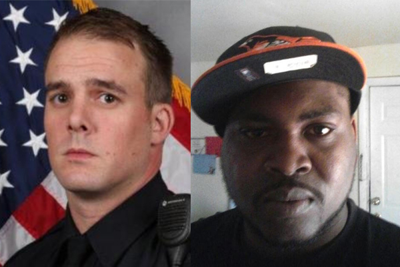


Officer Josh Lippert and Jocques Clemmons
Metro Police Officer Joshua Lippert killed Jocques Clemmons on Feb. 10, shooting him once in the hip and twice in the back — but in the eyes of Nashville’s top prosecutor, it wasn’t murder.
Davidson County District Attorney Glenn Funk announced Thursday afternoon that his office will not pursue criminal charges against the officer in the death of Clemmons, a black man who attempted to flee a traffic stop. Ultimately, Funk came to the conclusion that Lippert acted justifiably in self-defense after seeing a gun Clemmons is said to have been carrying — a detail corroborated by an eyewitness interviewed by investigators.
"Officer Lippert has a reasonable claim of self defense and this office will not pursue charges against him," Funk said.
But although Funk declined to indict Lippert, he did offer up some pointed criticism of the department's approach to the subsequent investigation. Funk detailed several actions taken by the department during its investigation of the shooting — a probe conducted against Funk’s wishes after he had called in the Tennessee Bureau of Investigation to take over the inquiry — actions he said gave the appearance that the department was biased in favor of one of its own.
Funk also used the opportunity to make several proposals and outline two initiatives “designed to make the justice system more fair and equitable.” In doing so he might be attempting to offer an olive branch to activists likely upset by his decision not to charge a white officer for shooting a black man who appeared to be trying to run away.
The Justice for Jocques Coalition was not pleased with the decision.
"We do not need trigger happy officers running amok in our communities," the group said in a statement. "They will only be emboldened now that they see that there will be no consequences for their actions. The Coalition will continue to fight on behalf of the Clemmons family for the expeditious fulfillment of the demands which we have presented to the Mayor and the City Council."
Funk’s decision comes almost three months to the day after the shooting and following a month spent with investigative files from the MNPD and the TBI. On Thursday morning, he met with Mayor Megan Barry to inform her of his decision. He also met with Lippert’s attorney and spoke briefly with Metro Nashville Police Chief Steve Anderson, a man with whom he has had a somewhat contentious relationship in recent months. The chief was invited to attend the Thursday afternoon press conference.
Lastly, a little more than an hour before he announced his decision publicly, Funk met with the Clemmons family and their attorney Joy Kimbrough at his office downtown.
Later at the press conference, Barry delivered brief remarks and offered a message directly to the families of both men.
“As the mother of a son, I know this truth," she said. "Two families were impacted that day and those families and their lives will never be the same. To Officer Josh Lippert and his family, while this day may provide closure as far as the criminal justice process is concerned, I know that your lives have changed forever. To the family of Jocques Clemmons, I too know that your lives have changed forever and they will never, ever be the same. As a parent I cannot begin to fathom the pain of losing your son and I am so sorry.”
Surveillance cameras captured the fatal interaction between Clemmons and Lippert on that Friday afternoon in February, which lasted no more than a minute. Shortly after 1 p.m., Clemmons runs a stop sign and pulls his SUV into a parking lot off South Sixth Street in East Nashville’s James A. Cayce Homes. Lippert pulls in behind him in an unmarked police vehicle. As the two men exit their vehicles, Clemmons attempts to flee, trying first to run around Lippert then doubling back and taking off the other way.
Lippert gives chase, catching up to Clemmons at the opposite end of the parking lot and appearing to throw him to the ground. Clemmons gets up and tries to run once more but goes to the ground again after more contact with Lippert. It is during these few seconds, with the two men flailing around, that police claim a fully loaded pistol that Clemmons was carrying fell to the ground. Despite Lippert’s efforts to kick it away, they said, Clemmons picked it up. On the video, he is seen getting up off the ground once more and briefly facing the officer, who appears to have his gun drawn. Clemmons turns his back and starts to run in between two parked cars when Lippert fires, striking Clemmons three times.
Funk’s confidence that Clemmons did indeed have a gun on him — a gun that Lippert says became visible to him during the incident — was a key factor in Funk’s decision. His report cites a witness interviewed by investigators who was in the parking lot when the shooting occurred. She, according the report, observed Clemmons with a handgun and also saw him pick it up off the ground during the altercation, corroborating claims from Lippert and the MNPD, which posted a picture of the gun on Twitter immediately following the shooting.
In the end, Funk had one option if he was going to charge Lippert — second degree murder. Lippert had not wildly shot into a crowd or at a moving vehicle. He had knowingly fired at Clemmons, multiple times, aiming to incapacitate him if not kill him. Reckless homicide or involuntary manslaughter did not fit. The question for Funk, then, was whether Lippert’s conscious and intentional act was justified by a legitimate self-defense claim.
In his report, Funk notes that “Jocques Clemmons never verbally threatened Officer Lippert, never struck Officer Lippert and never stopped and directly aimed his handgun at the officer.” But, he adds, Clemmons did not comply with repeated commands from Lippert, including a command not to pick up his weapon.
From the report:
“Mr. Clemmons stopped and armed himself in the middle of the altercation with Officer Lippert by picking up the handgun.” “After picking up the weapon, Mr. Clemmons once again fell to the ground. As he stood up, he turned to run again and at one point his weapon was directed toward Officer Lippert. Officer Lippert fired three times, striking Mr. Clemmons once in the hip and twice in the back. Officer Lippert asserts he fired his service weapon at Mr. Clemmons in self-defense.”
In the hours after the shooting, the MNPD’s public conduct had appeared to be somewhat on the level, especially when compared with departments in other cities that have resisted transparency in similar situations. By the evening after the shooting, MNPD had released Lippert’s identity and video footage of the incident (details that other departments dealing with police shooting cases have often tried to withhold).
But the report released by Funk Thursday painted a somewhat critical picture, one that more closely resembled the view of those who had called out the MNPD for immediately referring to Clemmons as a “gunman” and releasing parts of his criminal record. In his report, Funk cites a MNPD incident report from less than six hours after the shooting that described the incident as a “justifiable homicide” and the investigation as “completed.”
“As of 6:06 p.m. when the report was written, the investigation had barely begun,” Funk’s report reads. “All of the surveillance video had not been collected or studied, and independent witness Person 1 had not been discovered, identified, located or interviewed. A canvass of the neighborhood had yet to be completed to identify other witnesses.”
“MNPD and TBI continued to investigate this incident for several weeks following this particular report that suggested a conclusion and claimed to be complete. Because of this, it will be difficult for many to perceive MNPD’s investigation as fair.”
Funk’s report also points to the terminology used to refer to Lippert and Clemmons in MNPD reports, describing it as problematic.
“At least twenty-nine (29) MNPD investigative reports regarding this matter refer to Jocques Clemmons as “suspect,” Joshua Lippert as “victim,” and / or the crime investigated as “Aggravated Assault.”“Because Mr. Clemmons was deceased at the time that all of the reports were prepared, the only potential charges to be investigated involved Officer Lippert’s actions. Identifying the officer as the victim and Mr. Clemmons as the suspect sends a message that could be perceived as biased, and seems insensitive because no charges could be brought against Mr. Clemmons. To label the parties in this manner, particularly in the beginning stages of the investigation, could create an appearance to the public that the investigation was biased.”
It doesn’t end there. Funk also notes that there are “significant differences” between the interviews the MNPD and the TBI conducted with one witness in particular.
“Had MNPD not been investigating itself, any perception that these differences could be attributed to bias would not exist,” the DA report reads.
Lastly, Funk’s report reveals that the MNPD’s Office of Professional Accountability recommended that Lippert be exonerated before the investigation was complete.
“While OPA and the District Attorney are charged with making different decisions about the case, both decisions are made after considering the same facts. To publish a report before all information is available may be seen as an attempt to influence the prosecutorial decision.”
As Funk notes in his report, the Clemmons shooting quickly became a catalyst for debate on a number of topics related to criminal justice and policing. On Thursday, along with announcing his decision on the matter, the DA unveiled two initiatives and several proposals framed as a response to those conversations.
He announced that his office would be expanding efforts to reduce pretrial incarceration and recommending that defendants charged with a number of nonviolent misdemeanor offenses be released before trial or granted a reduced bond.
Additionally, Funk announced the creation of a Conviction Integrity Unit, “in order to make certain that no one suffers from a wrongful conviction.”
Beyond those specific initiatives, Funk outlined several topics he said he hopes to discuss further with Barry and Anderson:
1. A joint study to review the potential issues presented in the Driving While Black report released by community activists in October.
2. Whether or not MNPD should formally review incidents involving officers drawing weapons, whether the weapon was discharged or not.
3. Policies to further encourage intentional, deliberate recruitment of minority personnel.
4. Funding for the Restorative Justice Program. The Office of the District Attorney General is committed to partnering with Juvenile Court to establish a Restorative Justice Program this year, wherein victims can be fully supported while juvenile offenders have the opportunity to avoid detention for some specific, agreed upon charges.
Before the press conference, as word of Funk's decision got out, the Justice for Jocques Coalition released the following statement:
Today Metro District Attorney Glenn Funk made a decision that impacted the family of Jocques Clemmons and will serve as the example for how the cases of Metro Nashville Police officers who kill citizens in the line of duty will be handled in the future. We had hoped that he would do the right thing and seek justice on behalf of this family. Unfortunately, he has decided to set the precedent that MNPD officers who shoot fleeing citizens in the back will not be held accountable for their actions. Although the MNPD has obstructed the process from the beginning, that is no excuse for ignoring the evidence which clearly shows that Jocques Clemmons posed no threat to Officer Lippert and that Officer Lippert’s actions were wrong and wantonly and capriciously violent. We do not need trigger happy officers running amok in our communities. They will only be emboldened now that they see that there will be no consequences for their actions. The Coalition will continue to fight on behalf of the Clemmons family for the expeditious fulfillment of the demands which we have presented to the Mayor and the City Council. Particularly at this point, we see no reason why the police report which documents the police response to the incident cannot be released without further delay. Furthermore, we continue to demand the immediate firing of Officer Lippert. He simply cannot be allowed to be set loose upon the public where he will, without doubt, continue to brutalize and abuse innocent citizens at his whim. We are grateful for the support we have received from the people of Nashville. Thank you for standing with us. Let’s take this disappointment in stride and continue to fight for the right of every citizen to live in a neighborhood where they feel safe and secure.



