
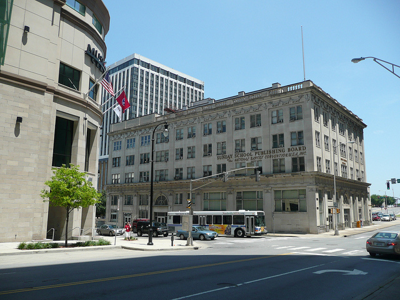

Morris Memorial Building
Last year, in an article I wrote about interesting black Nashvillians, I said, “Knowing Nashville's propensity for razing historic buildings, it may be dangerous to draw attention to the work of Moses McKissack, one of Nashville's most prominent architects.” I am heartsick to find the Morris Memorial Building, a building McKissack designed and then had his offices in for many years, on Historic Nashville Inc.’s nine most endangered buildings in Nashville this year:
Located downtown near the Courthouse Square, the Morris Memorial Building is a four-story Neoclassical Revival-style office building designed by McKissack & McKissack, a prominent African- American architectural firm based in Nashville. Constructed from 1924-1926, the steel, masonry, and limestone building housed the National Baptist Convention, which published religious materials for African-American Baptist churches, as well as other African-American businesses including the architectural studios of McKissack & McKissack. Listed on the National Register of Historic Places in 1984, the Morris Memorial Building is the only building still standing that is originally associated with African-American businesses in the downtown core. Recently, a developer announced a proposal to extensively renovate and enlarge the building with an eight to ten-story addition to the roof, which would adversely impact the building’s integrity as an important African-American landmark and result in the building be removed from the National Register of Historic Places.
It’s impossible to overstate how important this building is. It’s not just that it’s a stunning example of McKissack & McKissack’s work. It’s not only that it is the last office building that housed African American businesses during segregation in that part of town still standing. It’s that the Morris Memorial Building is a bandage on an old psychic wound. Before that lot held a beautiful building designed by a black architect for black institutions to use, it housed a hotel where black people weren’t allowed to stay. And before that, it housed the offices of slave traders.
Unlike other Southern cities, Nashville didn’t have an auction block. It had two or three spots in the city’s heart where a person could come and sit in an office and buy another person. The biggest and longest-lasting of those spots was right there, where the Morris Memorial Building stands now. You can see why the National Baptist Convention wanted it, how they intended to take this place of great evil and sorrow and transform it into something beautiful and sustaining. They wanted to cap off a cursed spot so that good could flourish.
As a city, we need to trust that McKissock & McKissock knew exactly the building that needed to be on that spot, the proper answer to the noise that place’s past makes. If we don’t have something more profound than what McKissock came up with to say about the history and future of that spot — and I’m sorry but “It’d be better if it were taller” is not it — then we shouldn’t allow that building to be fucked with. What happened on that spot matters, still. What black Nashvillians did to address that grave evil, the future they imagined for themselves instead, still matters.
I genuinely don’t know what it says about our city and our relationship to the past and our respect for people’s hard work that altering this building is even being considered. But it doesn't say anything good.
Photo by Reading Tom under Creative Commons 2.0 license



