
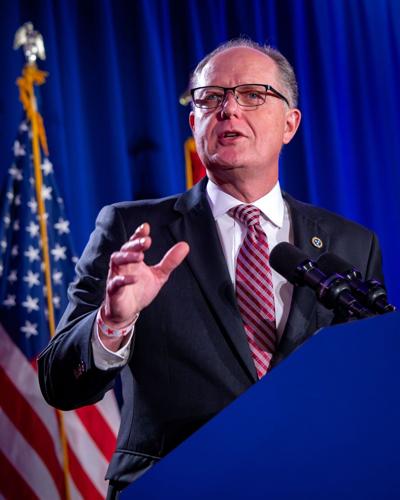


Senate Majority Leader Jack Johnson, November 2024
Republican bills to expand the state's school voucher program passed their first committee votes this week, paving the way for further debate.
The bills would see the maximum number of Gov. Bill Lee’s “Education Freedom Scholarships” for students in the 2026-27 school year expanded from 25,000 to 40,000. The governor's budget called for $150 million to further the program.
Also, the legislation would allow the state to participate in a federal education tax credit program created by the "One Big Beautiful Bill Act." This would allow taxpayers to receive a tax credit of up to $1,700 for donations to "scholarship-granting organizations" designated by the state.
On Tuesday, the legislation's House version, House Bill 2532 — sponsored by House Majority Leader William Lamberth (R-Portland) — passed the K-12 Subcommittee in a 5-3 vote. Republican Chairman Kirk Haston (R-Lobelville) joined Democratic Reps. Sam McKenzie (D-Knoxville) and Yusuf Hakeem (D-Chattanooga) in voting against the bill.
When asked by McKenzie how many voucher recipients were already enrolled in private schools before getting the state money, Lamberth responded, “I don't know, and don't care.”

During State of the State address, Lee proposes $58 billion for 2026 budget; Democrats’ rebuttal focuses on affordability
“These are all Tennessee children that need education, and their parents feel like the schools they're sending them to are the best for them to receive that education," Lamberth said. "So whether they're in a public school or private school, I just want them in a great school that they're going to get a wonderful education and succeed later in life. So we don't keep up with that data.”
Rep. William Slater (R-Gallatin) argued that the bill “doesn’t go far enough.”
More than 50,000 applications were received for the program’s 20,000 vouchers in January ahead of the 2026-27 school year.
The Senate version of the legislation, SB 2247, received additional Republican opposition in the Senate Education Committee on Wednesday but ultimately passed in a 7-2 vote. Democratic Senate Minority Leader Raumesh Akbari (D-Memphis) and Sen. Joey Hensley (R-Hohenwald) voted against.
Hensley questioned the need to expand the program with this bill, citing the original bill’s automatic annual increase of 5,000 spots for students.
“I voted for the vouchers before, but certainly am for [school] choice, and I'm for increasing it [by] 5,000," Hensley said. "But until we can get better funding, I don't think I can support the [expansion to] 40,000."
Akbari also questioned spending more state dollars on an expansion push without complete data.
“I know that this is not a relitigation of whether or not vouchers should exist —they do exist — I am very clear on that,” Akbari said. “It's more so saying, 'Do we double a program that we haven't had, in my opinion, an opportunity to collect sufficient data for like two to three years to see exactly what's happening?'”
Sen. Rusty Crowe (R-Johnson City) said he’d vote to move the bill along but would be meeting with members of the Tennessee Department of Education to learn more about the need for the bill.
“We know without a doubt that there are tens of thousands of families that are seeking educational opportunities in various forms and fashions,” said Senate Majority Leader Jack Johnson (R-Franklin), who sponsored the bill. “Some of them are seeking respite from the sacrifices they've made for years to create opportunities for their children, themselves. Some of them are seeking new opportunities that they've never had the financial viability to pursue, but we know they're there. These are real people. These are real applications, and they're real children.”
The bills will now advance to the House Education Committee and Senate Finance, Ways and Means Committee.
The House K-12 Subcommittee and Senate Education Committee are both set to debate a Republican-backed voucher program accountability bill next week, after a Democratic accountability bill died in committee in February.



