

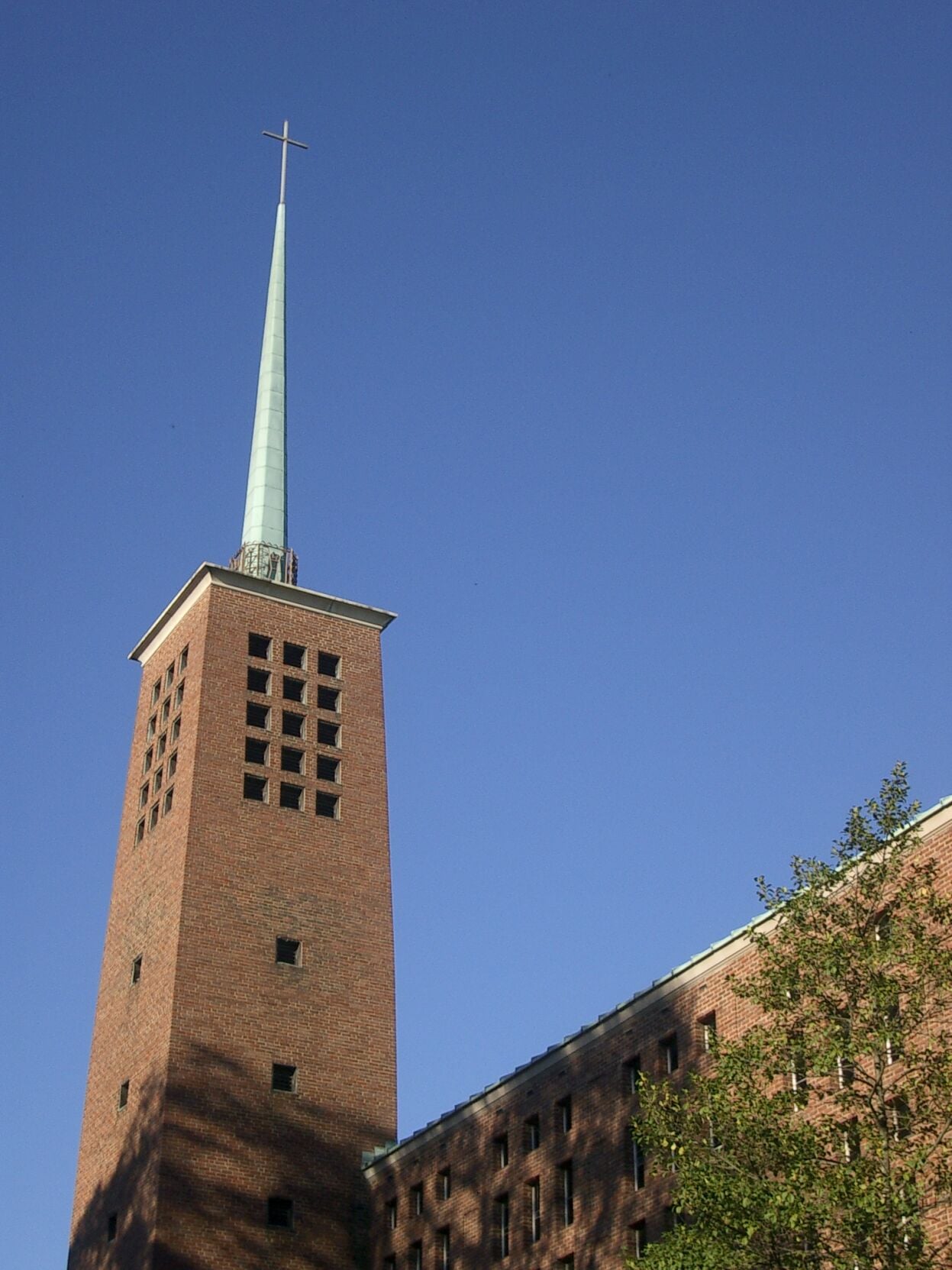
Benton Chapel on the Vanderbilt Divinity School campus, 2007
This story is a partnership between the Nashville Banner and the Nashville Scene. The Nashville Banner is a nonprofit, nonpartisan news organization focused on civic news. Visit nashvillebanner.com for more information.
Vanderbilt University has confirmed that the Vanderbilt Divinity School has been placed into receivership. Dean Yolanda Pierce and Deputy Provost Tracey George informed the current students and faculty in an email Tuesday.
“Receivership is a temporary administrative arrangement in which the university oversees a school’s operations in order to return it to independent, healthy standing,” the message reads. “The goal is to position the divinity school for renewed investment and growth.”
“As a lawyer, I know from lived experience that ‘receivership’ is interpreted to mean bankruptcy, because in the real world, receivership means bankruptcy,” George tells the Nashville Banner. “But in higher education, it’s more like a corporation when they’re doing a review of the organizational structure of one of their units.”
George says Pierce and the faculty will retain complete authority over the divinity school’s academics.
“The dean is still the dean,” she says. “The faculty are still the faculty.”
George describes the process as “collaborative” and says the university will oversee operations, including “running their budget, figuring out how they’re going to manage their space, figuring out what their comms are and how they’re going to manage their students and staff.”
“It’s not the kind of reorganization that bankruptcy implies,” she says. “But having talked to enough alumni about it now, I appreciate why it can cause anxiety. So receivership here is a path to rejuvenation. It’s a way for the university to invest more in the school.”
George acknowledges the stress the process can cause. She adds that across the nation, theological education is in a difficult place, saying demand has declined over the past two decades. She says that as people are less likely to attend church, there’s an accompanying decrease in graduate education for church leaders.
“It’s a really important moment,” George says. “If we want the school to live for another 125 years, we need to think hard about what the focus of the school will be and what we need to do to take the steps necessary to protect it.”
George says the receivership will last for two years at most. She adds that other departments have completed the receivership process in the past, and one is currently going through the process. A source within the university identified the second program as the Department of Teaching and Learning at Peabody.
“Every academic unit that has gone through receivership at Vanderbilt has emerged stronger and is thriving today,” George says. “We are making that same investment in the divinity school now, and we expect the same result.”
Faculty Perspective
Some Vanderbilt staff express wariness about the top-down nature of the receivership, feeling that the reasoning and rationale for these most recent receiverships were different than for those in the past. These current receiverships involve well-established parts of Vanderbilt. Staff points to Peabody’s status as a top-tier school of education, as well as Vanderbilt Divinity School’s gravitas and history. In the face of declining federal funding, those professors feel like the university should fund those schools instead of, in one employee’s words, “leaving [them] to die on the vine.” Staff members are worried that the departments could lose more funding and programs.
An employee who spoke anonymously to protect their job points to Vanderbilt’s use of funds on new campuses in New York and San Francisco rather than focusing on the established schools the university already has.
“We spent so much money building the Commons, right?” says the employee, referencing the on-campus residential area where all first-year Vanderbilt students live. “[The point] was a common residential experience. Now you’re building campuses elsewhere that will take that apart.”
Others mention the history and prestige of Vanderbilt Divinity School and its importance to social justice and the civil rights movement. One staffer points out that the university just celebrated the birthday of James Lawson, an alumnus who helped plan the downtown sit-ins in the 1960s, while the school was being placed into receivership.

Neighborhood group wants more concessions in university plan to transform parking lots into business hub
Several Vanderbilt employees who spoke to the Banner in recent weeks also feel that, under Chancellor Daniel Diermeier’s administration, communication has been lacking and faculty governance has been in decline, with little faculty input into key decisions. Some professors take issue with “A Declaration of First Principles,” a foundational document the Board of Trust put into action in June 2026, and an April 2026 report commissioned by Vanderbilt and Washington University in St. Louis on scholarship in the humanities. As reported in the Vanderbilt Hustler, the report, co-authored by the incoming dean of Vanderbilt’s College of Arts and Sciences, was commissioned to address the following complaint:
“The traditional goal of coming to understand the human world through careful scholarship has been subordinated to, or even displaced by, a ‘political’ goal: the aim of realizing a conception of social justice nowadays associated with the progressive left.”
Some professors took issue with the report’s methodology, as one of its authors acknowledged using artificial intelligence to survey some of the work the report critiqued.
More relevant to the divinity school, a section titled “Academic Freedom” in “A Declaration of First Principles” reads, in part, as follows:
“Faculty have a corresponding duty to act in accordance with and actively maintain scholarly standards. Faculty fail to live up to this duty if they individually or collectively subordinate scholarly standards to a political and social agenda. The freedom to ask questions and pursue research ideas should not be inhibited or limited because the hypothesis and research ideas are at odds with political commitments or social goals.
“When academic units deviate from these commitments, academic leaders need to address such dysfunctionalities through standard academic processes such as replacement of leadership; reorganization of units, including receivership and closure.”
Dr. Phillis Sheppard, faculty chair for Vanderbilt Divinity School for this academic year, says she had “no reason to dismiss” the administration’s position that this receivership isn’t connected to “A Declaration of First Principles.” However, she adds: “If they’re not connected, they’re definitely on very close parallel trains. Whether they’re connected or not, the optics make it seem that they are.”
“Not surprisingly, there’s a great deal of anxiety [among the faculty],” says Sheppard, referencing the receivership. “It’s still emerging, what it means. We just don’t know what the future looks like, and what a new, restructured divinity school will look like. Anytime you have something like that, along with whatever’s new, something is lost.”
Sheppard says the faculty would like a clearer picture of what kinds of data and concerns led to the receivership. “I think that’s complex,” she says, “and we would sit better with the bigger picture that [the administration] carry.”
Sheppard acknowledges the up-and-down nature of enrollment in theological education, but adds, “I also don’t think it can totally be a numbers game. It’s not clear to us how the particular history of the divinity school is being held and integrated into these decisions.”
Like other Vanderbilt faculty, Sheppard speaks of “process” and “communication.”
“The way in which not only decisions are made, but how they’re communicated, not just to staff but to the student body, to our partners in the community,” she says, “I think the divinity school takes those relationships quite seriously. I think we, for the most part, have a solid history of communicating.
“And these are the kinds of currency that you have when you sit at the table that can easily be lost and cannot be regained.”
Sheppard mentions that she’s teaching spirituality and social activism, and wonders aloud what that could mean in the context of “A Declaration of First Principles.”
“What does that mean pedagogically?” she asks. “Are we just teaching students to think about spirituality and social activism? Do we intend that students graduate able to think critically but not respond to the ethical demands to be engaged actively? Do we think that upon graduation that will suddenly happen? What is the relationship of this to our pedagogical aims?
“I think these are challenges not just for Vanderbilt, but for higher ed. But I’ve been appreciative that both the Vanderbilt report and the Board of Trust’s declaration is sparking conversation — certainly in-house, but across higher ed.”
This article first appeared on Nashville Banner and is republished here under a Creative Commons Attribution-NoDerivatives 4.0 International License.



Post a comment as anonymous
Report
Watch this discussion.
(0) comments
Welcome to the discussion.
Log In
Welcome to the discussion.
Keep it clean. Please avoid obscene, vulgar, lewd, racist or otherwise abusive language. Comments featuring hate speech or threatening or violent content will not be tolerated.
PLEASE TURN OFF YOUR CAPS LOCK.
Be truthful. Don't knowingly lie or mislead.
Be proactive. Use the “report” link on any comment that violates our comment policy.
Share with us. We'd love to hear your feedback.