
This story is a partnership between the Nashville Banner and the Nashville Scene. The Nashville Banner is a nonprofit, nonpartisan news organization focused on civic news. Visit nashvillebanner.com for more information.
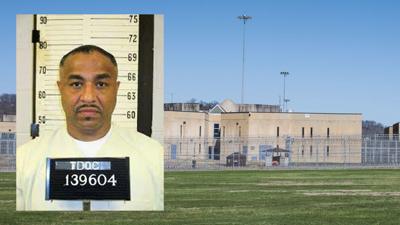
Tony Carruthers’ death sentence was stopped, temporarily, at the last minute on Thursday.
As the state of Tennessee attempted to prepare Carruthers for execution by lethal injection at Riverbend Maximum Security Prison in Nashville, the doctor contracted by the Tennessee Department of Correction could not find a vein for a backup IV to administer the dose of pentobarbital. According to an emergency filing with the Tennessee Supreme Court, protocols called for putting in a central line, but the doctor was “not qualified” to perform the procedure.
“Shortly after the motion was filed, Governor Bill Lee issued a reprieve,” the court posted minutes later. The reprieve is for one year.
According to TDOC, an attempt to insert a central line “pursuant to the protocol” was unsuccessful.
“This was a tortured, botched execution,” Carruthers’ ACLU attorney Maria DeLiberato told media Thursday. “I mean, there's no question about it. By the grace of God, he's still alive. But they tortured him, trying to find a vein.”

The idea that three victims were buried alive has persisted for decades despite expert refutations and doubt from the original medical examiner
Sitting outside the prison after the execution was called off, DeLiberato told reporters that state executioners spent more than an hour trying to successfully insert the secondary IV line — according to protocol — including attempts on Carruthers' left arm, feet, hand and jugular vein before attempting a central line in his upper chest. By the time that failed, DeLiberato said, Carruthers was “in agony.” Still, she said the execution team made one more attempt to insert a line, this time in his right shoulder, before the execution was called off.
Throughout that process, media witnesses were held in the viewing room adjacent to the execution chamber. With the lights off and the curtain closed, they could not see the extended struggle to establish IV lines. Some of the activity in the execution chamber could be heard, however. At one point, before the doctor on the execution team attempted to place the central line, he could be heard telling Carruthers that he was about to administer the local anesthetic lidocaine. Minutes later, in an exchange she later confirmed, DeLiberato could be heard questioning if the doctor was qualified to perform the procedure.
“I am qualified,” he said.
“Do your job, sir,” said Riverbend warden Kenneth Nelsen, according to DeLiberato.
Just after 11:20 a.m., almost an hour into the executioners’ struggle to place IV lines, Carruthers could be heard groaning in pain.
“You all should have been in that room with me,” DeLiberato told media afterward. “If the state of Tennessee is going to execute its own, there has to be full and complete transparency. There was no transparency here, and this botched execution showed why there must be.”
The dramatic events capped a week of activity in state and federal courts and included a last-minute denial by U.S. Supreme Court Justice Brett Kavanaugh to stop the execution.
The state received further scrutiny this week about the quality of the lethal injection drugs. Prison officials refused to confirm whether the pentobarbital they planned to use to execute Carruthers was expired.
After a 1996 trial, Carruthers received three death sentences for the 1994 kidnapping and murder of three people: Marcellos Anderson, Anderson’s mother Delois and Anderson’s teenage friend Frederick Tucker. In 2000, co-defendant James Montgomery received a new trial, after which he pleaded guilty and received a 27-year sentence. Montgomery was released in 2015.
Since the trial, in which Carruthers represented himself, he has maintained his innocence. Before the trial, he clashed with six appointed defense attorneys, after which the judge declined to appoint a seventh. Attorneys have argued that severe mental illness has prevented him from working with defense attorneys and preparing an effective defense in court. Carruthers’ attorneys said that during the trial, the state relied on the testimony of a paid informant who later recanted his testimony, saying prosecutors had coached him.
Carruthers’ attorneys exhausted potential paths to relief. Attorneys argued he is legally incompetent to be executed due to psychotic delusions. According to the American Civil Liberties Union, 130,000 people signed a petition asking Lee to postpone the execution until DNA and fingerprint analysis could be performed on still-untested crime scene evidence, including the victims’ fingernails. On May 20, Lee declined to grant clemency. The ACLU also filed lawsuits in state and federal courts requesting a stay of the execution until the completion of DNA testing and fingerprint analysis, but the Tennessee Supreme Court and U.S. District Judge Eli Richardson denied the petitions within the last week.
On May 20, the ACLU applied directly to the U.S. Supreme Court for a stay of execution, once more requesting DNA and fingerprint testing. That appeal was denied Thursday morning.

“Can this really be happening?” wondered Carruthers’ sister, Dr. Tonya Carruthers Hervey, at a public plea for her brother’s clemency on May 18 at the Tennessee State Capitol. “Has this been happening for so long? And why, when we have the technology to have gotten all of our questions answered a long time ago?”
Hervey recalled a brother who made money in the summer cutting lawns, then took his three siblings to Kroger to buy snacks with his earnings.
Carruthers was set to be the 11th person killed by the state since Tennessee reinstated its death penalty in 2018. Anthony Darrell Dugard Hines, Christa Pike and Gary Wayne Sutton are all scheduled to be executed before the end of 2026.
Following the litigation surrounding Byron Black’s execution in 2025 — in which the Tennessee Supreme Court overruled and reprimanded the trial court for its ruling — the high court has taken a more immediate role in execution litigation. An amended rule now requires “collateral litigation” related to the “method or timing” of an execution to be filed directly with the Tennessee Supreme Court. Pike’s legal challenge to her execution is currently pending.
Correction: A previous version of this story incorrectly stated that Maria DeLiberato told reporters that a staff member from the state attorney general’s office said “do your job, sir” to the doctor attempting to place IV lines. The AG’s office confirmed to the Banner that a member of its staff was present in the room, but DeLiberato said that it was Riverbend Maximum Security Institution warden Kenneth Nelsen who made that statement.
This article first appeared on Nashville Banner and is republished here under a Creative Commons Attribution-NoDerivatives 4.0 International License.






Post a comment as anonymous
Report
Watch this discussion.
(0) comments
Welcome to the discussion.
Log In
Welcome to the discussion.
Keep it clean. Please avoid obscene, vulgar, lewd, racist or otherwise abusive language. Comments featuring hate speech or threatening or violent content will not be tolerated.
PLEASE TURN OFF YOUR CAPS LOCK.
Be truthful. Don't knowingly lie or mislead.
Be proactive. Use the “report” link on any comment that violates our comment policy.
Share with us. We'd love to hear your feedback.