
Nashville, I’m growing more and more worried that the Fort Negley redevelopment is unstoppable. On Thursday morning, the mayor’s spokesperson, Sean Braisted, tweeted that the partnership developing Fort Negley is a great deal because the community gets “park space, green space, affordable housing, artist and maker space at no cost to taxpayers.”
I pointed out that it wouldn’t be terribly expensive to tear up the parking lots and throw down some grass seed, which would give us a lot of park space at very little cost. Braisted replied, “And then you would have a grass field and no built park infrastructure, affordable housing, artist, musician, and maker space. Which some people may want, but it wasn’t what the local community identified at the public meetings to develop the RFQ.”
Which, you know, fine, fair enough. But this raises two questions I think are really important. Has the community been made aware of the scope of the archaeological importance of that whole area and how we already irreparably damaged the site when we put up the Adventure Science Center and Greer Stadium? Were they given a clear sense of what’s there and needs protecting and the fragile and irreplaceable nature of the site before they were asked what should be done with it? I mean, there’s a huge world of difference between “Hey, what should we do with these parking lots and this empty stadium?” and “What should we do with this fragile Civil War site that was home to the African Americans who saved the city and most likely still contains the graves of the people who died here building these fortifications?”
I know a lot of people who live over there and I think if they’d been asked the second question, the answer wouldn’t have been “Eh, who cares?” But it’s pretty clear that this project has been pitched to the community as if Fort Negley is just the rocks on the top of the hill. That is just not true. It’s so patently false as to be almost obscene that the project is talked about as being “next to” or “beneath” Fort Negley. It will be on the Fort Negley site. Know that.
Another question is whether, when we’re talking about a rare and fragile piece of history — not just our city’s history, but our nation’s — we can leave it up to a neighborhood to decide what happens to the site. Even if everyone in the neighborhood wants new restaurants or a place to play music and they don’t care if it goes right on top of one of the most important African American history sites in the city, does that mean the rest of us shouldn’t care? Or is it our jobs to try to save what we can, what little is left?
There may not be a fiscal cost to losing much of the Fort Negley site, but there’s a cost.
I think this is unstoppable. I’m pretty despondent about it. But, my god, we are not going to do this and then claim in 20 years “Oh, boo hoo, no one told us. We wouldn’t have done this. We wouldn’t have destroyed that. But we didn’t know.”
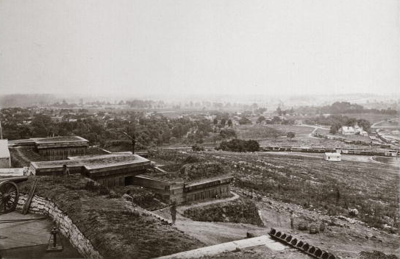
Know this: Zada Law (and if you don’t know her name, you should learn it, because Law is someone whose information you can trust) has already run LiDAR at Fort Negley and identified some potential remains of the earthworks that may not seem like anything to the untrained eye. Here’s a drawing that shows some of the features of the fort that are not at the top of the hill. Here’s another drawing that shows a wall and tents outside the hilltop area. Here’s a sketch made by a Union soldier that, again, starts to show how vast the encampment was there — and those are just soldiers! The drawing doesn’t show us where the contraband camp was. The right side of this George Bernard photo shows the area we’re talking about developing. Look in the field there. Would you like to know what that stuff is? I would.
And then last, but not least, peep this map from the Tennessee State Library and Archives (Unofficial Motto: We Hold No Maps Not Worth Peeping.). The “New Graveyard” is right where they’re putting the development.
So, know this, Nashville. There is stuff at the base of the hill. There are remnants of old walls, the remains of old camps, both soldiers and contraband, and the remains of old cemeteries. There is also the enormous possibility there is still one large, unmarked burial ground there.
And once you dig out foundations for buildings, those sites are lost.
We may lose those sites. It feels like we’re going to lose those sites. And that’s a tragedy. You could make the argument that we saved the nation — Nashville, we saved the nation — and we saved the nation because black Nashvillians made the city impossible to conquer. And yet, we’re still embarrassed by that, like there’s something shameful in not having been better Confederates.
So, fuck it. Sure, let’s dig it up and pave it over and knock it down and try as hard as we can to forget our most glorious moment. We could be proud of what we did here, of what Fort Negley represents. We could cherish it, this unique treasure, but, sure, let’s just continue to be ashamed of what black Nashville did for us, for the Union. Let’s gloss it over and downplay it and destroy it and forget about it.
And then in 50 years, when our grandchildren ask us how this could have happened, we’ll all shrug and claim we didn’t know any better. That’s just how things were back then.
We do know better, though, Nashville. We do.



