
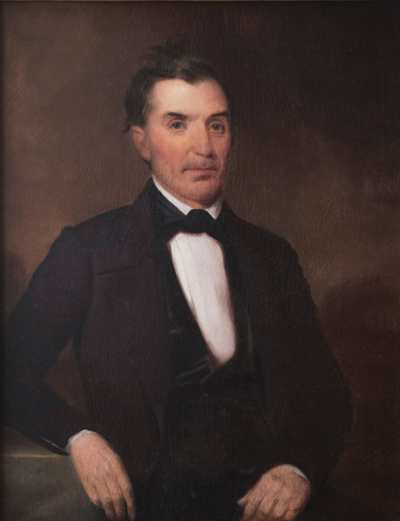

Isaac Franklin
Patricia Sullivan in The Washington Post has a story about white descendants of James Franklin, father of the notorious slave-trader, Isaac Franklin, coming to terms with being descended from a family of slave traders.
We’ve talked before about these kinds of complicated things. One Franklin descendant, Lyn Hoyt, says at the end of the story:
“While I do not feel directly responsible for my ancestor’s actions, I feel a shame,” Hoyt, of Nashville, said. “My hope is that being honest and telling my family’s story could help people better understand a very difficult aspect of our country’s history. Could that be a form of individual reparations? Maybe. Acknowledging the truth is important.”
In reading the story, I was reminded of the testimony from people who had experienced racial violence in Tennessee that
I heard last year before the Unsolved Civil Rights Crimes Special Committee.
As a country, we’re trying to live with a legacy of racism without telling ourselves the truth about that legacy.
If this were a physical condition, the problems with this approach would be obvious. If four of your neighbors all have carpenter’s nails in their thighs and your grandfather has a nail gun in his hand, and you’re insisting that no one can receive help for their wounds unless and until they accept that your grandfather didn’t shoot them, or that your grandfather wasn’t trying to shoot them, or that he’s a good person and you’re a good person and you need them to acknowledge that, everyone would see how you’re directly impeding efforts to help the people with nails in their legs.
Literally, an easy and helpful thing you can do is say, “Holy shit. Yes. My grandfather shot you with a nail gun. Probably the one he’s holding. Yes, you need help.”
Just acknowledging the truth is important. And that’s something black Americans are still waiting for white Americans to do — just tell the truth of slavery. Of the Jim Crow era. Of the Civil Rights era. Of what’s going on now.
So, the importance of what the white Franklins are doing can’t be understated.
They’re telling the truth. A difficult truth. A truth that is hard for them to deal with. They’re willing to be publicly uncertain and uncomfortable, to not know what the right thing to do is.
But they are willing to be uncertain and uncomfortable in the service of the truth.
That’s an important thing for the families of Franklin’s victims — for the people with cultural capital who also know the truth to refuse to be a part of any further gaslighting of these families — but it’s also important for those of us who need some direction for how to stumble forward toward the truth ourselves.
The white Franklins are doing what needs to be done for their family’s victims and their families. That’s one thing and I’m glad to see it.
But their willingness to do it publicly, humbly and uncomfortably, is a gift to white America, if we’ll take the lessons being offered.



