
On Tuesday, media folks got a press release describing how Jack Cawthon, owner of Jack’s Bar-B-Que on Charlotte, had found the city’s lost first prison in deeds and thus was dedicating a historical marker to the prison at the corner near the restaurant. Jim Myers at The Tennessean has a story heavily based on the press release.
Let me be as clear as I can. I think a historical marker dedicated to the old prison is a great idea. I love Jack’s food and recommend you all eat there. I love restaurant PR people; please don’t hurt me. I would like to be able to eat around town without needing to pay cash and wear a disguise. I’m sincerely happy that people digging up Nashville’s old history is so popular these days that a restaurant can build a feel-good moment around you eating some delicious pork products and pondering the old prison that used to be right where you’re sitting.
Except, if you’re sitting in Jack’s, the old prison didn’t used to be right where you’re sitting. It's prison adjacent. (That's not a slight at Jack! He dug through a ton of property records and found that his restaurant is indeed on what were the grounds, probably at the edge.)
It’s like if you went out to the new old state penitentiary, off of Centennial Boulevard, and found that the owner of the Pilot Station had put a sign saying the prison was there. I mean, I guess, kind of. But man, I think everyone who’d ever been to prison would say there’s a difference between being in the prison and being on the grass outside the prison and that difference makes all the difference, as it were.
And I’m not really sure how lost we can call the old prison when Google maps still has a “Prison Ave” and the old warden’s house is still standing on McMillin Street closer to Church.
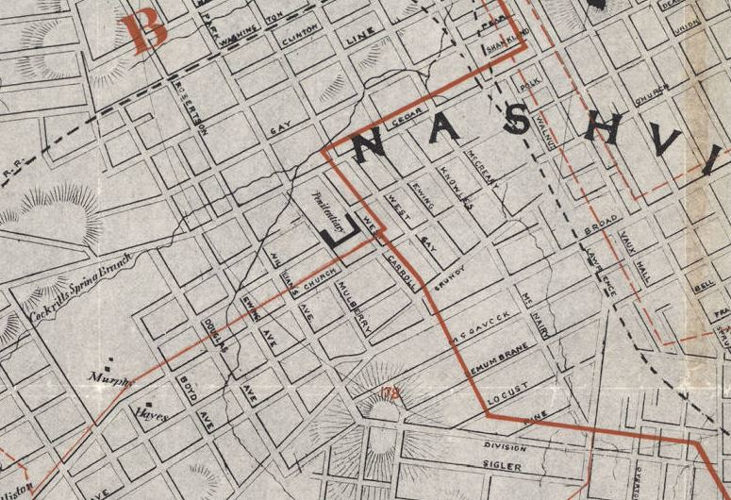
The Tennessee State Library and Archives has a map (unofficial motto of the TSLA: "Of course we have a map") that shows the location and orientation of the prison. As you can see, it faced Church street and lay between Ewing Avenue and Ewing — my God, the poor mailmen of 1879 Nashville, because you know those weren’t the only two Ewing streets in town. There’s another one over on Rutledge Hill and I believe one closer to the capitol. How did anyone get the right mail? But I digress.

The main thing we can learn from this map is that it would be worth our while to check out the Sanborn map (also available at the TSLA, but you have to go there to view it). The one available to me is from 1888 and there’s a ton of stuff to be gleaned about the prison in it. The prison was surrounded by twenty-foot high walls that would have run behind Jack’s present location and it faced Church. By 1888 the prison was obviously being used to manufacture wagons. And if someone told the Sanborn people it only held 650 prisoners, they were lying.
Goodspeed’s 1886 History of Tennessee has a great description of the prison:
“The principal front of the building presents a southern exposure, is 310 feet long, and consists of a center and two wings. The former, slightly projecting, is composed of brick embellished with cut stone dressing 120 feet long, 32 feet wide, and three stories high. It contains the warden and keeper’s apartments, two infirmaries, and apartment for confining female convicts, and sundry other rooms for the use of the establishment. In surveying the front of the center building, the most conspicuous feature that strikes the eye is a large gateway in the center 23 feet high, 14 feet wide, the piers and arch being formed of large blocks of well-polished white stone, and filled by a massive wrought iron port-cullis weighing nearly a ton. The buildings are constructed of large blocks of well-dressed lime stone, the wall being 4 feet thick and 33 feet high, pierced with narrow, grated windows corresponding in height with those of the center. On the center of the building, and immediately over the gateway above described, rises a splendid Doric cupola that accords with the noble proportion of the whole.”
That’s not even the best part! Goodspeed’s goes on, “The first prisoner received into the institution was W.G. Cook, from Madison County. It is stated that he was a tailor, and was convicted of malicious stabbing and assault and battery. He stabbed a man with his shears and assaulted him with his goose. He was made to cut and make his own suit, the first work done in the penitentiary.”
He assaulted a man with his goose! (Just live with that a moment, because I’m going to have to disappoint you and tell you that a goose is also the name for a tool a tailor uses to press things, like a small iron.)
At first, prisoners were put to work making all kinds of things — shoes, barrels, chairs, hats, blacksmith stuff, etc. But after the Civil War, the state discovered that prisoners weren’t earning enough to cover their costs. And, to make a long story short, that’s how Cherry, Morrow & Co. got involved. They basically leased the whole prison — building and people--from the state and used them as their wagon-making facility and workforce. They paid for almost everything connected with prisoner care. The State only paid for the warden, superintendent, physician, and chaplain.
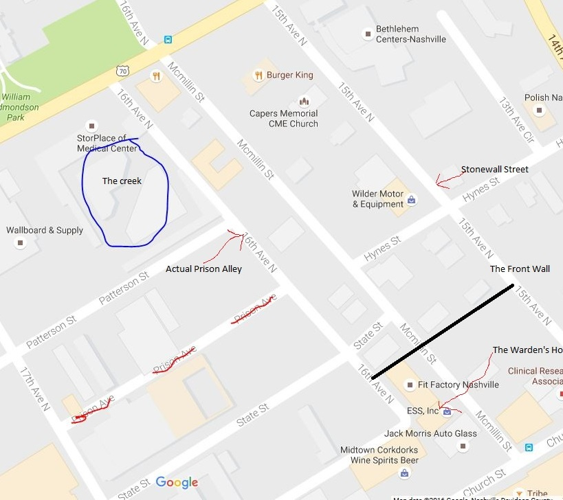
The thing I’m most curious about is that those walls were massive. I wonder if the foundations of those walls, at least in part, might still mark the old boundaries of the prison. Anyway, if you want to explore, I made you a map to help orient yourself. The two outer boundaries of the prison were Prison Alley, which is wrong on Google Maps, and Stonewall Street, which are 16th and 15th respectively. McMillin, which now goes through, didn’t used to and was the old entrance to the prison. You can use the weird architecture of buildings in the neighborhood to locate the old creek, which runs directly under Jack’s, if that helps make sense of the TSLA maps. If you walk down McMillin toward Church you will be in the walls of the old prison once you’re south of the Burger King. Just past State Street would have been the grand entrance to the prison.
Not lost. Not really forgotten. Right where it’s always been.




