
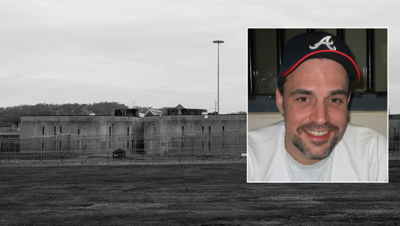

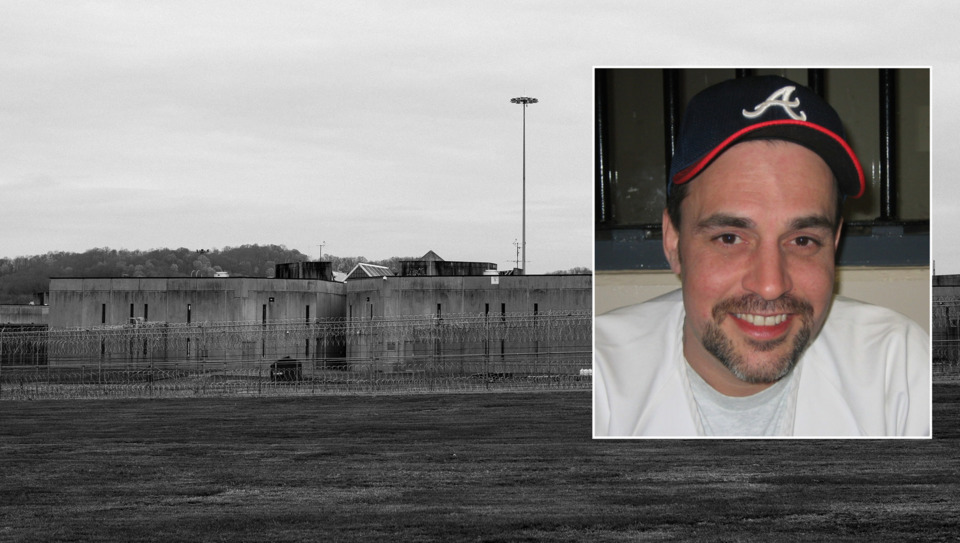
At a security checkpoint outside Riverbend Maximum Security Institution Thursday night, an officer leaned down toward my driver-side window.
“You been here before? You know the drill?”
This was the sixth grim assembly of this sort at Riverbend since August 2018. Everyone was taking their places for another state killing. We all know the routine well now.
By this point, around 6:30 p.m., witnesses inside the prison were making their way to the execution chamber to watch Lee Hall be electrocuted to death. His brother was there to see his final moments, as was the sister of Traci Crozier, the estranged girlfriend Hall killed 28 years ago in Chattanooga.
Outside, in a field within view of the prison, a few dozen death penalty abolitionists and regular death row visitors gathered for a vigil, as they had five times before in the past 16 months. In a separate cordoned-off area reserved for supporters of the execution, five people stood quietly with a large photo of Crozier. One of them was a man dressed in the robes of a priest, with flashing rainbow holiday lights draped around his neck. He’d entered the area with an oversized Bible, which officers at a checkpoint had flipped through before sending him on.
The men and women holding the vigil, who gather each time there is an execution to mourn and to hope for a last-minute reprieve — and to insist that the condemned man is someone worth mourning and sparing — stood circled in the cold, their faces illuminated by large flood lights and their voices competing with the loud hum of a generator. They worked through a liturgy, led by the Rev. Matthew Lewis, a young priest from Christ Church Cathedral. They did not obscure the horrific details of the crime that sent Hall to death row or ignore his victim.
On April 17, 1991, after Crozier had left her increasingly abusive relationship with him, Hall threw a lit container full of gas into her car while she was in the front seat. Severe burns covered her entire body, but she remained conscious and alert enough to tell emergency responders she was worried about her hair. She survived until the next day. At one point during the vigil, a reading described what Crozier had been like before that day, and how her murder had affected her family and loved ones.
But there were other facts as well. Hall suffered from severe cognitive impairments, according to his lawyers, and had himself suffered abuse growing up. A majority of the jurors who sentenced him to death later came to oppose his execution. At the time of his trial, they did not have the option of a life sentence without the possibility of parole.
Hall has always expressed remorse for Crozier’s death. In a court filing from last year, his attorneys write that he “broke down sobbing uncontrollably during medical testimony” about her injuries, a nightmarish accounting of the suffering he’d caused. He testified on his own behalf at the trial and said that he’d never intended to kill Crozier, only to burn her car in anger (which he’d done before). He said he’d been drinking heavily since she left him and smoking crack cocaine.
In prison Hall's record was clean, and over the years he lost his vision — the result, his attorneys say, of inadequate care and neglect by prison officials. By the time his execution was scheduled he was functionally blind, and he is now only the second blind prisoner to be executed in the United States since 1976.
Before Hall left his cell for death watch on Monday night, fellow death row inmates had to help him pack up his things to give away. Standing in the circle Thursday night, Lewis described his visit with Hall on Monday and recalled feeling Hall’s hand clutching the back of his jacket as the reverend led him through the unit back to his cell.
Beyond making a point of Hall's blindness and remorse, Hall’s attorneys had been pleading — with Gov. Bill Lee as well as with state and federal courts — for a reprieve that would allow full consideration of an issue they say kept Hall from having a fair trial. Earlier this year, one of the jurors who sentenced Hall to death admitted that she had been raped and abused by her former husband, a fact she’d failed to disclose when asked during jury selection. The juror said she “hated” Hall because of her personal history. Tennessee courts have granted new trials because of similar instances of juror bias, including in a notably similar case just last week. But Gov. Bill Lee, the Tennessee Supreme Court and the United States Supreme Court all declined to halt Hall’s execution.
After a series of readings, statements and prayers, the vigil went silent as attendees waited for an announcement that the execution was done. Until John Dysinger, who had already read a statement about Hall’s life and background and the legal issues surrounding his case, spoke up again. Dysinger and his family had been longtime visitors of Don Johnson, who was executed in May. Johnson had sung hymns, including “Soon and Very Soon,” from the gurney during his lethal injection. In his honor, and for Hall, Dysinger asked the group to join in singing “Soon and Very Soon.”
At 7:27 p.m., word came from the prison in the form of an emailed media advisory written in the bloodless, bureaucratic language of the Tennessee Department of Correction: “The death sentence of Lee Hall was executed by means of electrocution on December 5, 2019 in accordance with the laws of the state of Tennessee. The sentence was carried out at the Riverbend Maximum Security Institution in Nashville. Hall was pronounced dead at 7:26 p.m.”
Over the next hour, as media witnesses gave a press conference in the prison parking lot, the details of what had gone on inside trickled out. Hall’s last words, spoken from the electric chair, were, “People can learn forgiveness and love to make this world a better place." Witnesses said they saw what looked like smoke coming from Hall’s shrouded head. The state would later tell Kimberlee Kruesi of the Associated Press, without further explanation, that it was “steam and not smoke as a result of the liquid and heat."
At the same press conference, there were statements from Hall’s family and from Hall himself, both read by one of his attorneys. In his statement, Hall apologized to Crozier’s family and to his own. He asked for forgiveness. His family said they were “devastated by the loss of Traci and now Lee,” and added that they wished they “could have changed the events of that tragic day.”
Traci Crozier’s sister, Staci Wooten, witnessed the execution and read a statement herself.
“The day has come and gone now," she said. "The day my family has waited on for 28 years.”
In their own ways, both families acknowledged that the execution would not bring an end to grief but, at best, only a transfer of pain.
“Now our family’s peace can begin, but another family’s hell has to begin,” Wooten said.
“Now we have all lost,” Hall’s family said in their statement.
Wooten added that it was important to her family that people know her sister, not Lee Hall, was the victim here.
“Hopefully today, ending this monster’s life will bring some peace within everyone who has had to suffer throughout these 28 years without my beautiful sister,” she said.
No one holding vigil in the field denied that Traci Crozier’s death had been horrific, unjust and wrong. But those who had spent time with Hall had encountered a mere man, not a monster.
On Thanksgiving Day, Dan Mann and his wife Bethany visited death row, as they’ve been doing on a regular basis for years. They’d brought food for the man they visit, Larry McKay, as well as Abu-Ali Abdur’Rahman, who is facing an execution date next year. But when Abdur’Rahman came out to get his meal, Mann told me, he had Hall with him. Unlike a number of his fellow death row prisoners, Hall still maintained a close relationship with his mother, brother and other family members. They were coming to see him.
Mann and Hall fell into conversation after a stray comment from Mann about Hall of Fame pitcher Nolan Ryan led to an enthusiastic and in-depth discussion of baseball. Hall was an obsessive sports fan, and people who knew him well — as well as those who only met him briefly — say his sports knowledge seemed encyclopedic at times.
“It was like an uncle or a nephew you’d have a conversation with over Thanksgiving dinner,” Mann said.
Soon Hall’s family arrived. Mann recalled Hall’s brother handing Hall chocolate bars, telling him what kind he was about to eat each time since Hall could not see. On holidays, prisoners are permitted to take pictures with visitors, so Hall’s mother, his stepfather and his brother were able to pose for a photo with him one week before he would be strapped into the electric chair.
On Thursday night, Mann posted a picture on Twitter of the area reserved for protesters outside of Riverbend.
“The vigil begins for Lee Hall,” he wrote. “I’m tired of coming to this field.”
For Lewis, who has recently started work as a spiritual adviser on death row, this was the first time a man he knew had been executed. The trauma of the experience was apparent on his face.
“As a priest, you know, I sit with people at the end of life and do a lot of palliative care,” he said after the execution was through and the field was clearing. “But those people are dying, they’re not being killed.”
In his final moments with Hall earlier this week, standing in the doorway of his cell, Lewis read to him a favorite passage from Romans 8.
“For I am convinced that neither death nor life, neither angels nor demons, neither the present nor the future, nor any powers, neither height nor depth, nor anything else in all creation, will be able to separate us from the love of God that is in Christ Jesus our Lord.”
Lewis was also able to record an audio message for Hall. The legal team had collected a number of such messages for Hall to hear because he could not read letters. In Hall's final hour, before he was taken to the death chamber, his attorneys played the messages for him.
“I told him I was hoping for him to have a peace that passes understanding and for him to know that he was in greater care than he knew,” Lewis said.
In the makeshift parking lot beside the field, and on the road leading out past the prison grounds, corrections officers waved their flashlights to direct the crowd.
But they didn’t need to. Everyone knew the way.



Post a comment as anonymous
Report
Watch this discussion.
(0) comments
Welcome to the discussion.
Log In
Welcome to the discussion.
Keep it clean. Please avoid obscene, vulgar, lewd, racist or otherwise abusive language. Comments featuring hate speech or threatening or violent content will not be tolerated.
PLEASE TURN OFF YOUR CAPS LOCK.
Be truthful. Don't knowingly lie or mislead.
Be proactive. Use the “report” link on any comment that violates our comment policy.
Share with us. We'd love to hear your feedback.