
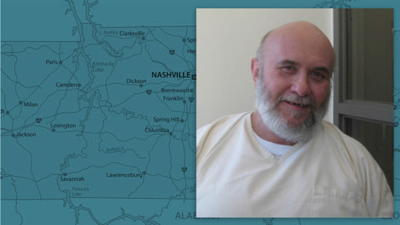


Edmund Zagorski has been executed in the electric chair for the 1983 murder of John Dale Dotson and Jimmy Porter, two men who'd met Zagorski in the Hickman County woods to buy 100 pounds of marijuana. He was pronounced dead at 7:26 p.m. Thursday, Nov. 1.
He is the first person to die in the electric chair in the United States in five years. Tennessee's last electrocution was that of Daryl Holton in 2007. Zagorski's last words before the chair was activated were, "Let's rock." Media witnesses described his body rising up in the chair as each jolt of electricity went through him.
Zagorski — a 63-year-old man who, like many of the men on Tennessee's death row, spent more of his life on death row than on the outside — chose the electric chair over the three-drug lethal injection protocol the state used to kill Billy Ray Irick in August. He was one of 42 Tennessee death row prisoners who have the right to choose between the two methods because they were convicted before Tennessee adopted lethal injection. Initially, state officials rejected Zagorski's choice. He made his decision on the eve of his original Oct. 11 execution date, and the state said it was too late to change methods. A federal judge ordered the state to honor Zagorski's right to choose electrocution, before Gov. Bill Haslam granted him a temporary reprieve.
All along, Zagorski and his attorneys have argued that he was forced to choose between two cruel and unusual execution methods — the lethal injection protocol, which medical experts say causes an experience akin to being buried alive and burned alive, or the electric chair.
Zagorski was convicted of the double murder in 1984. He was said to have met Dotson and Porter in the woods, where he then shot them, slit their throats and stole their money. Questions about what exactly happened that night have been raised in court filings and by advocates in the years since his conviction, but Zagorski did not testify at his trial.
Zagorski's case illustrates what researchers have called "Tennessee's Death Penalty Lottery." A paper on the subject written by attorneys Bradley MacLean and H.E. Miller Jr. lays out the case that Tennessee's death penalty is handed out on an arbitrary basis. Citing that paper in a court filing earlier this year, Zagorski's attorneys wrote: “At least 20 (twenty) other persons convicted of drug-related double homicides (or worse) have not been sentenced to death, but to life imprisonment,” and “while triple and double drug-related homicides in Tennessee have resulted in life sentences, there is a long list of persons who have committed triple, quadruple, quintuple, and even sextuple homicides in Tennessee for whom the punishment imposed has been only life imprisonment.”
Gov. Bill Haslam denied clemency for Zagorski despite pleas from death row and prison staff who described him as a rehabilitated man who lived an exemplary life on death row. Six of the jurors who sentenced Zagorski to death also came forward to say that they would not have voted for a death sentence if they'd had the option of life without the possibility of parole — an option that is now available to all Tennessee juries.
Ahead of his original execution date in October, Zagorski answered written questions from the Scene. Asked if he had anything to say to the public about his life, the crimes for which he was convicted, or his time in prison since, he said this:
"To the general public, things are not always as they seem. I think people need to relax a little bit more. And be a little less judgmental about your neighbors. And try not to dictate everybody else’s life. Always try to have more friends than you do enemies."



