
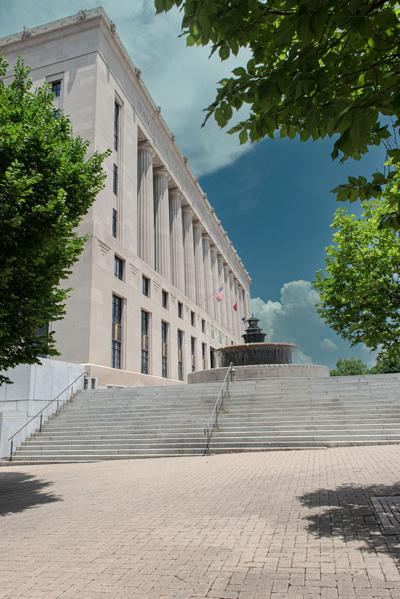


Metro Public Courthouse
Years and years ago, I had a discussion about Nashville with former Metro Councilmember Fabian Bedne. I still think about that conversation all the time. Obviously I’m paraphrasing a little bit, but the gist was that Nashville is set up to be inefficient, to move slowly, and for portions of the government to have differing agendas from other portions. The thing that struck me about this conversation is that Bedne both found this setup frustrating and appreciated that it would be very hard for any one local politician to run the town by fiat.
I’ve been thinking a lot about this lately now that I’m on the Metro Historical Commission, because it’s made me realize just how little I know about how the city runs. And I’ve written about the city for a quarter-century! (Maybe I shouldn’t be admitting this in public, but whatever. Someone’s got to be willing to admit to being the dumbass if any of us dumbasses are ever going to learn anything.) For instance, does every department have a set of commissioners providing some kind of civilian oversight to the department? How many commissioners does the city have? Some departments have boards — like the Metro Nashville Public Schools board, for instance. Are those board members functionally the same as commissioners?
And why did we choose to set it up this way? Why are there so many opportunities for regular people to have oversight of city departments? Don’t get me wrong: I think it’s cool, and I’m enjoying my part. But clearly this is in response to something. I think the obvious guess is that, at some point, the city wanted to ensure that no single person could dictate the direction of the city, and the city wanted to keep change from happening too quickly. But I could be wrong! Those may not have been the motivations, but they certainly are the results.
This is frustrating. And I think we see people venting their frustrations with this in many ways — from thinking that if we cut the Metro Council in half the city will magically become more efficient, to wanting the mayor to meet with this pissed-off person or call that upset organization, as if it is within the mayor’s ability to cut through the byzantine web our forebears have trapped us in.

HubNashville — Davidson County's non-emergency service portal — now has a place to leave compliments
But here’s the thing: We should not want a system where we have this complex mess of a city government designed to slow everything way down, but where the mayor can dictate when the rules don’t apply. A system where the mayor picks favorites (say, the zoo, or Parks, or Cheekwood, hypothetically) and gives them access and relief that other people don’t get. Or where the mayor picks bad guys and sets out to destroy them — like NES, for instance. That's a two-tiered system. We should be aiming for fair rules that apply to everyone the same, not being pissed when people we like don’t get the benefit of special treatment.
But on the other hand, if it works, who can blame people for wanting special treatment for people they care about?
Here’s what I wonder: Does this setup still serve us? Are we getting what we want for our city now out of a setup designed for a much smaller town? Is this the best shape for a city government to take now that our city is what it is? And if not, can we change it?



Post a comment as anonymous
Report
Watch this discussion.
(0) comments
Welcome to the discussion.
Log In
Welcome to the discussion.
Keep it clean. Please avoid obscene, vulgar, lewd, racist or otherwise abusive language. Comments featuring hate speech or threatening or violent content will not be tolerated.
PLEASE TURN OFF YOUR CAPS LOCK.
Be truthful. Don't knowingly lie or mislead.
Be proactive. Use the “report” link on any comment that violates our comment policy.
Share with us. We'd love to hear your feedback.