

@startleseasily is a fervent observer of the Metro government's comings and goings. In this column, "On First Reading," she'll recap the bimonthly Metro Council meetings and provide her analysis. You can find her in the pew in the corner by the mic, ready to give public comment on whichever items stir her passions. Follow her on Twitter here.
“Is there a deferral option?” asked Councilmember Kyonztè Toombs. “Because I feel like we would be sending this candidate into a buzzsaw.”
She was discussing Mayor Freddie O’Connell’s latest appointment to the Metro Arts Commission: Atmanand Jaikarran, a project manager at the National Museum of African American Music.
Jaikarran had just answered a series of questions from councilmembers during a Rules, Confirmations and Public Elections Committee. The vibe in the room was decidedly uncomfortable.
At one point, Jaikarran admitted, “I don’t really know a whole lot of what’s going on” with the Arts Commission, though he noted that he did watch one commission meeting. When asked what he recalled from that meeting, he said, “I was at work. It was in and out. I believe it was 70 minutes, so I don’t remember any takeaways really from that. I think it was a heavy topic, obviously.”
Heavy indeed.
In a double-take-inducing moment, Jaikarran shared that he recently told a woman colleague to “just be quiet.” According to Jaikarran, he was admonished by his wife, who called him an “ass” and “misogynistic.” On his wife’s advice, he apologized to his colleague.
At this point, I half-expected Ashton Kutcher to hop out from behind the curtains with a camera crew, ready to revive early-Aughts classic Punk’d.
As councilmembers delicately tiptoed around the suggestion that perhaps Jaikarran was not quite ready for prime time, O’Connell’s administration debated their own options: Should they see the appointment through, or cut their losses and withdraw Jaikarran’s name from consideration?
Due Diligence
There are a lot of eyes on the Metro Arts Commission right now. It doesn’t take a rocket scientist to know that this council is going to be scrutinizing commission appointees a bit more closely than other boards and commissions. Accordingly, the mayor’s office should double down on due diligence for these appointees. They could start with reviewing the questionnaires that all appointees are required to complete before appearing at the Rules Committee.
In response to the questionnaire’s prompt to “describe your qualifications and/or reasons why you wish to be confirmed for this appointment, Jaikarran responded, “Serve my community.” Jaikarran’s résumé was not provided to the council for review prior to the Rules Committee meeting.
The warning signs to a potential failed appointment are usually easy to find. But you can’t find what you don’t look for.
Jaikarran’s appearance before the Rules Committee was a bizarre ride from start to finish. It gave me flashbacks to the time former Mayor John Cooper put forward an appointee to Metro’s Employee Benefit Board who thought it was actually pretty cool that the Supreme Court overturned Roe v. Wade. Just as Cooper withdrew that appointment, O’Connell quietly withdrew Jaikarran’s appointment before it could be considered by the full council.
In a statement, O’Connell’s press secretary Alex Apple writes, “While we were encouraged by both early community-based support and Mr. Jaikarran’s qualifications and interest, he didn’t meet Mayor O’Connell’s overall expectations for a nominee.”
Councilmember Joy Styles, who chairs the council’s freshly renamed Arts, Parks, Libraries and Entertainment Committee, made no secret of her frustration with the administration’s decision to put Jaikarran forward. “Tuesday night’s Rules Committee meeting exemplifies exactly why we must vet appointees ahead of voting,” she says. “To show up unprepared for a commission that has several ongoing issues is just unacceptable.”
Asked whether she has any advice for O’Connell as he works to fill remaining vacancies on the commission, Styles says she hopes the mayor’s office will consult with her committee in advance of submitting appointments. “Collaboration always works best.”
Lydia Yousief, director of the Elmahaba Center, has advocated for significant changes to the makeup of the Arts Commission. Seeing Jaikarran’s questionnaire responses, she utters a mirthless laugh, followed by a deep sigh.
“There are a lot of people who would qualify, who are ready to serve on this commission, and they are not being asked,” Yousief laments.
She says community members and working artists want to see more people on the commission who’ve actually relied on Metro Arts funding. Right now, says Yousief, “You have a commission that feels that it has to align itself with [Metro] Legal and [Metro] Finance, and I feel like a lot of that would not be an issue if we had people who knew what it felt like ... to be that small organization that needs this funding to grow.”
“That’s what we need on the commission," Yousief adds. "People who know what’s at stake. This is decades and decades of defunding, and we are just asking for the bare minimum.”
A Tale of Two Tall Guys
In the category of “things that are none of the mayor’s concern,” the Council’s Rules of Procedure sit somewhere near the top of the list.
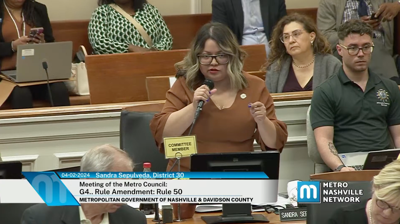
Nonetheless, Mayor O’Connell’s administration gave its two cents on a proposed rule change regarding appointments to boards and commissions. Spearheaded by Rules Committee Chair Sandra Sepulveda, the amendment would require nominees to be deferred for one meeting after appearing before the Rules Committee.
This means they wouldn’t be confirmed until the following meeting, at the earliest, providing a two-week buffer. Sepulveda argued that the change would allow for more fulsome vetting and due diligence by the council. Councilmembers often hear from nominees for the first time just a couple of hours before they have to take a vote, which leaves little room for further consideration.
Dave Rosenberg appeared on O’Connell’s behalf Tuesday night to try to talk the council out of this proposed change. It was an odd choice, as Rosenberg’s job title is director of data and innovation. I haven’t seen his job description, but I’d wager a guess that opining on the council’s rules of procedure isn’t on there.
It felt to me like a move by O’Connell to try to use Rosenberg’s relationships with his former colleagues — Rosenberg served on the council from 2015 to 2023 — to influence how the council conducts its business. The council wasn’t particularly interested in the administration’s opinions, no matter the messenger. They voted 29-10 to approve the amendment.
Fellow Tall Guy Bob Mendes, who serves as O’Connell’s chief development officer, got a much warmer reception.
After months of negotiations, Mendes is on the brink of successfully ushering through the O’Connell administration’s first big deal: a development agreement for 30 acres of Metro-owned land on the East Bank. The agreement passed easily on second reading Tuesday night with minimal amendments and maximal praise.
Councilmember At-Large Zulfat Suara described the process surrounding the deal as “the way that business should be done.” Other councilmembers applauded the administration’s transparency and highlighted Mendes’ work to bring councilmembers into the process early on.
Mayor O’Connell, no doubt buoyed by Mendes’ success, simply overplayed the Tall Guy Card by bringing Rosenberg into the mix.
Fruit of the Poisonous Tree
Rarely has any legislation on first reading received as much vitriol as the slate of bills first introduced by Councilmember At-Large Quin Evans Segall in February. Dubbed “NEST” (“Nashville’s Essential Structures for Togetherness”) by Evans Segall, the bills range from minor Metro Code cleanups to sweeping changes to the zoning code that could dramatically reshape the way development happens in Nashville.
Evans Segall withdrew the two most contentious measures on Tuesday night, but she’s moving forward with the smaller, more technical proposals. But the limited scope of Evans Segall’s remaining proposals didn’t keep her colleagues from trying to block them. Fed up with incessant questioning about a bill to eliminate certain residential washer/dryer hookup requirements and allow gas stations to have unisex bathrooms, Councilmember Jordan Huffman begged his colleagues to “please, for the love of God, put aside personal grievances here, and let’s let this go through the legislative process.”
I have to wonder if this innocuous bill would’ve faced such strong opposition had it come from another councilmember. At this point, it seems like some councilmembers just really dislike Evans Segall, and they’re determined to try to sink any proposal she brings to the floor.
You know the adage about how holding onto anger is like drinking poison and expecting the other person to die? Well, we’ve got a handful of councilmembers who need to call the Poison Control Center.



Post a comment as anonymous
Report
Watch this discussion.
(0) comments
Welcome to the discussion.
Log In
Welcome to the discussion.
Keep it clean. Please avoid obscene, vulgar, lewd, racist or otherwise abusive language. Comments featuring hate speech or threatening or violent content will not be tolerated.
PLEASE TURN OFF YOUR CAPS LOCK.
Be truthful. Don't knowingly lie or mislead.
Be proactive. Use the “report” link on any comment that violates our comment policy.
Share with us. We'd love to hear your feedback.