

@startleseasily is a fervent observer of the Metro government's comings and goings. In this column, "On First Reading," she'll recap the bimonthly Metro Council meetings and provide her analysis. You can find her in the pew in the corner by the mic, ready to give public comment on whichever items stir her passions. Follow her on Twitter here.
It’s not often a council meeting opens with song.
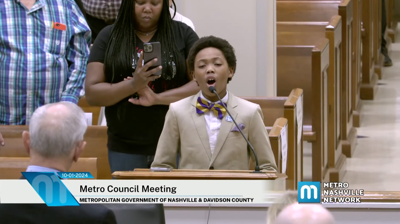
On Tuesday, Councilmember At-Large Delishia Porterfield invited middle schooler Ethan Freeman, a sharply dressed and decidedly confident young man, to join her in offering the invocation. Porterfield delivered a lengthy speech, at times struggling to hold back tears. She concluded her remarks by calling on colleagues to fight “until we all know justice, liberation and peace ... believing that a change will come.”
Freeman followed, performing a soulful rendition of Sam Cooke’s “A Change Is Gonna Come,” a song that became an anthem of the civil rights movement upon its release in 1964. Freeman might not have hit every note flawlessly — he’s in sixth grade, after all — but he didn’t need to be pitch-perfect to convey the song’s central message: Even in the face of brutal injustice, hope lives on.

In her latest recap, @startleseasily reports on the Metro Council's attempts to rein in actions by hate groups
To What End?
On Tuesday, the council passed a slate of bills attempting to tamp down on Nashville’s Nazi problem. The bills sailed through second reading with little discussion and minimal objection, but each received at least one “no” vote or abstention on third reading.
Councilmember Clay Capp expressed particular concern that a prohibition on distributing handbills after 7 p.m. might overly burden free speech, with no clear benefit to public safety. “Sometimes, if you want to organize your neighbors, you need to leaflet,” said Capp. “And you may even need to do that in the evening or early in the morning, depending on your work schedule or your caregiving schedule, and I don’t want to turn that into a code violation.”
Each violation of the ordinance carries a $50 fine, a penalty that could quickly add up for folks leaving innocuous flyers on neighbors’ doors. Of the four bills in the slate, the handbill ordinance came closest to being rejected outright. It received 23 affirmative votes, just two more than the 21 needed to pass on third reading.

Reps. Jones and Hardaway speak out against hate group who hurled racist insults at the young street performers
During the public comment period, one resident spoke passionately in support of the bills, citing a disturbing incident over the summer when neo-Nazis downtown hurled racial slurs at Black children. Instead of telling the Nazis to go home, the police told the kids to leave. The commenter described the police response as “misguided” and founded on a “pretense of protection that ... bordered on police negligence [and] dereliction of duty toward our children.”
It’s unclear to me, though, how this slate of bills could have prevented or ameliorated that situation. Violations of the ordinances are not criminal; the most they can result in is a civil penalty. More to the point, the neo-Nazis don’t seem to have actually violated any of the ordinances. They weren’t covering their faces or blocking anyone’s passage into a public building. There were no after-dark leaflets or signs placed above highways. Even if the ordinances had been in effect at the time, the police couldn’t have cited the neo-Nazis for anything.
So what, exactly, is the point?
Like a Good Neighbor
A forced downzoning by Councilmember Brandon Taylor received final approval Tuesday in a nearly unanimous vote, despite sharp criticism from Nashville YIMBYs. The site in question, a 0.17-acre lot on Arthur Avenue, was upzoned from single-family to two-family in 2022. The owner applied last year for permits to build two units on the site, but the permits expired when plans stalled earlier this year.

Two of five nominees will be selected by Metro Council vote on Nov. 7
The owner attended the Planning Commission meeting in August to oppose the effort to downzone his property. He shared his belief that the proposed downzoning was due to a “lady down the street” who “didn’t like that the grass was high.”
“I think I ticked off the lady maybe three doors down,” he lamented.
Normally, I might call the councilmember petty for engaging in what amounts to legislative retaliation over something as mundane as a neighborhood squabble about too-high grass. But there’s more to the story.
Word on the street is, the would-be developer has allowed the property to become a de facto dumping site, attracting vermin and other pests that pose a legitimate public health risk. Anonymous reports to the Codes Department over the past two years describe the lot as “a mini junkyard” littered with trash that “makes Arthur Avenue look like a dump.”
I’m generally opposed to ratting out your neighbors, but when your “neighbor” doesn’t live there and has allowed the property to deteriorate to the point of attracting rodents, I say give 'em hell.



