

Read "A Mystery of Death and Vigilante Justice in 19th-Century Nashville, Part 1" here.
Has anyone ever gotten the story of the murder of John Collins right? Not me! When I said last week that we would talk about old John this week, I said, “Next week we’ll talk about the earlier murder of [Ed Collins'] brother John (1856-1891) up in Edenwold.”
He wasn’t murdered in Edenwold at all! It wasn’t that Dry Fork they were referring to. It was the one I live on! I was tipped off when I was looking at the one available census record of the family who killed John. They lived by Carneys and Binkleys, and if you ever see those two last names together, that screams “Northwest Davidson County!” But then there were also Stumps and Durards. That’s already four last names that don’t really matter to this story, but believe me when I tell you that those four names in close proximity tell you that you’re in Whites Creek.

Examining the killing of Ed Collins, 'a terror to the whole south end of the county'
So the killing family. That’s already wrong in a way I can’t straighten out. The boy in the family was Foster Graves. According to many news stories, he was 14. That matches the 1880 census. His father was William Graves, who was about 40 years old at the time of the murder. The wife’s name was listed in news stories as Anna or Tennie. In the 1880 census, the wife is Martha. To add to the confusion, Foster had a sister, Joanna, who was five years older than him. In other words, she was an adult when the killing happened. Maybe Martha died and William remarried? Maybe the Anna mentioned was actually Joanna? Who is Tennie? Who knows?
So John Collins and Foster Graves both take their wagons to town every day, and they then pasture their horses in the same field at night. On Monday, May 25, 1891, the Daily American recounted the version of events told to them by Constable Manlove. (Snicker quietly at that name if you need to snicker.)
Saturday evening Collins chided the boy for leaving the pasture fence down, and told him he must not do it again, whereupon he began cursing Collins. Collins then smacked his jaws and sent him home. The boy went home and told his father, and about 10 o’clock that night, the father, son and mother went to Collins’ house prepared for revenge.
Switch over to the Banner and we learn:
Mr. Collins was in bed when the negroes came. He arose and went to the fence. The elder Graves asked him about striking his son and Mr. Collins did not deny having struck the boy. Graves said he replied: “I would rather you would strike me than my boy.” Graves states that Mr. Collins replied that he would strike him, and he at once got over the fence and a fight ensued.
The fight was gruesome. Collins cut the elder Graves across the face with a Barlow knife. Mrs. Collins was screaming from the doorway. The men got up from the ground where they had been wrestling, and Foster hit Collins on the head with what turned out to be a wagon spoke. Collins’ skull was broken in five places, and his bottom teeth were broken out. Somehow he lived through this long enough, according to the Daily American, to tell his wife, “You had better send for a doctor, I’m badly hurt,” before falling over on the bed and dying. William Graves told people at the jail that “the Lord had decided that either Collins or he would have to be killed, and that he was on the good side of the Lord and had killed Collins.”
On June 23, 1891, the Daily American reported on the trial, and we learn a few more relevant facts. Collins and his family were “living with J.B. Freeman in the Twenty-third District, near that intersection of the Buena Vista and White’s Creek turnpikes.” This intersection still exists. There’s a Shell gas station there now. And Collins’ widow had “three small fatherless children, one a cradled babe, and the oldest about five years old.” The outcome of the trial was that William Graves was sentenced to 10 years in prison and Foster Graves to five. The female Graves, whatever her name was, was acquitted.
This is a very light set of sentences for beating a white guy to death in the road in front of his house. Now, that Banner story from May 25 reports that a heavier punishment was on the table: “It is stated by people who live there that if the particulars of the murder had been known Saturday night, Graves and his son would never have been brought to jail.” In other words, they would have been lynched.
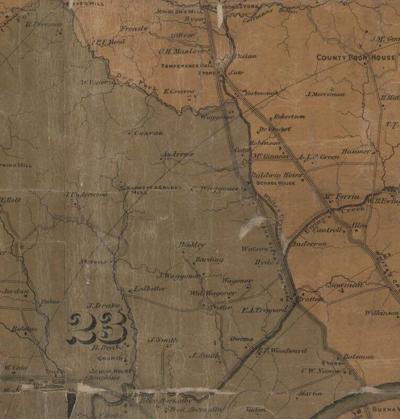
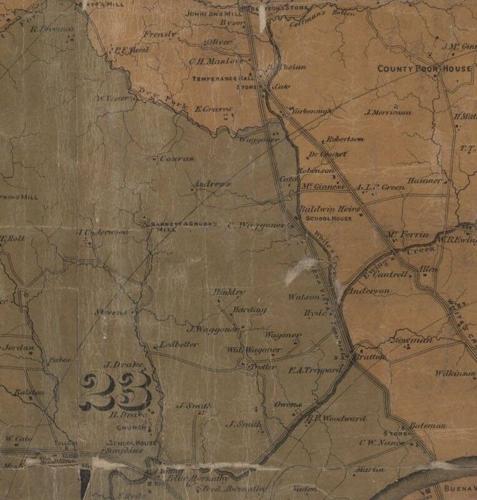
Here’s the problem with that. If you observe this 1871 map (Shout out to the TSLA! Sorry about your boss), and you look at the area around where Buena Vista and Whites Creek meet up, you’ll see that there are a lot of houses there. At 10 p.m. in 1891 there is no noise. And in May? Everybody’s windows were open. And no one heard anything? Please.
Did the Graveses really kill Collins over Collins smacking around their kid? I don’t know, y’all. My dad was born 50 years after this happened, and anyone in his neighborhood would have smacked him around if he was out of line. I’ve heard stories of my grandfather beating other people’s kids. Maybe the 1940s and 1950s were worse for kids than the 1890s, but I doubt it. It just seems implausible to me that this would have caused the Graves family to march over to the Collins house in the dark to confront him. I can’t imagine that a Black family in the 1890s would have expected anything but violent nonsense from a white guy, and I can’t imagine they would have thought there was anything they could do about it. I just don’t think the assault that afternoon was the whole issue.
The bigger question is why the rest of the white community didn’t lynch them. Sure, John Collins wasn’t from there. But his wife Minnie Lee was. Her dad was a Smith (see the aforementioned map, right by the "23"), and his mom was a Heaton/Eaton, of the Heaton’s Station-Eaton’s Creek variety. Minnie Lee’s mom was a Nance. (If you’ve still looking at the Smiths on the map, keep sliding to the right and you’ll see C.W. Nance. That’s Minnie Lee’s grandpa.) These were families who’d been there forever. And you’ve just left Minnie Lee a widow with three small children?
Except — let’s back up a couple of years, to 1890. On July 24, the Banner ran a short story.
John Collins appeared before Justice Harris yesterday afternoon and swore out a writ of replevy to recover possession of John Franklin Collins, his infant son. Collins claims that his wife left him and took their three children and refused to allow him to have either one, and hence this court proceedings. The warrant was placed in Constable Drumright’s hands, but when the officer called on Mrs. Collins, at Mrs. Smith’s boarding-house, on Summer street, she refused to give up the child. Collins then swore out a search warrant, but when the officer returned to execute it neither Mrs. Collins nor the child could be found and have since eluded the officer.
Well, well, well. If it isn’t a good explanation for why her community didn’t hear her husband being beaten to death in the street and for why his murderers got light sentences. She tried to leave him. She hid his kids from him. And then she had to go back to him. It’s enough to make a person wonder who actually struck the killing blow.
In 1900, all three of the Collins boys were in the orphanage. But by 1910, they were all out west, near their mom and their new little sister. William Graves died in prison from consumption. Tennie Graves knocked around Nashville for a while and then disappeared from history. Foster Graves left no trace.
I told you by the end of this we’d all have mixed feelings. And here we are. I was really hoping I might find evidence of Foster ending up OK, but that was probably too much to ask from a mess this big.
I was talking to a friend who’s well-acquainted with Old Nashville (really Old Nashville) and how people carried on. He told me a story about a Belle Meade woman who was drunkenly dancing with a katana and accidentally cut her husband in half. Allegedly. And how everyone thought her son — the man’s stepson — had actually killed him because everyone knew he was a real jerk to his wife. No one was prosecuted, my friend explained, because Old Nashville had an unwritten rule that some men just need killing.
My guess is that, in the strange deaths of the Collins brothers, we’re seeing this unwritten rule in action.



Post a comment as anonymous
Report
Watch this discussion.
(0) comments
Welcome to the discussion.
Log In
Welcome to the discussion.
Keep it clean. Please avoid obscene, vulgar, lewd, racist or otherwise abusive language. Comments featuring hate speech or threatening or violent content will not be tolerated.
PLEASE TURN OFF YOUR CAPS LOCK.
Be truthful. Don't knowingly lie or mislead.
Be proactive. Use the “report” link on any comment that violates our comment policy.
Share with us. We'd love to hear your feedback.