
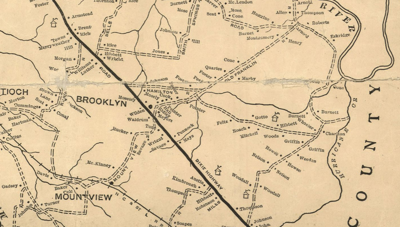

Last week I mentioned in passing infamous Antiochian Sherman Begley, who probably killed a white man and got away with it. I thought that was strange for the 1890s, out in the country. That’s not how most Tennessee history tends to go. A Black man merely accused of killing a white person could end up lynched, even if the supposedly dead white person showed up to the lynching alive and well. So it was curious to me that Sherman wasn’t the victim of vigilante justice, especially since there was a lynch mob.
I was intending to tell you about how half-assed this lynch mob was — how they ransacked a couple houses, seemed to have accidentally shot a man while almost shooting one of the members of their own mob, and then got lectured by the guy they shot until they got embarrassed and went home. Because that shit is funny! I mean, up until the moment I am about to tell you about, I would have thought that was as noncommittal as a lynch mob could get.

The famed Nashville sculptor reportedly carved a headstone for a quarry worker — but the search for its location leads to a dead end
But then, one news story about the situation mentions that the dead guy was actually the second guy in his family to be killed by Black people who then faced very little punishment for it. This first guy was beaten to death in the road at night in a village where — let me remind you — there is no television, radio or air conditioning. It is quiet at night and everyone’s windows are probably open. And the white folks in that corner of the county just did the 19th-century equivalent of issuing a statement that said, in essence, if they’d known this was happening when it was happening, they would have formed a lynch mob, but alas.
Come on! They knew it was happening! What else is there to hear except the man getting his head bashed in in the road while his wife screams in the yard?
So now I’m just staring at these sets of facts, trying to make sense of it. How do two members of the same family living far apart on two different sides of the river get killed by two different groups of Black people who didn’t seem to know each other in the 1890s, and life just goes on?
This week, we’re going to talk about the murder of Ed Collins (1871-1894) down in Antioch, and next week we’ll talk about the earlier murder of his brother John (1856-1891) up in Edenwold. And at the end of it, we’ll all probably have very mixed feelings about the whole thing. Fair warning.
It’s hard to know where the relevant facts start, but I’m going with the Collins boys’ mom, Martha Jane. Usually, I don’t worry too much about exactly when a person in the 19th century was born, because people’s birth years fluctuate wildly in records, and usually it doesn’t matter. But in this case, Martha’s first son was born in 1846 or 1847. So it does matter if she was born in 1835, like she indicates in the 1860 census, or if she was born in 1828, like she indicates in the 1870 census, because either she was 11 or 12 when she got pregnant for the first time, or she was 16 or 17. Yuck.
Anyway, Martha Jane's first husband was Thomas Collins, and truly the only thing you need to know about him is that he wasn’t dead when she started having babies with his brother Frank and married him. So either she was a bigamist, or she somehow managed to get divorced in the 1850s. She and Frank get married in 1858, after they’re four kids in. Frank is the father of Ed and John. She later filed for divorce from Frank, but I couldn’t tell if she succeeded.
Ed appears to have been a garbage nightmare of a person. Sorry Collins descendants, but he was like Jesse James, but without the big scores. In a Daily American story dated July 28, 1892, we start to learn the shape of ol’ Ed. He was in a gang.
They have not murdered anyone or committed theft so far as is known, but they have simply been a terror to the whole south end of the county, fighting and carousing and threatening.
The story ran on the occasion of Ed’s arrest — alongside Joe Miller and John Hall — and the paper was optimistic about the rest of the gang being captured before long. But they were not, and no one would come forward to testify against these three, so that was that.
Then, on Nov. 7, 1894, a farmer who lived along Hibbitt’s Lane, which the Banner reported “runs through a lonely and sparsely settled section” of southeast Davidson County, looked down the road and saw a wagon being pulled by mules with no driver. Said driver, Ed Collins, was dead, tangled in the tongue of the wagon, and being dragged down said lane. He had been shot in the back.
The only suspect was “a negro man” who had thrown a rock at Collins the year before and been shot from ambush by Collins, who was acquitted for the shooting. Later stories name this man, Frank Ridley, who was arrested for being an accessory to the murder. But no one believed he’d killed Ed.
That weekend, either the lynch mob formed or the Collins gang was put to the task of tracking down the suspect in the case, Sherman Begley. The plan was to kill him. The Banner listed their names of the mob: James Jones, Joe Miller (who was earlier arrested with Ed), Sam Bradley, Elisha Johnson, Andrew Waggoner, Thad Castleman, Mack Boner (who himself was later murdered over what the perpetrator called “family matters”), Dave Burnett, Ben Cone, John Hall, Sam Collins (Ed’s cousin-brother) and Frank Collins (Ed’s dad).
Sherman was eventually caught and put on trial. Witnesses failed to show up. The defense declined to put on a case, and the Banner reported that “the jury retired and was out only about five minutes, when they returned with a verdict of not guilty.” Nashville, the only explanation I have for this is that Ed’s white neighbors hated him so much for some reason that they let someone, probably Sherman, kill him without consequences.

About 130 years ago, this obscure part of town was full of vice — and roving gangs of violent women
But Sherman’s shooting-people days were not over, and a man can only press his luck so hard. In November 1907, Sherman Begley went on trial for shooting William Card, the principal of the Black public school in the old Third District. His defense was that he was at home reading the funnies in the newspaper with his kids. This time, though, witnesses showed up, and Begley went to prison.
But let’s think about this situation. We know that Ed and his buddies were running around committing crimes. And we know that people were afraid to testify about those crimes. And we also know that the people with the most freedom to do something about Ed were Black men — Frank Ridley, who beaned him with a rock, and Sherman Begley, who shot him in the back. So let me ask you: What crime would victims be unwilling to report or see prosecuted? What crime ruined the victim?
I think Ed and his buddies were running around committing rape. It explains why white people refused to testify against them. In a time when having premarital sex "ruined" a white woman’s reputation — even if it wasn't consensual sex but rather a crime against her — and made it harder for her to get married or to retain social standing, white families kept that sort of thing secret to try to preserve the “purity” of the victim.
Black women of the era had no such inherent social purity. (For more about this, see Linda Adeniji’s “The Unrapeable Black Woman: How the Lack of Legal Protections Through the Centuries Promoted the Tradition of Unreported Sexual Assaults.”) And so we appear to looking at a circumstance so rare that I don’t know if I’ve ever heard of it before. The alleged inherent promiscuity that made Black women "unrapeable," since they were supposedly always available to have sex with — which in all other circumstances is one of the most vile and pernicious and damaging white fantasies about Black women that exists — meant that Black men in Antioch could do what white men couldn’t. They could bring vigilante justice to the attacker, because the nature of the attacker’s assault couldn’t ruin the reputation of the affected Black women, if that ever was revealed to be the motivation for the crime.
This would explain why Sherman Begley not only lived, but was acquitted, even if the papers never spell it out. If Ed Collins and his gang were assaulting women of all races, and Begley and Ridley put a stop to it, that would explain all of the weirdness of this story — most of all why they lived after Ed died.



Post a comment as anonymous
Report
Watch this discussion.
(0) comments
Welcome to the discussion.
Log In
Welcome to the discussion.
Keep it clean. Please avoid obscene, vulgar, lewd, racist or otherwise abusive language. Comments featuring hate speech or threatening or violent content will not be tolerated.
PLEASE TURN OFF YOUR CAPS LOCK.
Be truthful. Don't knowingly lie or mislead.
Be proactive. Use the “report” link on any comment that violates our comment policy.
Share with us. We'd love to hear your feedback.