
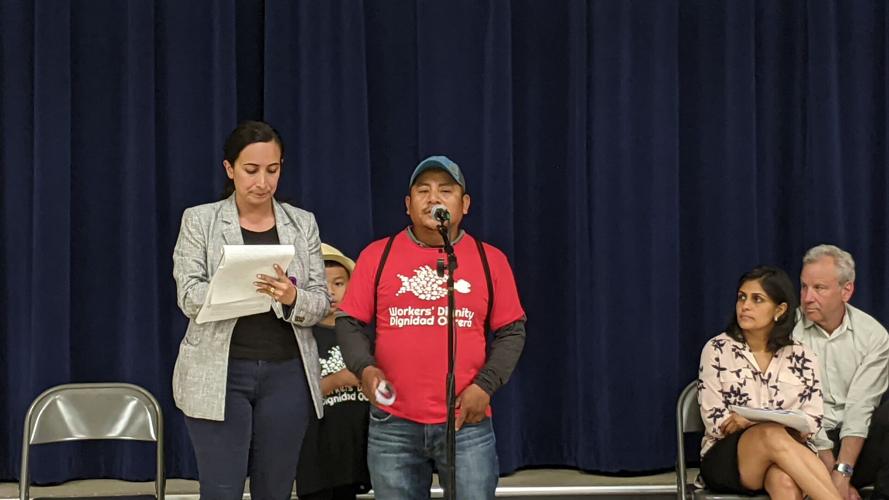


Nicolas Alvarado speaks. Rob Bond, far right, listens in.
On Wednesday, tenants who say they received sudden notices to leave their apartments had a public meeting with the out-of-state owner of their complex. The tenants at Mosaic Apartments have been organizing since late May, and the meeting was their chance to relay their demands and complaints to ownership group Bond Companies.
“My wife received a phone call at 11:30 a.m. from the office,” said Nicolas Alvarado, a tenant at the apartments, during the meeting’s public comment period. “I was at work when that happened, and she told me they were evicting us.” He left work immediately to petition the decision — his lease was still valid.

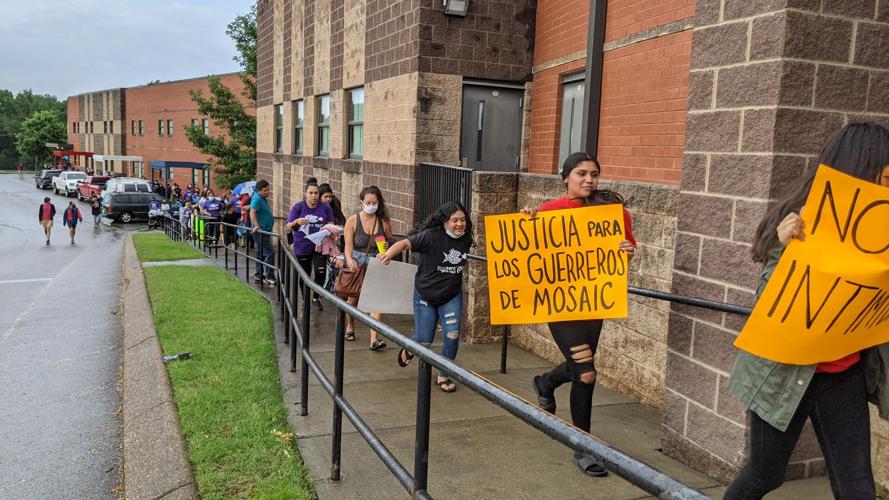
Tenants with signs enter Glenview Elementary
“I was told I had no rights because I don’t have papers in this country,” he said.
Several of the tenants who spoke said that on Friday, May 21, they received similar phone calls telling them they had just three days to leave their apartments due to damage from the recent floods. Some were told they would be able to move back in four to six weeks and get their security deposit, but apparently not everyone got the same message. Similarly, it was unclear whether they would receive any financial help to relocate or get their security deposits back.
Another tenant had lived at the apartments for 10 years, through the tenures of various management companies, and says he was told he had from Thursday afternoon to Monday morning to leave his apartment — otherwise the sheriff’s office would be called to remove him from his unit.

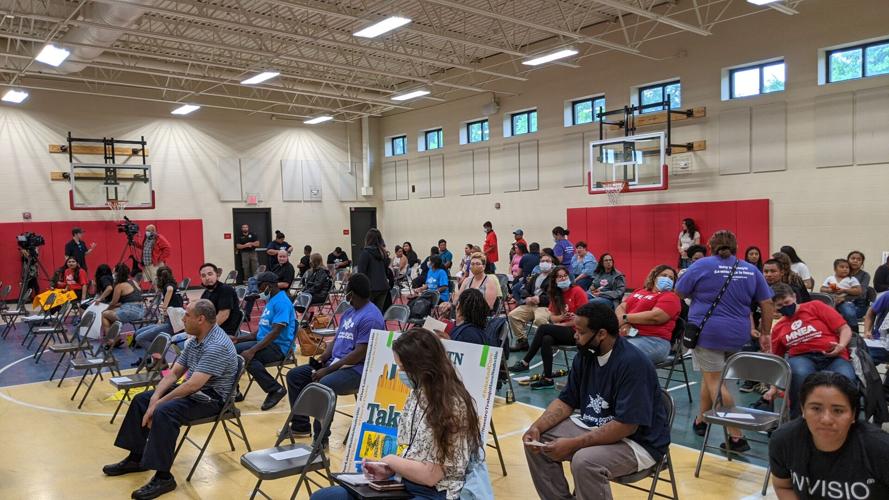
Dozens attended the meeting between Mosaic Apartments tenants and ownership
It was initially unclear who did the inspection — Metro Codes quickly denied it was their department, and even sent out a team to evaluate, finding issues at the complex but no uninhabitable units. Tenants soon began protesting, with assistance from labor advocacy organization Workers’ Dignity. Workers’ Dignity believes as many as 90 families may be facing displacement.
The management of Mosaic Apartment later told tenants, local politicians and press that residents who had to move would receive $1,500 in assistance and could get their security deposits back. Tenants would also have 14 days to move out and could return after four to six weeks. They also said in a statement that local company BluSky performed the inspection that found flood damage.
Councilmember Russ Bradford, whose District 13 is where Mosaic is located, and state Rep. Mike Stewart organized the meeting to bring the tenants, management and advocates together. It was held at Glenview Elementary across the street from Mosaic.
Not every tenant who spoke at the hearing said they had received the notice to leave, but almost all of them had complaints about on-site management and poor conditions of their units and the complex. Pests, plumbing issues, broken air conditions and a lack of trash pickup painted a grim picture of life at Mosaic, and tenants were equally displeased with the property manager — saying she was rude, unhelpful and even made comments about a “Guatemalan invasion” at the apartments. Many called for her to be fired.
One tenant said she received rental assistance through United Way, but Village Green — which manages Mosaic Apartments — would not accept it. (She did not blame the property manager for that specific situation.)
Tenants also shared a list of demands, including $6,000 in compensation for relocation efforts, easier access to dumpsters, improvements to plumbing, an emergency maintenance number and more.

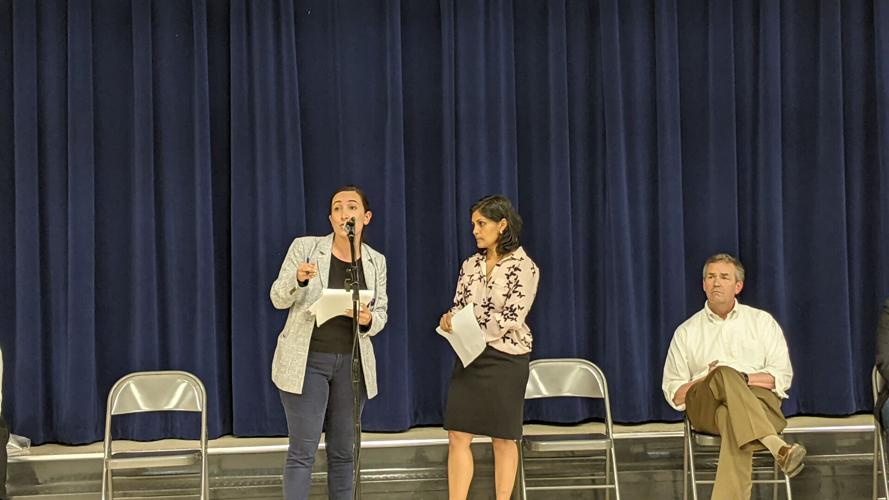
A translator relays a message from Bond Companies' lawyer. Rob Bond is seated to the right.
Rob Bond of Bond Companies, which owns Village Green, flew out from California to attend the meeting along with two lawyers. At the start of the meeting one of Bond’s lawyers presented information to the attendees, saying that only 54 units were affected by flood damage and that only seven units required tenants to be temporarily relocated. The attorney also noted that some tenants had already been relocated to other Mosaic Apartments units or to a sister property — though activists responded that the temporary housing was in some cases smaller, more expensive or both.
“There's been a lot of false information and miscommunication from a lot of different sources,” the attorney said. “There has never been a plan for mass evictions, and there was not a plan for mass evictions.” Bond, whose company purchased Mosaic in 2020, reiterated the message minutes later.
Bond also spoke after the public comments, saying tenants’ stories were “different from some of the stories I’ve heard internally.” Bond said he had to leave to catch a flight, and denied requests to change his plans and stay later or share the BluSky inspection report. After some back-and-forth with Workers’ Dignity advocates, he said “we’re done” and stormed out.
Speaking with media in the hallway, Bond repeated that Workers’ Dignity was sharing incorrect information, and said he didn’t know what tenants were told or not told.
“I don't know what they did or did not receive,” he said. “I'm not here. I'm not a manager.”
Asked about Metro Codes inspection — which found issues but nothing requiring people to leave home — Bond said, “Metro Codes came up with a few minor things. … We're addressing those that will be done in a timely manner.”
Asked if he would share the inspection report with the media, Bond replied, “I don’t have a copy with me.”
In response to Bond’s comments about misinformation, Cecilia Prado, co-director of Workers’ Dignity, tweeted: “[Worker’s Dignity] has knocked every single door at Mosaic Apartments. Hey Rob Bond, let’s compare our data.”



Post a comment as anonymous
Report
Watch this discussion.
(0) comments
Welcome to the discussion.
Log In
Welcome to the discussion.
Keep it clean. Please avoid obscene, vulgar, lewd, racist or otherwise abusive language. Comments featuring hate speech or threatening or violent content will not be tolerated.
PLEASE TURN OFF YOUR CAPS LOCK.
Be truthful. Don't knowingly lie or mislead.
Be proactive. Use the “report” link on any comment that violates our comment policy.
Share with us. We'd love to hear your feedback.