
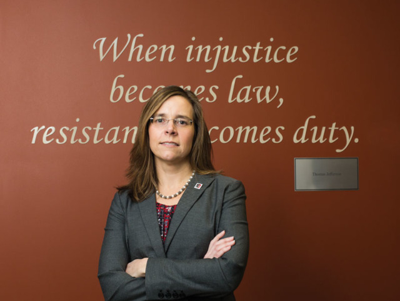


Dawn Deaner
Public defenders' offices around the country this week are celebrating Public Defense Week, in honor of the anniversary of the U.S. Supreme Court decision in Gideon vs. Wainwright. Gideon was the first Supreme Court case to recognize the Sixth Amendment right to counsel and to mark it, public defenders are devoting each day to a specific topic be it capital punishment (yesterday) or ensuring justice for children (tomorrow).
Pith spoke with Metro Public Defender Dawn Deaner about today's topic, racial injustice, where it can be seen in Nashville and what she believes can be done about it.
You’ve been working in Nashville for a while now. It seems to me that this is something we’re talking more about. Does it seem that way to you, that this issue is getting more attention in a positive way?
I would definitely say it seems like racial injustice in the criminal justice system is getting more attention today than it was 20 years ago. I started 21 years ago practicing in Nashville at the public defender’s office, and at that point we were in the midst of the “tough on crime” era, the ratcheting up of sentences and the length of sentences. We were really in the middle of the mass incarceration age, but with no real appreciation by individuals working in the system or people in power that what they were doing was — we hadn’t seen the buildup of the prison population in the mid-'90s to the extent we see it now. Hindsight tells us where we’ve come from. We can now see just how inequitable things have been.
The criminal justice system has decimated communities of color to the extent it can’t be ignored. And people are talking about it. With the publication of Michelle Alexander’s The New Jim Crow, with movies like Ava DuVernay’s 13th. There is much more raised consciousness today. The Black Lives Matter movement. I think it’s impossible today to ignore the racial injustices that exist in the criminal justice system.
Not to kind of rank injustices, but what is the thing that comes straight to mind when it comes to racial injustice in Nashville in the criminal justice system? What is the biggest problem you think we face?
I think the way I would answer that question is what are the most obvious. Because I think racial injustice exists throughout the system, but I think that there are ways in which it is more obvious than others.
I would point to, it's not just about what happens to individuals once they get into the criminal justice system. It's just as much, if not more, about how individuals wind up in the criminal justice system. And I think that is the place where we are starting to see the most obvious disparities. It is in, how do people get arrested? How are people ending up within the court system? We're not necessarily looking so closely at what happens to individuals once they are in the criminal justice system. So I think Nashville is talking a lot today, and there's a lot of focus on policing issues. Which is how people get into the criminal justice system. But another way in which people get into the criminal justice system is with our laws — what laws are passed and what laws are enforced. So when we look at the driver's license laws and the criminalization of driving on a suspended or revoked license.
Those are the things that I think people are more obviously looking at and saying why is it that 50 percent of the people getting arrested in Nashville are African-American, yet they are only 27 or 28 percent of our population in Davidson County. Why does that disparity exist? Policing contributes to that, but what our laws are — what we're passing, what we're making a crime contributes to that as well. We aren't focusing so much on, are there disparities that exist for individuals once they are arrested. But I think as public defenders those are things that we see, day in and day out, that our clients experience. But it's harder to quantify, it's harder to really look at that.
One thing you mentioned before is trust in the system. How does that apply to this issue of racial injustice? How do you see that playing out?
I think that because we are in the South and we're in Nashville, if we're going to talk about racial injustice we have to recognize that our court system has never been a place where people of color have received legitimate equal treatment. I think we have to just acknowledge that. Historically, our court system has never been equal for people of color.
The origins of police patrols in the south were slave patrols, they were running around and looking for escaped slaves. Once we moved past slavery, the next step was convict labor. That history then led into Jim Crow and every step of the way the criminal justice system was used as a way to continue to oppress people of color, particularly African-Americans. So if you are an African-American, the history of the criminal justice system as you have seen it is as a tool of oppression. And there have never been a time in this country when the criminal justice system for African-Americans has been anything other than that. So, we cannot look at today's court system and say, "Oh, well everybody's color blind now and we all disavow racism and everybody gets treated equally." Certainly, we can say that, but communities of color and African-Americans, that's not their historical perspective of the court system. So of course there is distrust in African-American communities of whether or not they are or can be treated fairly in our court system.
I know your office has done speaking tours and listening tours, partly to try to rectify that, but what else do you think needs to happen?
Truthful, honest conversation No. 1. And No. 2, empowering communities of color to have some influence and control over how the system operates. Whether that's the option of a citizen review board for the police department to look at what kinds of practices they are implementing, to make recommendations, to feel like they have some ability in the conversation around community policing to be a community that can tell the police, "This is how we want to be policed."
I think it's going to take, frankly, people in power — privileged people in power, white people in power — being willing to acknowledge the history behind where we are today and being willing to examine the system from somebody else's perspective that's not the same as ours and trying to produce more fairness.
We hear a lot about how African-Americans in Nashville, in addition to being disproportionately represented in the number of people who are arrested, they are also often times disproportionately the victims of crime. And I think that we need to be asking ourselves, why is that? And the answer to that is not because people of color are more violent. It is not because African-Americans are more violent. That's, to me, offensive to take that response or have that attitude. The reality is that everything is connected. So economic disparities and oppression contribute to the problems of violence that we see.
One book that I recommend that really started me thinking about this is the book called Ghettoside by Jill Leovy, where she essentially puts out her theory that black lives historically in this country have alway been devalued. So, in law enforcement and criminal justice history, if black folks were killing black folks, the white power structure didn't really care and it wasn't a concern. So that neglect and that devaluing of black lives meant that individuals who were African American and who were the victims of violent crime didn't feel like they had a criminal justice system that was going to provide justice for them. It didn't care about them. And the individuals perpetrating those offenses realized that they would not be held accountable, either. And that created a sense of a shadow system of justice, vigilante kind of justice and that creates unchecked violence. And it's because the traditional criminal justice system and system of accountability isn't working for communities of color. They don't trust it and it doesn't work for them. What Leovy talks about in her book is because communities of color have no faith in the traditional law enforcement system and the traditional criminal justice system, it reduces willingness of witnesses to crime to cooperate, it just undermines safety in communities of color and particularly poor communities of color. So, if we want to address violence in our community, I think we are going to have to have conversations around issues like that. We're going to have to recognize that perhaps the decisions that we've made around public safety and how to keep people safe aren't being successful.



Post a comment as anonymous
Report
Watch this discussion.
(0) comments
Welcome to the discussion.
Log In
Welcome to the discussion.
Keep it clean. Please avoid obscene, vulgar, lewd, racist or otherwise abusive language. Comments featuring hate speech or threatening or violent content will not be tolerated.
PLEASE TURN OFF YOUR CAPS LOCK.
Be truthful. Don't knowingly lie or mislead.
Be proactive. Use the “report” link on any comment that violates our comment policy.
Share with us. We'd love to hear your feedback.