
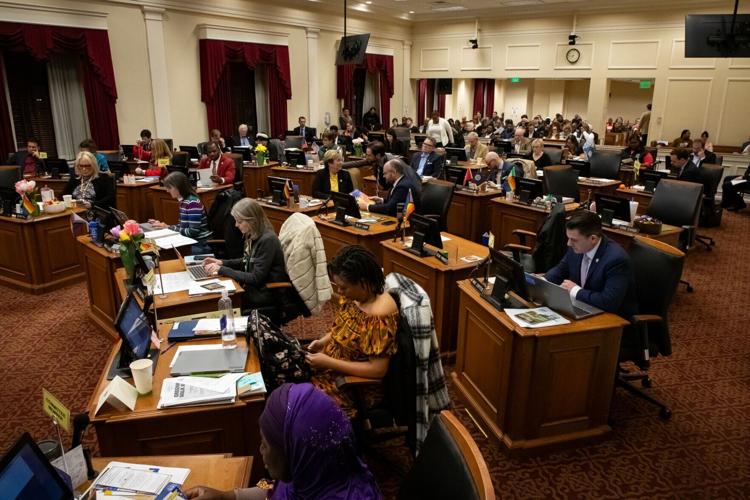


A zoning ordinance related to Vanderbilt’s Innovation District received its final approval from the Metro Council on Tuesday, as did legislation to implement restrictions on police surveillance drones and to refinance Music City Center.
Here’s a look at some of the matters the council passed on Sept. 1.
Vanderbilt Innovation District
The council approved a zoning measure allowing Vanderbilt University to move forward with its planned 43-acre Innovation District. The legislation received its final approval from the council on Tuesday and permits the multibuilding mixed-use Innovation District planned by Vanderbilt, in partnership with the Nashville Innovation Alliance, to commence.

New amendment adds building height limits amid neighborhood concerns; final consideration set for Sept. 1
The future district — which could take up to 30 years to complete, according to VU student newspaper The Hustler — is billed as a hub for entrepreneurship as well as a venue for arts and retail businesses, residential buildings and restaurants.
The district has been the subject of debate between the project’s developers and some of the neighborhood’s residents. Various members of the Hillsboro-West End Neighborhood Association have expressed concerns regarding building heights and argued that the development could lead to increased traffic and unsuitable density in the area. In contrast, various residences of the area have voiced support for the project.
An amendment added to the bill in August provides height limits for buildings and funds for traffic calming, while establishing a Metro advisory committee to provide feedback on the development. The council Tuesday night approved an amendment brought forth by Councilmember At-Large Burkley Allen to require bird-friendly glass on certain building exteriors within the VU Innovation District.
“Tuesday’s approval of Vanderbilt’s proposed innovation neighborhood caps a more than two-year collaborative process with city leaders, neighbors and the entrepreneur community in developing the plan,” says Eben Cathey, Vanderbilt senior director for local government relations, in a statement issued Tuesday night.
“The approved plan will be transformative for the city, Vanderbilt and for the surrounding neighborhoods. … With the Metro approval process behind us, we will turn our attention to bringing our innovation neighborhood to life. We share the thoughts of many in our city when we say we could not be more excited to see it become a reality.”
Music City Center Financing
The council also gave its final approval to a piece of legislation to refinance the debt structure on Nashville’s Music City Center convention facility, allowing the Convention Center Authority to transfer up to $300 million to the East Bank Development Authority for infrastructure projects.
The legislation was filed by Mayor Freddie O’Connell’s office, which has maintained it will strengthen Metro’s credit rating and free up non-tax revenues for affordable housing projects.
The effort follows the Tennessee General Assembly’s passage of a law to redirect tax dollars generated from Music City Center’s tourism development zone to the East Bank Development Authority, which could use the funds for high-cost infrastructure projects. This led to an approval last week by the EBDA to allocate up to $80 million in funding to be allocated toward the extension of Marine Drive between Cowan Street and Dickerson Pike, as well as other improvements along Cowan.
The legislation could also pave the way for a $1 billion expansion of the Music City Center’s SoBro footprint. In addition, excess revenues could be allocated toward businesses downtown in the form of grants. The Metro Finance Department has said that the refinancing of the debt could free up funds for the city to create an affordable housing bond. Some councilmembers expressed concern that the legislation unfairly benefits the downtown core rather than Nashville as a whole.
Drone Restrictions
The council also moved forward with plans to restrict the use of surveillance drones by the Metro Nashville Police Department, following the conclusion of MNPD’s pilot “Drone as a First Responder” trial program in Madison.

Drones are the latest step in Metro police’s ‘steadily expanding surveillance apparatus’
The bill, sponsored by Councilmember Sandra Sepulveda, received its final approval Tuesday and requires council approval and a public hearing to be held before other “Drone as a First Responder” programs could be implemented.
The bill also allows the programs to be used only in response to or during an active shooter incident, hostage situations, searches for missing persons and a natural disaster or state of emergency declared by the Nashville mayor. Facial recognition technology used by the drones would also be banned, as well as autonomous drones manned by AI rather than people.
President Pro Tempore
Councilmember At-Large Olivia Hill was elected by her fellow councilmembers to a one-year term of president pro tempore of the legislative body.

Olivia Hill
President pro tempore presides over the council in the absence of the vice mayor. Hill received 20 votes, defeating District 25 Councilmember Jeff Preptit, who received 14 votes.
Hill succeeds Councilmember At-Large Delishia Porterfield in the position. Vice Mayor Angie Henderson noted Tuesday that all presidents pro tempore during this term of the Metro Council have been women.
In Other Business:
The council approved on first reading legislation filed by Mayor Freddie O’Connell intended to increase support for small businesses in Davidson County. The bill would create a legacy business program and workforce investment incentive, as well as modify Metro’s existing property investment incentive.
A renewable energy project was also approved on first reading. The proposal, filed by the mayor, would create a set of agreements between Metro Water Services and Burnham Nashville to construct a renewable natural gas facility, which would convert biogas from MWS’ biosolids facility into renewable natural gas to be injected in the nearby gas pipeline, generating energy credits that can be marketed and potentially result in millions of dollars in revenue for Metro.
In addition, the council approved a resolution honoring the life and legacy of singer-songwriter and philanthropist Dolly Parton, who died of cancer last week at age 80. The council also passed a resolution requesting the Metro Nashville Airport Authority board to rename Nashville International Airport as Dolly Parton International Airport. Gov. Bill Lee announced last week his intentions to partner with the airport authority to make the name change official.
This article was first published by our sister publication, the Nashville Post.



Post a comment as anonymous
Report
Watch this discussion.
(0) comments
Welcome to the discussion.
Log In
Welcome to the discussion.
Keep it clean. Please avoid obscene, vulgar, lewd, racist or otherwise abusive language. Comments featuring hate speech or threatening or violent content will not be tolerated.
PLEASE TURN OFF YOUR CAPS LOCK.
Be truthful. Don't knowingly lie or mislead.
Be proactive. Use the “report” link on any comment that violates our comment policy.
Share with us. We'd love to hear your feedback.