
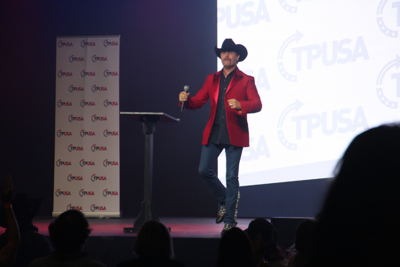


John Rich speaks at a presidential debate watch party at Rocketown in October
For those of you who don't follow nanoscopic auto-twangist John Rich on Twitter, first of all, congratulations on your discretion in this matter. However, you are missing some of the sharpest constitutional analysis this side of Rudy Giuliani's leaking brake fluid.
To wit, on Nov. 18, the definitely-not-big half of Big & Rich tweeted, "When this election mess makes it to the #SupremeCourt, I predict the judges won't be able to make a decision one way or the other because of the volume of irregularities. My bet is that they lean on the #12thamendment and kick this election back down to the state legislatures."
His next tweet then helpfully provided a link to Cornell Law School's page about the aforementioned 12th Amendment, along with the partisan breakdown of state legislatures (29 Republican, 19 Democrat and two split). That last one isn't exactly right, because Nebraska's unicameral legislature is technically nonpartisan — but that has no bearing on this, mostly because the 12th Amendment doesn't have anything to do with state legislatures or even mention them. Which Rich would know if he, y'know, actually clicked on the link he'd provided.
The 12th Amendment was ratified following the shambolic elections of 1796 and 1800. In the former case, the original method of electing the executive branch, which didn't foresee the rise of political parties, resulted in political enemies John Adams and Thomas Jefferson being president and vice president, respectively, which proved less than ideal. In 1800, Jefferson and Aaron Burr tied basically because there were no Zoom meetings then, and it took until mid-February to sort out.
So the electoral method got a little tweak, the constitution got a little more specific, and we got the method of election we use, largely unchanged, today. As the 12th Amendment explains, electors cast two ballots — one for president and one for vice president — and the sitting vice president opens the ballots in front of Congress. If there's not a majority for president, the House chooses among the top three vote-getters, each state getting one vote regardless of how many representatives it actually has. If I had to guess, this is where Rich's confusion comes from. The amendment reads, "But in choosing the President, the votes shall be taken by states, the representation from each state having one vote."
The text of the amendment does not mention state legislatures, the Supreme Court, massive dumps, Just for Men, shoe lifts or any thing else John Rich believes can fight back reality.
I don't want to spend too much time exploring John Rich's mind palace, lest I stumble onto the lyrics of the "Save a Horse (Ride a Cowboy)" concept album, but if I had to guess, Rich has spent too much time on message boards and Facebook and watching Newsmax and has conflated a bunch of things he's heard that are technically in the Constitution and in law, and developed this theory where the Supreme Court would throw up its hands and state legislatures would be authorized to choose new electors and all this is laid out in the 12th Amendment.
Yes, it's true the Constitution says electors are chosen by states "in such Manner as the Legislature thereof may direct," which some have interpreted to mean state legislatures can chose whomever they want whenever they want. The problem with that is that every state legislature directed a manner already — winner-take-all based on the popular vote in 48 states, and a district-based system in Maine and Nebraska. This theory also ignores the part where it says Congress sets the date for the choosing of electors (it actually says "chusing," which is charming) and that we already had that date.
Rich also ignores the Electoral Count Act, which I don't really blame him for because it's extraordinarily complicated, confusing and contradictory. But in short, it says if there are multiple slates of electors from a state, Congress decides which will count, and if Congress can't decide, the default is the slate sent by the governor of the state. Which, in all these disputed states, will be electors for Biden.
"OK, J.R.," you are saying (if, against all odds, you are still reading this). "We didn't need 677 words to know John Rich ain't exactly Learned Hand."
And, of course, there is something to be said that fairly prominent Trumpists like Rich are espousing these half-informed but-but-but-what-abouts and that, at best, people who know better are offering very little pushback to these scraps of hope and that, at worst, they are cynically enabling them, creating an environment where rank-and-file Trump supporters are enmeshed in this denialism that is going to make for an ugly scene, not unlike the Millerites and The Great Disappointment, when, y'know, reality rears its ugly head and Joe Biden is sworn in Jan. 20. And there's probably a point to be made about the fragility of lower-case-L liberal democracy if we are relying on mere technicalities to keep it humming.
That's all true of course, but this story takes an even stupider turn.
Former Scene music editor Adam Gold, who has a long and distinguished track record of ridiculing the Walter Ulbricht of Love Circle, tweeted at Rich, saying he oughta put up or shut up, offering to bet him $10,000 that the Supreme Court wouldn't throw the election to the state legislatures. A safe bet on Gold's part, because that's not how this works.
And that was that until yesterday, when the Supreme Court issued a comically terse ruling in one of the Hail Mary lawsuits. With no dissents and no comments, it was the judicial equivalent of RandyJacksonThatsANoFromMeDog dot gif. Gold fired a screenshot of the ruling Richward, asking him how confident he felt in his earlier prediction.
Despite every lawsuit being tossed unceremoniously like a jobber in the Royal Rumble, and with even Republican (even Trump-appointed) judges playing the part of the Big Show, Rich seemed more confident than ever, establishing the rules for this little wager.
Under Rich's plan, both parties will place 10-large in an escrow account. If, as is definitely going to happen, Joe Biden is sworn in, Rich said Gold is to withdraw the $20,000, but he has to donate Rich's half to Folds of Honor. (NB: Folds of Honor is a really good charity with a great track record and is certainly worthy of your support, despite Rich's endorsement of it; you can't pick your fans.) If, on the other hand, Trump takes the oath (which, again, isn't happening), Rich will take the loot and donate Gold's $10,000 to the charity of his choice. (For the record, Gold's stake is being covered by a beat-keeping key member of the Nashville music community who is putting Adam's gold on the ceiling, if you catch my drift.)
John Rich needs to go to the same gambling tutorial as John Cooper, because that is not how betting works.
When one makes a bet, one offers something of value (the "stake") to their adversary, preferably something the adversary would want. The adversary does likewise, unless he or she needs to lay odds, as Elaine had to do in "The Contest" episode of Seinfeld. Once the triggering event is decided, the winning party reclaims his own stake as well as the loser's. The loser does not get to dictate how the winner utilizes that which the loser has already lost.
If Rich had in mind the idea that a charity could benefit from his dumbassery, the move is to say, "If I win, you donate $10,000 to Folds of Honor and if you win, I'll donate $10,000 the charity of your choice." There's no need for escrow accounts in this far-less-convoluted method, and it has the added benefit of actually making sense. Under the scheme devised in the unregulated sweat lodge that is Rich's brain, Gold (who is 100 percent guaranteed to win here) will simply get back his $10,000 and the $10,000 he profits will be required to go elsewhere. Sure, John Rich is out 10 grand and we all get the enjoyment of him being mind-numbingly wrong, but what does Adam get out of the deal? A pain-in-the-ass trip to the bank?
For what it's worth, Gold agreed to these weird stipulations, suggesting to me he needs a better second, as the current one doesn't seem willing to tighten up the rules (if you get my meaning).
During all this, the Supreme Court docketed the latest and perhaps most hilarious effort at judicially overturning the election, as Texas and a host of other red states (though thankfully not Tennessee ... yet) are suing Nevada, Arizona, Wisconsin, Michigan, Pennsylvania and Georgia (the last of which, by the way, is run by Republicans) because something-something mail-in balloting diluted something equal protection something irregularities something-something Texas' attorney-general is under indictment for security fraud and definitely isn't trying to weasel a pardon out of this something-something. (Update: Tennessee appears to be joining the amicus brief filed by Missouri's attorney general.)
Responses from the defendant states are due Thursday, which means the hilarious dismissal of this oddball original jurisdiction end-around should come relatively quickly, certainly before the electoral college meets to vote Dec. 14, and maybe then John Rich will admit he was wrong?
We aren't holding our breath — we don't want to turn blue, if you pick up what I'm putting down — but at least some good will come of it: Folds of Honor will be able to fund a hefty scholarship. Hopefully to a college that teaches civics.



Post a comment as anonymous
Report
Watch this discussion.
(0) comments
Welcome to the discussion.
Log In
Welcome to the discussion.
Keep it clean. Please avoid obscene, vulgar, lewd, racist or otherwise abusive language. Comments featuring hate speech or threatening or violent content will not be tolerated.
PLEASE TURN OFF YOUR CAPS LOCK.
Be truthful. Don't knowingly lie or mislead.
Be proactive. Use the “report” link on any comment that violates our comment policy.
Share with us. We'd love to hear your feedback.