
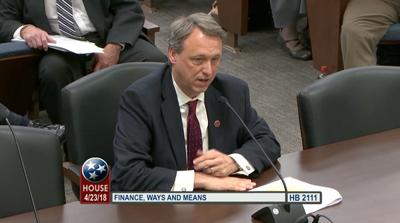


Steve Crump, the elected district attorney for the 10th Judicial District and the legislative chair for the state DAs conference
Writing for In Justice Today last month, Josie Duffy Rice spotlighted the power and influence prosecutors wield behind the scenes at state legislatures, crafting or killing proposed legislation that shapes the criminal justice system. Prosecutors in Tennessee served up a perfect example of that just two weeks ago, as the legislative session came to a close.
The Tennessee District Attorneys General Conference killed a drug-free-school-zone reform bill (HB 2111) that had bipartisan support, after the bill was amended to remove paralegal positions for district attorneys' offices. And it was no back-room maneuver. They did it right in the open. You can watch it right here.
Ostensibly meant to prevent or punish drug dealers who sell to kids, Tennessee's drug-free-school-zone law sets a mandatory minimum sentence for drug sales — or possession with the intent to sell — within 1,000 feet of a school, daycare, public library or park that is longer than the sentence for rape or second-degree murder. It came under particular scrutiny last year because of the case of Calvin Bryant, a man arrested in 2008 for selling hundreds of ecstasy pills to a Metro police informant. Bryant had no prior criminal record, but because the sale had taken place within 1,000 feet of a school, he was sentenced to 17 years in prison, with the chance of parole after 15.
A Reason investigation in December dug into the way drug-free school zones end up functioning as a trap, landing offenders with unduly harsh sentences and, not surprisingly, disproportionately affecting African-Americans. Crucially, the investigation showed that — with zones as large as Tennessee's — it can be nearly impossible for huge swaths of a city's population to avoid being in a drug-free school zone at all.
All of this inspired a bipartisan effort to reduce the size of Tennessee's drug-free school zones to 500 feet, with the hope that fewer unintended targets would be ensnared by the law and its accompanying sentence. The bill was sponsored by two Republicans, Rep. Tilman Goins and Sen. John Stevens. And because the Fiscal Review Committee determined that reducing the size of drug-free school zones would result in a savings of nearly $4 million for the state, they proposed using some of those funds to pay for additional positions in DAs' offices and for public defenders — alternative sentencing coordinators for prosecutors in 18 judicial districts and a new appellate division for the District Public Defenders Conference.
The bill went through criminal justice committees in both chambers without opposition. But that changed after a Senate finance committee removed paralegal positions for prosecutors from the bill. By the time the House Finance, Ways and Means Committee took up the bill on April 23, the DAs conference had moved from being neutral on the bill to being strongly opposed.
“There was no active opposition going through [earlier committees]," Goins told the finance committee. “The opposition began when the amendment went on that removed positions from the district attorneys. So it’s hard for me to pinpoint what the true issue may be.”
In testimony before the committee that day, Steve Crump, the elected DA for the 10th Judicial District and the legislative chair for the state DAs conference, said the conference felt the paralegal positions would help prosecutors find new ways to address the opioid epidemic. On balance, he said, the conference saw that as a worthwhile trade-off and opted to remain neutral on the bill rather than outright oppose it, even though he claimed the conference had always opposed shrinking drug-free school zones. But now, with the new positions stripped out of the bill, he cast the legislation as a gift to drug dealers.
“You don’t get a $3.7 million savings that involves the Tennessee Department of Correction unless a lot of people are in jail a lot less time," he told the committee. "People who sold drugs within school zones, as you currently made illegal and an enhanced punishment. You don’t get a savings from the Tennessee Department of Corrections unless you put, in this case, drug dealers on the street early.”
Crump rejected Goins' suggestion that the loss of new positions had affected the conference's position.
“To characterize this as 'We’re not for this now because we didn’t get positions' is simply wrong,” he said.
But lawmakers from both parties weren't buying it.
Republican Rep. Gerald McCormick challenged Crump about why the DAs conference was neutral on the bill if prosecutors have "always been opposed" to shrinking drug-free school zones. House Minority Leader Craig Fitzhugh was similarly dubious.
“General, I’m concerned about the credibility of the DA generals," Fitzhugh said. "I don’t know that you oughta lay your credibility on the line for this one.”
Republican Rep. Ryan Williams said he agreed with Fitzhugh.
“The timing’s really bad," Williams said. "It kind of points in a different direction, that you’re mainly frustrated that you lost the 18 positions, that you were for it before you were against it, and that kind of bothers me, really. Especially when you sit up here and say that this committee, if they vote for this, is soft on crime."
Patrick Frogge, executive director of the public defenders' conference, told the committee his conference supported the bill on policy grounds. When asked, he said that support would not change even if the new positions for the public defenders conference was stripped out of the bill as well.
“The reason I thought there was broad agreement is that most people who work in the courts realize that it’s a really broad school-zone [law]," he said. "That it sweeps up a lot of people who aren’t dealing drugs to kids.”
With opposition from the DAs conference, though, that broad support had evaporated.
The bill died after a nine-to-13 vote.



