

This story is a partnership between the Nashville Banner and the Nashville Scene. The Nashville Banner is a nonprofit, nonpartisan news organization focused on civic news. Visit nashvillebanner.com for more information.
After two days of jury selection, the trial of former House Speaker Glen Casada and his chief of staff Cade Cothren dug into the heart of the case on Thursday.
In his opening statement to the jury, Casada attorney Ed Yarborough painted the situation as a product of the machinations of Casada's political rival, Cameron Sexton, who succeeded him as speaker of the House, and argued that Sexton used his relationship with the FBI to take down Casada.

Federal prosecutors offered Casada a plea bargain, which he rejected
“Mr. Sexton developed a relationship with the FBI on and off for four-and-a-half years,” Yarborough said. “In fact, the last time he met with them was just a few days ago.”
Casada and Cothren face 20 counts of money laundering, bribery, wire fraud and theft related to the operations of a mailer company, Phoenix Solutions. The company was established after Cothren’s departure from his role on the speaker’s staff. Casada — along with former Rep. Robin Smith (R-Hixson), who pleaded guilty and will be testifying at the trial — allegedly pressured other state House representatives to use Phoenix Solutions to purchase constituent mailers, for which each House member receives a yearly $3,000 stipend. In return, Smith and Casada allegedly received kickbacks from Cothren. However, Yarborough and Cothren's attorney, Joy Longnecker, both argued on Thursday that everything they did was perfectly legitimate.
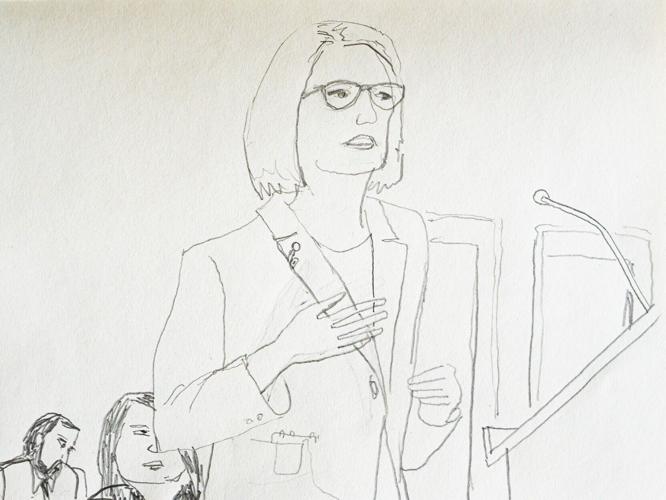
“The prosecution has literally made a federal case out of junk mail,” Longnecker said. “What happened in this case was just politics and business as usual on the Hill.”
But according to the prosecution, Casada and Cothren’s activities went beyond “business as usual.”
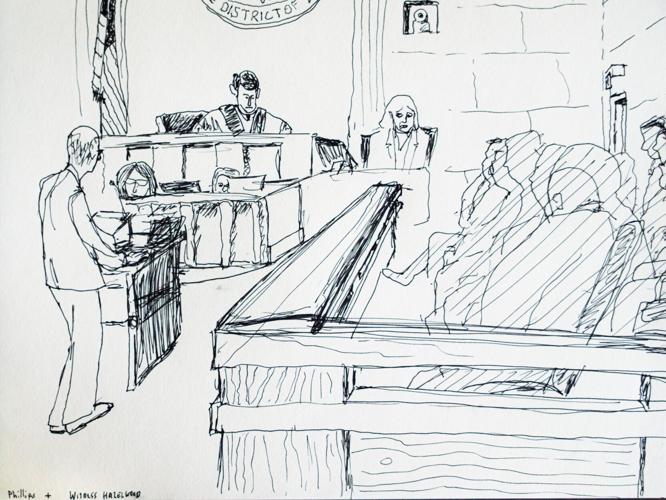
“This is a case about powerful politicians who used their influence to line their pockets,” federal prosecutor Taylor Phillips said.
Following opening statements from Phillips, Yarborough and Longnecker, the government called three witnesses Thursday: former state Rep. Patsy Hazlewood (R-Signal Mountain), state Rep. Esther Helton-Hayes (R-East Ridge) and state Rep. Jay Reedy (R-Erin). As the prosecution attempted to build its case, the defense portrayed the situation as a matter of political infighting and honest business.

Cade Cothren's attorney, Joy Longnecker, during opening statements.
‘A Corrupt Way of Doing Business’
Hazlewood, Helton-Hayes and Reedy all unknowingly used Phoenix Solutions for mailers in late 2019. All three witnesses said they would not have felt comfortable doing business with a company run by Cothren due to his scandalous departure from the House following the disclosure of racist texts and illegal drug use.
“In my mind, it was a very corrupt way of doing business,” Reedy said. “When I became aware of what was going on, it was appalling.”

Just one day after his chief of staff resigned, House Speaker Glen Casada has named a new one.
Reedy did not recall how his mailers were produced by Phoenix Solutions, but Hazlewood and Helton-Hayes both stated that Smith approached them, wanting to create mailers for them through her consultancy firm. Both said they had worked with her on mailers previously and were unaware that she was working with Phoenix Solutions this time around.
“She usually used people locally, so I guessed she had for this as well,” Helton-Hayes said.
Hazlewood said she first heard about Phoenix Solutions when she received the invoice for her mailers, and it was from the company. That was when she asked Smith about it.
“She told me that she knew Matthew Phoenix,” Hazlewood said.
Matthew Phoenix was the alias adopted by Cothren to run Phoenix Solutions after he resigned from Casada’s office. Hazlewood said Smith told her she had met Phoenix at a Turning Point USA event.
Notebook
FAKE NEWS: Prior to the jury entering the room, Cothren's attorney, Cynthia Sherwood, brought a NewsChannel 5 story by Phil Williams to Judge Eli Richardson’s attention. The story, published Wednesday afternoon, claims that “federal prosecutors said they have evidence that the chief of staff to then-House Speaker Glen Casada fabricated evidence that was used in 2019 in an attempt to jail [Justin Jones].” Sherwood stated that such evidence would not be admitted into the court and asked Richardson to reiterate to the jurors in his instruction that they should refrain from consuming any media related to the case throughout the trial.
JURORS DOWN: Before opening statements even began on Thursday, the court was already down two jurors. One juror fell ill, and another did not realize until the last second that she would lose four weeks of income by taking a spot on the jury. Two alternate jurors took their places, which leaves only two alternates for the balance of the trial.
LAST NAMES PLEASE: After jurors left the room at the end of the day, Richardson brought up the fact that Sherwood and Longnecker had been using the first names of people when referring to them while speaking with witnesses. Richardson quoted one of his law school professors, former Nashville Mayor Karl Dean: “First names won’t fly,” he said. He requested that Sherwood and Longnecker stick to last names whenever possible.
This article first appeared on Nashville Banner and is republished here under a Creative Commons Attribution-NoDerivatives 4.0 International License.



Post a comment as anonymous
Report
Watch this discussion.
(0) comments
Welcome to the discussion.
Log In
Welcome to the discussion.
Keep it clean. Please avoid obscene, vulgar, lewd, racist or otherwise abusive language. Comments featuring hate speech or threatening or violent content will not be tolerated.
PLEASE TURN OFF YOUR CAPS LOCK.
Be truthful. Don't knowingly lie or mislead.
Be proactive. Use the “report” link on any comment that violates our comment policy.
Share with us. We'd love to hear your feedback.