
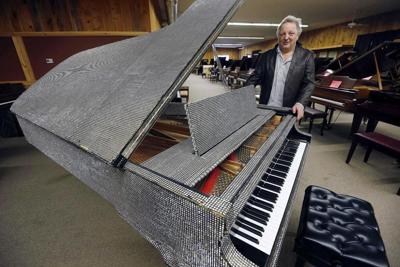

More than two years into its legal quest for the return of one of Liberace’s bejeweled pianos, Nashville-based guitar maker Gibson Brands (via its nonprofit arm Gibson Foundation) is facing new hurdles.
Indira Talwani, a federal judge in Boston, ruled last week against Gibson’s requests that she declare that Rob Norris, owner of the Piano Mill in Rockland, Mass., had breached his contract with Gibson and improperly taken possession of the piano that they say they only meant to loan him.
“They were the Goliath and we were the David, and they really tried to pummel our guy,” Dan Gibson, one of Norris’ attorneys, tells the Scene's sister publication, the Nashville Post.
A pretrial conference is tentatively set for June 27. Left up to a jury, the judge ruled, remains the question of who actually owns the concert grand piano custom-made for Liberace by Baldwin Piano in the 1980s.
The piano’s paper trail is limited, but the two sides largely agree that, in 2011, Gibson (which had acquired Baldwin and, they thought, the Liberace piano, out of bankruptcy a decade earlier) asked Norris to remove the piano from the seventh floor of the Hammerstein Ballroom in Manhattan. Norris was under the impression, he has since testified, that he would get to keep the piano if he could simply get it moved. Gibson argues, however, that Norris was to keep the piano at his Massachusetts shop on a long-term loan.
There is no loan document in the court records, and Gibson said that they have been unable to locate the two key former employees who communicated with Norris in the decade since he took possession of the piano.
The piano’s ownership history is even murkier than that, as Gibson Brands President Cesar Gueikian said in a deposition that he thought Gibson’s 2001 purchase of Baldwin included the piano, but he is unaware of any inventory documents proving that to be true.
The company later drew up documents detailing a purported transfer of ownership from Gibson Brands to nonprofit arm Gibson Foundation in 2019. The goal, the two entities said, was to auction the piano off, with 5 percent of the proceeds going to Norris for his troubles and the rest going to fund the nonprofit’s activities.
But the transfer was not enough to reset the clock on Massachusetts’ statute of limitations on court claims. The court agreed with the Piano Mill that the state’s three-year limit on claims had passed without Gibson asserting ownership rights.
Norris argued that Gibson had initially filed the suit in Nashville, rather than Massachusetts, as a way to intimidate or inconvenience him, but Judge Talwani denied his abuse-of-process claim.
Still, some of Norris’ actions in the years after he took possession of the piano, including asking Gibson representatives for their OK on repairs and loan agreements, indicate that he believed the company at least still had an interest in the instrument. But it wasn’t enough to sway the judge, especially since Gibson had been unable to procure the two key employees who were involved with the transfer.
The dispute between the two parties dates to 2015, when the Piano Mill roof collapsed after a snowstorm. A Gibson employee expressed concern about the Liberace piano and asked to move it, but Norris denied the request. Gibson lawyers began contacting the Piano Mill that year.
Gibson representatives and attorneys did not respond to requests for comment.
Though the judge ruled that Gibson had failed to prove Norris had breached any contract or improperly taken possession of the piano, the court declared that the piano’s ownership remains “not undisputed.” That question is “for a jury, not the court, to decide,” the judge wrote.
This story first ran via our sister publication, the Nashville Post.



