

A police union survey conducted in late April found widespread dissatisfaction with Metro Nashville Police Department management and a belief that Nashville’s policing strategies do not work, among a variety of other findings.
The Fraternal Order of Police survey, the results of which were obtained by the Scene, received responses to 33 questions. Of the 1,225 members of the FOP, 593, or 48 percent, responded. The topics covered range from views of MNPD leadership and how it handles discipline, to morale on the force and maintenance of police vehicles.
It’s not surprising, of course, to find that the rank-and-file have some complaints about management. But still, some of the results stand out. For instance, 62 percent of respondents (367 officers) said they do not “have confidence that MNPD management will do the right thing.” On another question, 72 percent of respondents (420 officers) said they do not agree that “the Chief of Police dispenses discipline in a fair and consistent manner.”
More interesting, in light of the recent assessment of policing in Nashville by The Policing Project, is the response to a question about the department’s approach to law enforcement. In response to the notion that “the current strategy for crime prevention in Nashville is working,” 71 percent (421 officers) of respondents said “no.”
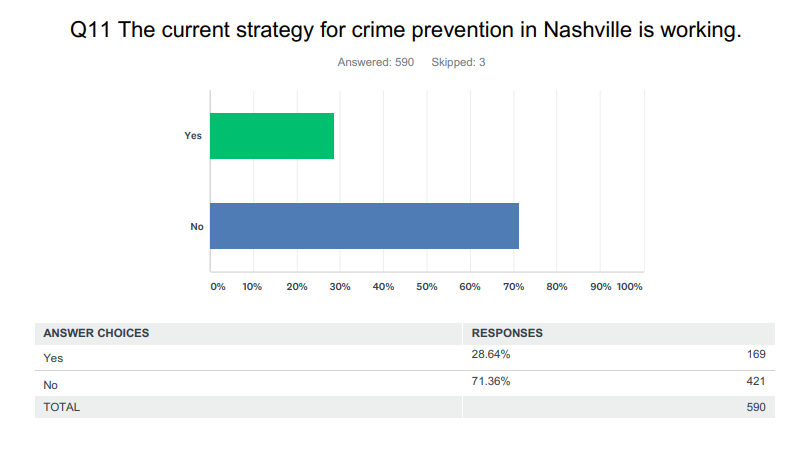
Of the three options respondents could choose from to explain why they feel MNPD’s strategy isn’t working, the most popular answer was “There are not enough officers on each detail to be effective.”
Among the conclusions drawn from The Policing Project’s report — which confirmed findings by Gideon’s Army that black drivers are disproportionately stopped by Nashville officers, and determined that Nashville’s high traffic stop rate does not affect crime — was the possibility that MNPD is under-resourced. Perhaps paradoxically, the group’s report suggested adding police officers might reduce some of the problems between marginalized communities and the police.
Later on in the FOP survey, respondents were asked to rate morale on the force. The average rating was a 4.15 out of 10. Asked to identify the reason for low morale, a large number pointed to staffing levels and the management of the department.
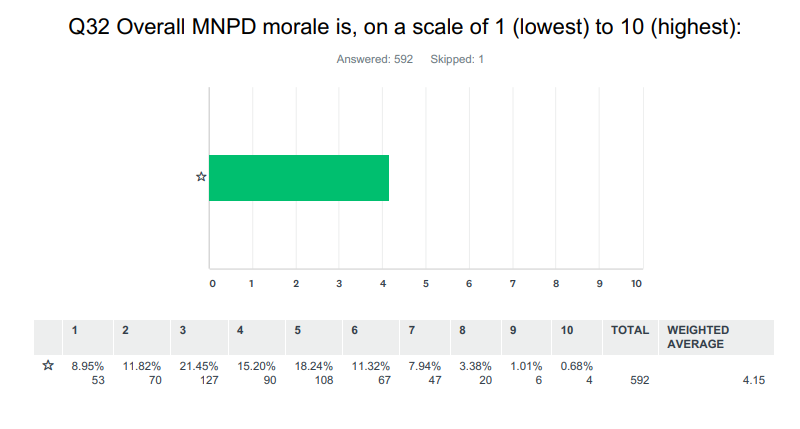
“Many of these concerns have been referenced in prior meetings with MNPD administration,” FOP president James Smallwood says in a letter accompanying the survey results. “We feel that these opinions have not been given the consideration they are due. This lack of attention to the employee’s opinions about the current state of the department, ultimately results in an overwhelming state of low morale amongst the MNPD employees. According to this survey, on a scale of one to ten, the average level of morale among sworn personnel is: 4.15.”
Smallwood continues: “This low level of morale is of grave concern to the Fraternal Order of Police. Low morale in any organization introduces a host of issues that create serious operational problems and can, if not addressed, result in catastrophic failure of that organization's mission. Even worse, this problem within a law enforcement agency introduces a host of problems that could produce a wave of setbacks that would have a ripple effect on our community for generations to come.”
Despite agreeing with some of the concerns raised about stop rates and MNPD resources, the FOP has dismissed the notion that racial bias might be a factor in the disparity that exists between how often white and black Nashville drivers are stopped. In fact, the organization misstated the Policing Project’s findings to argue that point. Before that, the union was engaged in a well-financed and plainly disingenuous campaign against the successful Community Oversight Now campaign. The FOP ran ads that made no mention of a police oversight board, but warned of a looming $10 million tax increase — even though a tax increase is not required by the charter amendment that created the board.
In response to the results of the FOP survey from this spring, MNPD spokesperson Don Aaron tells the Scene that the department is aware of them, although he sought to downplay their significance.
“Chief Anderson and the deputy chiefs are aware of the FOP survey from 8 months ago in which anonymous responses were received from some MNPD officers (the department is authorized for 1,511 officers; there are presently 1490, including trainees in the academy),” Aaron says in an email.
He went on:
“More is being asked of police officers, a finite resource in this city, than ever before. As we are able to expand the department as Nashville’s population continues to grow, including adding to the number of precincts, officers will have more time to engage in wider spread neighborhood initiatives. Chief Anderson has sought to begin staffing up for the opening of a 9th precinct. However, his requests have not been granted in recent years due to tight budget times.
"As to strategies, the attached charts show that major crime declined from 1997 through 2014 while the populations of Nashville and the surrounding area grew. In 2014, the [rate] plateaued and has gone up slightly between 2015 and 2017. The population of the city and surrounding counties continues to significantly increase. Larceny and auto theft are the two categories showing increases this year. You saw in Chief Anderson’s statement following the release of the Policing Project report that the department’s strategies are continuing to evolve in coordination with evaluations from precinct commanders, who are largely responsible for addressing crime trends in their specific areas.”



