
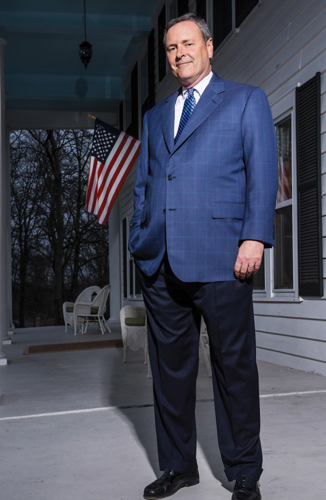
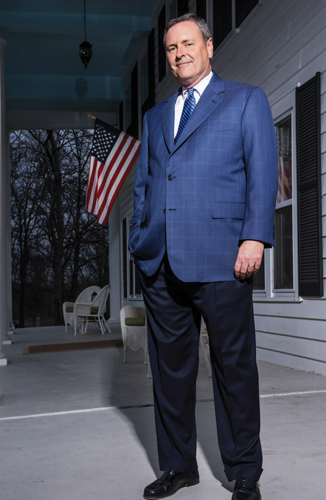


Glenn Funk
Davidson County District Attorney Glenn Funk is planning on making the rounds and speaking to various gatherings of Nashville's mover-and-shaker types in the coming months. He'll be "squawking," as he puts it, about two issues in particular: the salaries of his assistant district attorneys and the looming cost of police body cameras.
Funk was the guest speaker at Thursday's lunchtime meeting of the Kiwanis Club of Nashville at Bridgestone Arena's Patron Platinum Club, where he gave a spiel he says he plans on repeating. After detailing some of the office's successes — in domestic violence prosecutions, for instance — and explaining the "menace" of guns on Nashville's streets, he moved on to salaries, and urged the club's members to speak to the mayor and the Metro Council about it.
At present, Funk said lawyers in his office start out with a salary of around $51,000 to $52,000, while new public defenders are making around $64,000. Despite step raises over the years, Funk said his younger prosecutors still lag behind their counterparts in the public defender's office.
“It would take DAs roughly six or seven years to pass public defenders that are getting right out of law school,” he said.
Funk called the disparity “an insult to every law-abiding citizen in Davidson County that our government pays district attorneys substantially less than public defenders.”
He was at pains to emphasize that he thinks public defenders are important, and even underpaid. He said that he'd be fine seeing lawyers in both offices on the same pay scale, but that paying starting public defenders more than new prosecutors was unacceptable.
“Our city pays lawyers to represent criminals more than we pay lawyers to protect the community," said Funk. "Trust me, I’m not saying that the public defenders need less money, because I am not. They’re worth every penny. There are many places in this country where DAs make more than public defenders. There are many places where they’re paid the same. We’re the only place in America, maybe in the world, where we prioritize criminals’ lawyers over lawyers representing victims and community safety.”
Public defenders would likely make a distinction here: The clients they represent are not "criminals," but rather people accused — not convicted — of crimes who cannot afford to pay for an attorney. The Scene has covered the issues facing the public defender's office when it comes to resources that don't match a massive workload.
The DA's office received a small budget increase a couple years ago that allowed for a boost to salaries, but Funk says the disparity persists. And as a new budget cycle looms, he's taking his pitch public.
He told the group on Thursday: “I am going and not just making my case to the mayor’s office and to individual council members, but I’m pointing it out to groups like this, community leaders, who I think can reach out to their council members and say: ‘You know what, this is nuts. Our priorities are inverted and we need to make sure that the DAs are paid at least as well as the public defenders.’”
Mayor David Briley's spokesperson, Thomas Mulgrew, didn't have much to say in response to Funk's comments.
"Nashville has always generously supplemented the funds which the State sends to fulfil its obligation to pay our city’s District Attorneys," Mulgrew wrote in an email. "We will continue to do so and hope to work with General Funk to address his concerns in this year’s budget."
Funk said the salary increases he wants to see would require $400,000 additional dollars for his office.
But, he said, "We've got another problem, though, that's looming on the horizon that dwarfs this."
He then moved on to body cameras.
Former Mayor Megan Barry committed to the implementation of police-worn body cameras in 2016, and funds to purchase the cameras were included in the 2017 Metro budget. But police officials, and Funk, have been saying for some time that they believe the total costs of a body camera program will be much higher than most realize. On Thursday, Funk reiterated those warnings, saying he believed the policy "could be a $25-$30 million a year requirement for our government, and that’s even before we start paying for storage."
Funk said he is personally supportive of using body cameras.
“I kind of like the idea of body worn cameras, because I like to have as much evidence as possible when I am prosecuting a case, and that will provide more evidence that I can use to hopefully get even marginal cases turned into convictions,” he said.
But he also seemed increasingly frustrated about what he sees as a lack of awareness about the related costs of using body cameras — things like data storage and staffers in a number of different areas of the criminal justice system to review footage.
“I have a constitutional responsibility to provide to the defense counsel any evidence in a case," Funk said. "Defense counsel has to know what the evidence is in order to properly defend their client, advise them, do you take a plea bargain or take it to trial. If there happens to be something that they can claim is exculpatory, they need to be able to see that and show that to a judge or jury or to us as they’re negotiating. I don’t have an option — I have to give that to the defense. And that’s the right thing to do. It’s a constitutional requirement, it’s an ethical requirement. Police are going to make these tapes, I’ve got to be able to provide them. Well what does that require? That requires us to look at them.”
The DA told the group that his office will likely require $5 million to accommodate the body camera policy, and he estimated others like the public defenders, the police department and more would require a similar amount.
"Body cams are in the testing phase with MNPD," Briley spokesperson Mulgrew said. "A funding plan for next year’s budget is underway in coordination with the affected agencies."
Policing and criminal justice reform activists have at times been skeptical about high cost estimates from Metro officials — particularly the police department — who they see as resistant to reform.
Update (1/14): Metro Public Defender Martesha Johnson responds to Funk's comments in a written statement:
The Nashville Defender’s Office was disappointed to read about comments reportedly made by District Attorney General Glenn Funk at a recent Kiwanis Club meeting in which he described our work as “representing criminals.” These comments, which he has made before, are particularly disappointing given Mr. Funk’s responsibility as our top prosecutor to uphold the law, including the constitutional guarantee to the presumption of innocence. By referring to our clients as “criminals”, Mr. Funk sends a message that in Nashville, poor people accused of a crime cannot expect fair treatment from his Office. His use of that label also demonstrates his willingness to dehumanize and demonize the mothers, fathers, sons, daughters and other Nashvillians we represent-as well as our Office-to increase his budget.If Mr. Funk believes the attorneys in his Office are underpaid, he can advocate to change that without disparaging our clients or this Office. He can also do so without mischaracterizing the issues, or blaming Metro officials for what is really an opportunity for him to encourage adjustments to the State salary scale. The Nashville Defender’s Office takes pride in the work that we do daily. We support fair pay for our staff as well as the staff of the District Attorney’s Office; we do not, however, support the rhetoric and tactics of its elected leader on this issue.



