
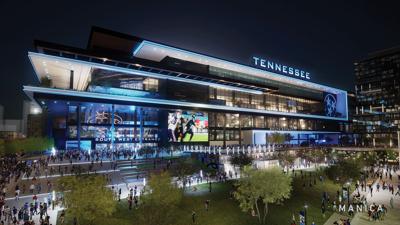

Mayor John Cooper and the Tennessee Titans have reached terms for a new stadium. Cooper filed an agreement between the city and team to the Metro Council on Friday afternoon, according to a press release. As of publication, the exact agreement had not yet been posted on the city’s legislative database.
The final agreement follows more than a year of negotiations between Cooper and the team. The stadium was budgeted at $2.2 billion in last year’s Capital Improvements Budget, but contributions released today add up to $2.1 billion — either number makes the facility the second-most-expensive arena in the world. That cost is expected to be split between the state, the team and Metro, which will contribute an estimated $760 million to the total cost. The city expects to spend an additional $1 billion in infrastructure upgrades related to a complete redesign of the East Bank, which will be home to a new stadium district.
“This agreement serves as the launching pad to channel future development on Nashville’s East Bank into the kind of neighborhood that serves all residents,” reads a statement from the mayor.
The team’s current lease, signed in 1996 by then-Mayor Phil Bredesen with terms highly favorable to the Titans, is set to expire in 2026. In recent years, the city has neglected maintenance costs at Nissan Stadium, and will reimburse the team up to $42 million for those receipts, according to the mayor’s office.
The Metro Council will review the mayor’s proposed deal in the coming weeks. In December, the council approved a nonbinding terms sheet that laid out various elements of a new lease between the city and team. Cooper argues that the new agreement shifts city liabilities from the general fund to specific revenue streams in and around a new stadium district on the East Bank.
The city plans to issue $760 million in bonds. These will be backed by a variety of revenue streams rather than the city’s general fund, including sales taxes collected in and around a new stadium and a 1 percent increase in the hotel-motel tax. It is not yet clear whether revenue bonds will be guaranteed by the general fund like the “backstop” used to secure debt for Music City Center.
Last week, Councilmember At-Large Bob Mendes argued against a new stadium in a widely circulated memo titled “Reject the Proposed Stadium Deal.” Critics of a new stadium, including Mendes, are wary of how pressure to generate sales taxes will shape the development of the East Bank — currently a sprawling industrial park — and cost the city. Mendes chaired the East Bank Stadium Committee, a body specially convened to provide a perspective on the stadium independent of both the mayor’s office and the team.
“I think the financing plan will force the area more toward tourism than being a neighborhood,” writes Mendes.
A new stadium would include a dome — a stipulation by the state, which is contributing a $500 million subsidy to the project.



Post a comment as anonymous
Report
Watch this discussion.
(0) comments
Welcome to the discussion.
Log In
Welcome to the discussion.
Keep it clean. Please avoid obscene, vulgar, lewd, racist or otherwise abusive language. Comments featuring hate speech or threatening or violent content will not be tolerated.
PLEASE TURN OFF YOUR CAPS LOCK.
Be truthful. Don't knowingly lie or mislead.
Be proactive. Use the “report” link on any comment that violates our comment policy.
Share with us. We'd love to hear your feedback.