
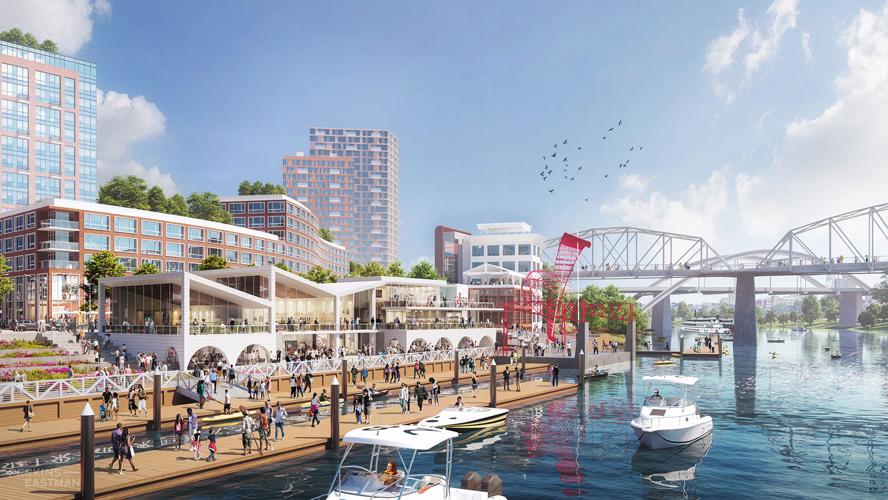
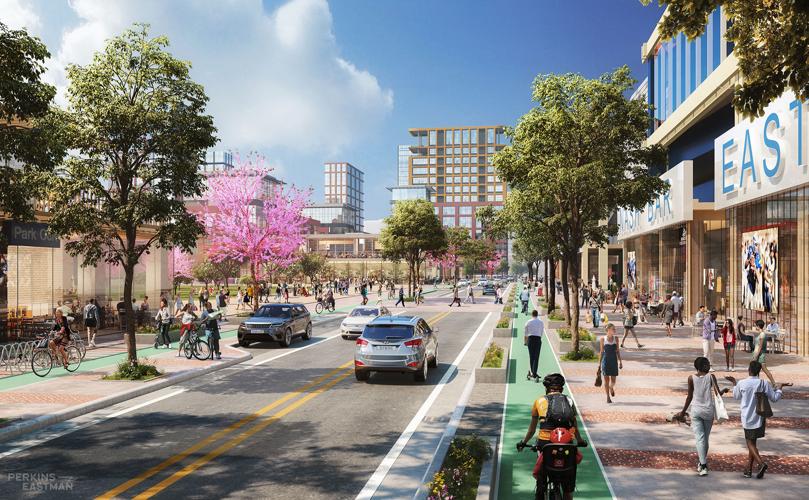

Every major Nashville media outlet has upped its coverage of the mayor’s plans to redevelop the East Bank in the past couple of weeks as Mayor John Cooper has begun to hype Nashville’s “next great neighborhoods.” The line used to be “next great neighborhood,” but East Bank promotional materials newly feature four distinct zones. From north (Oracle) to south (the I-24 Silliman Evans Bridge), they are: Jefferson-Spring, Capitol Crossings, Central Waterfront and Shelby’s Bend. If any development lesson can be learned from Wedgewood-Houston or Pie Town, it’s that kitschy branding is a good way to forecast a real estate bonanza.
Right now, the 335-acre campus is an industrial expanse dotted with warehouses, parking lots, petroleum storage containers, and a functional but outmoded NFL stadium. A primary hindrance to city development planning has been the site of the former PSC Metals scrapyard, now SA Recycling, though the site itself is still owned by prescient private equity billionaire Carl Icahn, who is sometimes on speaking terms with Mayor Cooper. Though there are no commercial residences on the East Bank footprint, the area is home to some unhoused people. Displacement across the highway preceded the recent demolition of RiverChase apartments, one of the few housing complexes near the urban core that honored Section 8 vouchers.
The city released its extensive design plans on Aug. 22, a summary of past slideshows and planning presentations titled the “Imagine East Bank: Draft Vision Plan,” supplying media with USB storage devices preloaded with high-resolution site renderings. At a press conference later that day, Cooper and planning director Lucy Kempf addressed media, Metro councilmembers, lobbyists and the public while Tennessee Titans executives milled around in the shadow of Nissan Stadium. That day kicked off a three-week promotional tour of open houses and Zoom calls offered as community-engagement events, which typically start with a presentation from planning staff (often Anna Grider, planning’s dedicated East Bank staffer) followed by audience questions. In-person events include full-color informational posters on easels. At First Church of the Nazarene last week, planning broke out its exceptionally adorable diorama of the city in miniature. It’s not clear how public feedback — especially residents’ refrains for guaranteed affordable housing units and a limit to tourist pandering — will affect the city’s existing vision, currently a combination of painstakingly thorough work from planners and input from Mayor Cooper.
Frequently referred to by the mayor and planners as a blank canvas and a once-in-a-generation opportunity, the East Bank has been designed to invite imagination. Before the next capital spending plan drops in the coming months, which will likely make some dent in the vast sum necessary to prepare the area for development, the city has encouraged residents to embrace the hypothetical — whether it’s a streamlined bike commute or what materials refer to as an “activated” Cumberland River.

Richel Albright, planning’s public information officer, tells the Scene that feedback has affirmed planning’s designs. “Generally, people are supportive of the plan,” she says, “and what we’re seeing most mentioned in survey comments are related to transit, bike and pedestrian access, affordable housing, plan implementation and waterfront access.”
The East Bank is also the city’s preferred escape route from one of its biggest financial liabilities — a 1996 lease with the Titans in which then-Mayor Phil Bredesen secured an NFL franchise with terms highly favorable to the team. Creative tax carve-outs and a $500 million subsidy from state lawmakers have tried to close the gap between new stadium estimates, budgeted at $2.2 billion by Cooper in May, and the city’s share of Nissan Stadium renovation costs. A report by stadium consultancy Venue Solutions Group estimated these at $293 million in 2017. At a Metro Sports Authority meeting in May, the Titans presented the city with their own estimates: $945 million through 2026 and $1.84 billion through 2039, the life of the Titans’ lease. The city’s costs hinge on its contractual obligation to provide a stadium in “first-class condition,” a standard subject to interpretation and boosted by new and renovated NFL arenas across the country. Contrary to the current perception furthered by the team and echoed by the media that Nissan is falling apart structurally, the 2017 report indicated that the bulk (in dollars) of necessary updates would be related to technology, like broadcasting infrastructure and video displays, followed by food service facilities, landscaping and interior design. Structural updates totaled $33 million through 2037.
Cooper frequently refers to a new stadium deal as Nashville’s chance to take the “general taxpayer off the hook” for stadium liabilities, a carefully worded statement pointing toward preemptively redirecting, rather than collecting and spending, public money. The city would borrow a billion dollars in debt secured by the East Bank’s potential to generate sales tax. Under prospective financing mechanisms, half of all local and sales taxes collected on the 130 acres around the stadium (and all sales taxes collected in the stadium itself) would service stadium debt in an arrangement nearly identical to downtown Nashville’s tourist development zone set up to pay for the Music City Center.
“The notion suggested in your comment that it’s essentially free to taxpayers is not really accurate,” Councilmember Bob Mendes rebuked Councilmember Brett Withers at the Aug. 18 meeting of the East Bank Stadium Committee, the new body convened by the Metro Council to review and coordinate information about a new Titans stadium. Committee chair Mendes (an at-large member known for his fiscal scrutiny) and Withers (an East Nashville district councilmember typically aligned with the mayor’s office) often butt heads over their willingness to kick the tires on a new stadium. The committee expects an update from Mayor Cooper, including terms for a new Titans lease, on Sept. 14. Discussion will likely continue through November.
Affordable housing, effective public transportation and a functioning school system typically dominate conversations about the city’s most pressing problems. As it campaigns to convince the public that the undeveloped East Bank deserves to be spoiled with time, money and attention, the Cooper administration has gestured that the site could also be a catalyst for solving Nashville’s other problems. Planners and the mayor’s office are reluctant to give details about how everything actually happens until hearing from the public. At the same time, the mayor prefers to downplay the East Bank’s connection to the Titans lease, for which the East Bank is an actual solution. Engagement events are scheduled through Sept. 21.



Post a comment as anonymous
Report
Watch this discussion.
(0) comments
Welcome to the discussion.
Log In
Welcome to the discussion.
Keep it clean. Please avoid obscene, vulgar, lewd, racist or otherwise abusive language. Comments featuring hate speech or threatening or violent content will not be tolerated.
PLEASE TURN OFF YOUR CAPS LOCK.
Be truthful. Don't knowingly lie or mislead.
Be proactive. Use the “report” link on any comment that violates our comment policy.
Share with us. We'd love to hear your feedback.