
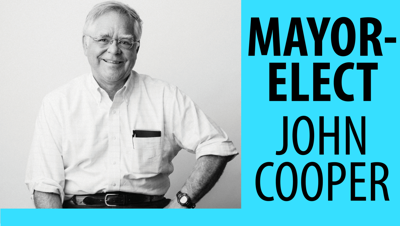


It’s a first in Metro Government history: An incumbent mayor has failed to win re-election.
On Thursday, At-Large Metro Councilmember John Cooper beat Mayor David Briley by roughly 39 points, closing a tumultuous season in Nashville politics that started with then-Mayor Megan Barry’s resignation last year. Barry was popular and expected to cruise to a second four-year term, but her unexpected departure elevated Briley, then vice mayor, to the city’s top job.
Briley took the podium just 15 minutes after the polls closed to concede the race. His time at the top comes to a conclusion after just 18 months, the shortest tenure in Metro history.
Cooper, whose brother Jim represents Nashville in the U.S. House of Representatives, will become mayor after four years on the Metro Council, where he was often a lonely voice in opposition to mayoral proposals — including capital spending plans and some economic incentive packages. Cooper and his campaign sought to capture the support of voters who believed that too much of Nashville’s growth in recent years has benefited downtown’s tourism-related and corporate businesses and not enough has flowed to residents and neighborhoods.
"It’s a happy night for Nashville," said John's brother, Rep. Jim Cooper, from election-night HQ Nashville Palace. "It doesn’t matter whether you voted for him or not. This is an opportunity for Nashville to be an even better city than it is already."
“Tonight is about a Nashville that works for everybody,” said Mayor-Elect Cooper. “As mayor — just taking a moment to see how that feels — I will work every day to continue to listen and learn, to put our neighborhoods first.”
A real estate developer and descendant of multiple old Nashville families, Cooper had the money to spread his message: He lent his campaign at least $1.8 million since entering the race in April.
Briley and his campaign apparatus repeatedly tried to paint Cooper’s message as overly vague and unachievable. They pointed out that Cooper’s proposal that the city start charging the Music City Center property taxes was impossible under state law, and that the millions of dollars it would bring in annually could only go toward a small fraction of Cooper’s promised redirections.
After the Aug. 1 first round of voting, in which Cooper beat Briley by 10 percentage points, it was too little, too late. Cooper, who had lagged in fundraising, immediately drew support from business leaders and others not predisposed to support his candidacy but who recognized the seeming inevitability of his runoff victory.
Briley will leave office with a complicated legacy. He, as he repeated frequently on the campaign trail, took over as mayor during a confusing time in Nashville. Among his first tasks was leading the charge on a doomed transit referendum — one that Cooper opposed. Later in the year, he opposed the ultimately successful ballot measure that established a police oversight board in Nashville. One of the biggest splashes he made during his abbreviated tenure — calling for a complete ban on shared electric scooters — fizzled out when the Metro Council opted to give the companies more time.
Cooper, meanwhile, comes into office bearing a long list of promises.



