
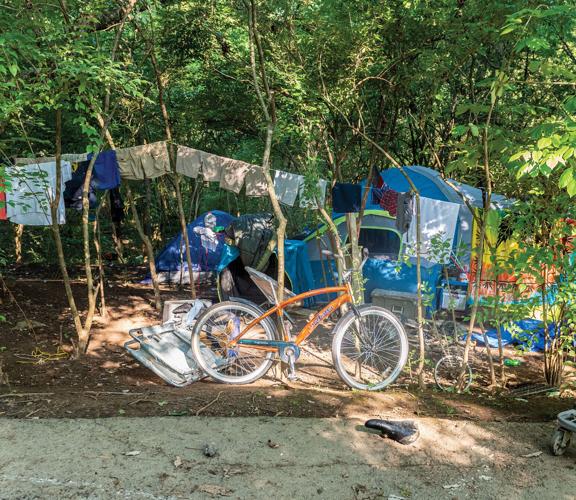


From the results of the point-in-time count to an update on the development of permanent supportive housing units, there was much to talk about Wednesday morning at the monthly meeting of the Continuum of Care Homelessness Planning Council. But the most pressing topic for the body, made up of service providers and other stakeholders in Nashville's homelessness community, may have been how local agencies and departments will respond to a state bill increasing the penalty for camping on public property.
The bill passed through the Tennessee legislature in April — gaining national attention when Frank Niceley (R-Strawberry Plains) referred to Hitler’s rumored period of homelessness, when voicing his support of the legislation — and would extend a law that makes camping on a state property a felony to other forms of public property. It would also make camping near or under state highway property a misdemeanor charge. (The charge would be preceded by warnings from law enforcement.)
After some discussion, a task force was assembled to explore what the local-level response to the law will be when it goes into effect on July 1. Members agreed that the Metro Homeless Impact Division will need to be in contact with city and state agencies, including law enforcement departments. Eventually, a task force was formed, headed by Vicky Batcher — a writer and vendor for local street paper The Contributor — and Jay Servais, the interim director of the Metro Homeless Impact Division.
District Attorney Glenn Funk has not issued a statement on whether he will enforce the bill, and Gov. Bill Lee did not sign the bill — though it will still go into effect.
The group also discussed a workshop regarding encampments that MHID staff, HPC members and others in the services community attended. Some potential strategies regarding encampments include prioritizing people who are both known to the city’s coordinated entry system and residing in a camp that's facing closure. That idea received some pushback, including concerns that it could encourage people to move to camps that will be closed in hopes that they'll receive faster service. The concerns echoed some of the complaints surrounding MHID's controversial program at the now-closed Jefferson Street Bridge camp, a focused housing effort that inspired complaints about proper procedure from HPC members.
Adding to the sense of urgency was an announcement that camps had been closed by the Tennessee Department of Transportation and rail-based transportation company CSX. April Calvin, assistant director of MHID, said she had learned of the closures on Monday and that she had reached out to the bodies involved, hoping to explain that MHID should be contacted prior to closures to help find housing and resources for people living at camps.
Beth Emmons, a spokesperson for TDOT, tells the Scene via email that no closures have taken place in recent weeks. Emmons says there was a cleanup near Nolensville and Harding Place, but “it was not a homeless camp but more of a party place where people would do drugs, drink alcohol, etc.”
India Pungarcher, a camp outreach worker for Open Table Nashville, pushes back on TDOT’s description of the place. She says that while some people do congregate at the cleared-out location, people also camped there and at other nearby sites.
The other site was near CSX tracks, close to the Restaurant Depot on Oldham Street. Claire Hennigan, another Open Table outreach worker, tells the Scene that a path to that encampment area had been closed off with debris piled up by construction vehicles, though some folks remain at nearby sites. On Friday afternoon, the Scene visited the site and saw the mound of debris Hennigan described. No tents were set up at the time. Hennigan says the people who would usually stay underneath the overpass have been relocated with Open Table's assistance.

Walled-off path near Oldham Street
When reached for comment, CSX provided the following statement:
At CSX, safety is our highest priority. Railroad property is privately owned and inherently dangerous. Being on railroad property without permission is criminal trespassing, which is not only illegal but can also lead to devastating consequences. In a continued effort to maintain a safe operating environment for our employees, CSX police began issuing trespass warnings starting in December of last year to individuals who were encamped on CSX property near an active rail line and the Cumberland River drawbridge. Advocacy groups visited the site to provide resources and individuals were given numerous opportunities to transition to safer living conditions prior to clearing the area last week.
In other news from the HPC, the results of the point-in-time count — the annual census of people experiencing homelessness — were shared, showing a small decrease in the number of Nashvillians experiencing homelessness. In 2022, 1,916 people were experiencing homelessness, down from 2,016 in 2020. No count was held in 2021 due to the COVID-19 pandemic.
Additionally, the groundbreaking of a long-awaited development containing 90 permanent supportive-housing units seems to be on track for this month. The groundbreaking date and corresponding ceremony haven’t been finalized but will likely be at the end of May. The permanent supportive housing development was originally planned to open back in 2021.



Post a comment as anonymous
Report
Watch this discussion.
(0) comments
Welcome to the discussion.
Log In
Welcome to the discussion.
Keep it clean. Please avoid obscene, vulgar, lewd, racist or otherwise abusive language. Comments featuring hate speech or threatening or violent content will not be tolerated.
PLEASE TURN OFF YOUR CAPS LOCK.
Be truthful. Don't knowingly lie or mislead.
Be proactive. Use the “report” link on any comment that violates our comment policy.
Share with us. We'd love to hear your feedback.