
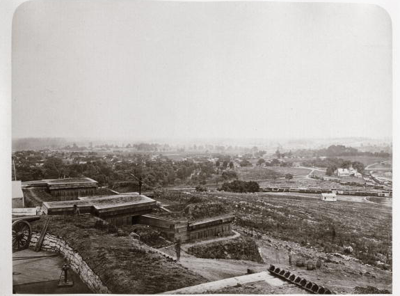
On Saturday, I went over to Community Day at Fort Negley, which was full of Abraham Lincolns and Uysses S. Grants, people hunting for fossils, grilled cheese and a demonstration of the Chew Crew during which the crowd was treated to a display of a man and his dog herding sheep. I was surprised to learn how many children assume everything on four legs is a “doggie.”
The potential impending development of Fort Negley was on the minds of many people, and the Friends of Fort Negley had a display showing their plan for the park, which involves returning the parking lots and stadium area to grass. As you can imagine, most people there were talking about the development of the park, and I was surprised and alarmed at how many people said they had “just heard” about it.
At one point, I kind of sarcastically said, “I can’t believe we have a state law that prevents you from moving a 50-year-old statue of Nathan Bedford Forrest, but we don’t have a law that protects an actual Civil War fort.”
But almost the second it was out of my mouth, I thought, “Wait, is that true?”
As you may recall, state legislators were outraged when Memphis was renaming its Confederate-honoring parks and trying to put Nathan Bedford Forrest back in the cemetery they pulled him out of in order to put him in the park they named after him and then renamed. So they passed the Tennessee Heritage Protection Act, which bars cities from altering war memorials. This is 4-1-412 in the state code, if you want to look it up yourself. (And, yes, I have been vehemently and vocally opposed to this state overreach, but if we have to have this stupid law, then it must apply equally to Confederate and Union things, right?)
So, the Tennessee Heritage Protection Act appears to me (though, of course, I am not a lawyer) to be directly applicable to this situation. Fort Negley is a Civil War fort. Fort Negley Park is the park that encompasses both the fort and the land on which the workers and Union soldiers lived and worked.
The Civil War is one of the historical conflicts specifically named in the act. And the statute defines a memorial as “any public real property or park, preserve, or reserve located on public property that has been named or dedicated in honor of any historic conflict, historic entity, historic event, historic figure, or historic organization.” Well, Fort Negley Park is a park located on public property that has been named in honor and dedicated to Fort Negley, which is in Fort Negley Park.
OK, so it seems that the whole of Fort Negley Park is exactly the kind of thing the Tennessee Heritage Protection Act is designed to protect — it’s a Civil War memorial. Not just the fort, but the whole park, since it has been named for Fort Negley.
So what can a city do to a park that is a war memorial? Not much. The law says, “Except as otherwise provided in this section, no memorial regarding a historic conflict, historic entity, historic event, historic figure, or historic organization that is, or is located on, public property, may be removed, renamed, relocated, altered, rededicated, or otherwise disturbed or altered.”
Putting up a neighborhood in the park seems to be a pretty clear case of disturbing and altering the park. It also seems clear that the law is written to prevent funny business. You can’t “un-park” the parts of Fort Negley Park that you want to develop as a way to get around this law. You can’t give the part you want to alter a new name to get it out from under the scope of this law.
There are a few things the city appears legally allowed to do to Fort Negley Park, according to the law — ”a public entity having responsibility for maintaining a memorial, or a nonprofit entity acting with permission of the public entity, shall have the authority to take proper and appropriate measures, and exercise proper and appropriate means, for the care, preservation, protection, repair, and restoration of the memorial.”
This is also pretty crucial, because it means the city is legally obligated to take care of Fort Negley Park. It also means the kinds of changes that can happen to the park are ones that preserve the park and restore it. So the Friends of Fort Negley’s plan to pull up old parking lots and knock down the stadium to return the park to something more historically accurate would probably be OK. Weirdly enough, it seems like it would probably be OK to refurbish the stadium and the parking lots, since they were in place when the law passed.
But put up a huge development on the park? That seems like a harder row to hoe.
The law does grant some exceptions. The city could petition for a waiver of this law. From the code: ”In order for a waiver to be granted, the public entity seeking the waiver shall demonstrate by clear and convincing evidence that a material or substantial need for a waiver based on historical or other compelling public interest exists; provided, that if a memorial is designated as a national historic landmark or listed on the National Register of Historic Places, there shall be a presumption in favor of preservation of the memorial.”
That “compelling public interest” part gives some wiggle room for the city. They might make a convincing argument that there’s a compelling public interest in this development, but Fort Negley is on the National Register of Historic Places. So that section of the law requires that the underlying assumption in any discussion of what to do on the property is that the ultimate goal is preserving Fort Negley Park. And again, not just the fort, but the whole park.
The other hurdle the city would have to clear to get its waiver is that it has to provide the names and addresses of “any private entities, groups, or individuals, including, but not limited to, descendants, that may have an interest in receiving notice of the petition.” So that would encompass the descendants of the Union soldiers who were stationed at Fort Negley, the descendants of the African-Americans who worked at Fort Negley, the descendants of the Works Progress Administration workers who restored the fort the first time, and anyone else — like, just for the fun of imagining the headache, the families of all the soldiers briefly buried at Fort Negley — who may be interested in what happens at the park. And then all those people would get to have their say.
That is, of course, if the law applies to Union memorials just as it does to Confederate memorials.
We know the state legislature is chock-full of men and women devoted to protecting our Civil War heritage, especially if that heritage comes on horseback, has a head of fantastic wavy hair, and swoon-worthy piercing eyes like Nathan Bedford Forrest. But when I asked around about which state legislators had come to Community Day at Fort Negley or had expressed any concern about the park, the only one people could remember hearing from was Brenda Gilmore.
Good for Brenda Gilmore, but where is Rep. Steve McDaniel, who’s a Civil War re-enactor and the author of this statute? Where’s Rep. Jeremy Faison and why isn't he crowing about the erasure of history now? Sen. Bill Ketron sponsored this bill. Is he too busy lately to check in and make sure it’s being applied fairly? Where are all the folks who have to publicly take to their fainting couches any time someone suggests it’s time to let old Nathan Bedford Forrest fade into history? I mean, if it takes some kind of Nathan Bedford Forrest connection to make people give a shit, people at the fort were afraid of Forrest. Shouldn’t that count for something?
And of course, the state loves to jump in and tell Nashville what it can do when it comes to all kinds of stuff — affordable housing, nondiscrimination initiatives, etc. So the silence when it comes to protecting this park is really noticeable. And it might lead one to wonder what’s different about Fort Negley? Why is it less worthy of protection than Forrest Hall?



Post a comment as anonymous
Report
Watch this discussion.
(0) comments
Welcome to the discussion.
Log In
Welcome to the discussion.
Keep it clean. Please avoid obscene, vulgar, lewd, racist or otherwise abusive language. Comments featuring hate speech or threatening or violent content will not be tolerated.
PLEASE TURN OFF YOUR CAPS LOCK.
Be truthful. Don't knowingly lie or mislead.
Be proactive. Use the “report” link on any comment that violates our comment policy.
Share with us. We'd love to hear your feedback.