


With 15 candidates seeking the five at-large seats on the Metro Council in the August election, it may be challenging for aspirants to stand out in the crowded field.
We spoke with most of them and will publish edited, condensed transcripts of those conversations in the days to come.
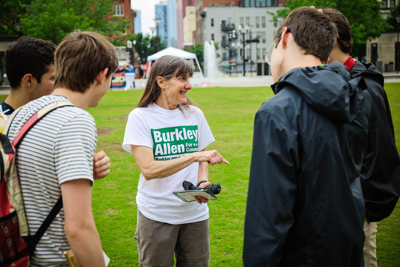
First up is Burkley Allen, currently finishing her second term as the Metro Council member for District 18, which includes parts of Green Hills and Midtown. A mechanical engineer by trade, she has a long history of community work with the Hillsboro-West End Neighborhood Association and other groups. She moved to Nashville in 1982 following graduate school.
How do you stand out in a field of more than a dozen candidates?
My eight years of experience on the council is a useful thing in terms of already having lots of good relationships and knowing the ropes. I've served a very active and engaged district for eight years and have served on the Planning Commission, as chair of the Planning Committee and on the Budget and Finance committee, and I think that's useful experience to hang on to.
How do you communicate with the entire county as compared to a single district?
The biggest difference is going to be the diversity of ideas. I've been very consistent about having a monthly newsletter that I send out. I intend to grow my email list so I'll be able to continue to do that. I've had quarterly office hours, which I'll have to travel to do. That will have to become roving office hours.
What sort of issues have voters been talking about the most?
The ones that always jump to the forefront are transportation, traffic. ... Congestion is a big problem, and how do we figure out what the mass transit solution is that can help forestall that becoming worse? Interestingly, a different part of the spectrum is the whole economic equity and housing affordability question — how this growth that Nashville is seeing can be good for everybody, and trying to figure out how those jobs can go to the folks that are already here.
What do you tell people should be done on those issues?
I break it down into three things. Long term, we need to make sure that our schools are preparing our students to be those future employees. Education is another one of the issues that comes up, so that fits in with that, and that we need to continue to develop our workforce development program. There's some other cities that have some great models for apprenticeship programs and partnerships between businesses and community colleges. … To make sure that we're preparing people to be that future workforce, that we’re giving them the skills they need to be hired by the new companies that are coming here.
We can't put a gate up and tell people not to come. Figuring out how to thoughtfully deal with the growth in terms of if we do incentivize companies, and because Nashville is so popular, most of them are coming without incentives. I think people lose that information in the process. Most people look at Nashville — a good place to be a vibrant economy that's well-diversified — and there are a lot of reasons to come. Trying to be thoughtful about how we increase the housing stock for everyone who's coming, not just the CEOs, but service workers and everyone down the line, is something the city has been looking for solutions and floating different types of possibilities.
We've made a commitment to put a large amount of capital into that, just making sure that money is leveraged well and that the public-private partnerships that we're going to need actually develop so that it’s not just the city trying to build that ... trying to create the right kind of conditions where the for-profit builders can also help build houses for that market.
When and how should voters consider another transit referendum following last year’s failed vote?
I think we need to go back and revisit the community engagement piece. The MTA process worked really hard to try to reach everyone, but there's nothing that gets everybody’s attention like putting something out there officially. A whole lot more people began to pay attention once we had put a plan together, and everybody’s got opinions. We need to back up a little bit and get all the people that said “we support transit, just not exactly this plan” to help buy into whatever larger plan we come up with, and then try to think through: Do we need to do this incrementally, to think up what the big plan is and then to attack one particular corridor and let folks see a success and discover that something like the Music City Star in another direction could be a big part of the solution? Or, if we have to continue to use — rather than a fixed route — rubber tires on some type of dedicated route, just to allow people to see it work somewhere makes it easier to grow it? That seems like a more incremental process that I hope could be successful.
Do you support Bob Mendes’ proposed property tax increase?
I am absolutely going to evaluate that possibility. I'm still gathering data on that one. One of the biggest topics that I'm hearing after transit and quality of life is schools, and making sure that they are providing our students with a great education. The biggest problem people say is discouragement among the teachers, which may be related to a number of things, but certainly teacher salary for the experienced teachers is part of that, as well as some other budget challenges we're having in regard to MTA. As the budget discussions continue, I'm going to be looking at what solutions are put out there. That's not one that I discount. I think it has to be considered carefully.
What did you make of the mayor’s parking privatization plan?
In terms of the modernization piece of it, I think there's no question that we need to modernize our parking system, and that is what initially drove this whole process. In looking at what most other cities are doing to modernize, it actually seemed to be the most common method: to hire the companies that have figured out how to do it and are adept at buying the equipment that it takes to do that process. I think that it's smart that we backed off, because it seems to me that there's an awful lot of misinformation that's feeding the opposition. It's a more useful conversation if everybody gets the information first and then we talk about whether that's the best plan for Nashville. Whatever happens, we absolutely need to modernize the system that we've got, because relying on quarters to feed a meter when there are better ways to do it is not serving the city well. It’s not providing the turnover the businesses need, and it’s not making it easier for people to find a parking space.
How does representing District 18 translate to a countywide constituency?
It's certainly been an engaged and active neighborhood that doesn't sit back and let problems just sit there. They identify problems and identify solutions. We've had a great track record of working in partnership to put the Metro resources together to work on that. The two neighborhoods in my district are two of the oldest in the city, so it's been exciting to watch other neighborhoods learn to emulate that model through some great resources out of the mayor's office as well as the Neighborhoods Resource Center. There are a lot more neighborhood associations around the city to work with and I'm enjoying getting to know as many of them as I can in this process. Coming from a very active, engaged neighborhood has shown me how the process ought to work, and I believe some neighborhoods are getting to that point. Being able to work with the district council members to help get those neighborhoods empowered and engaged is part of what I'll enjoy doing.
Anything else voters should know?
I'm known for being methodical and hard-working and listening to all sides and intend to continue to use that methodology on citywide issues.



