
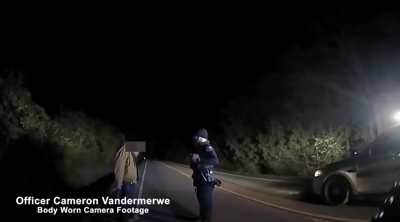

On Saturday night, a Metro Nashville Police Department officer shot and killed 64-year-old Drandon Brown. During a 71-second interaction that can be seen in this clip (the footage is graphic, discretion advised), Brown charged at an officer with a knife after a failed taser attempt.
It was the second officer shooting of the day, after police killed an armed man who shot at them during a crime scene investigation.
Local homeless advocacy nonprofit Open Table Nashville believes that when it comes to the shooting involving Brown, who was unhoused and experienced mental illness, things could have gone differently. And according to statements the Scene received from Metro officials, the dispatched response might have also been different, if not for a scheduling issue.
Brown, also known as “Chief,” was a longtime resident of nearby homeless encampment Brookmeade Park according to a statement from Open Table. The statement mentions that Brown had a dog named Daisy, and helped keep a garden for the encampment. The officer who interacted with Brown “immediately began to escalate the situation through his words, tone and actions,” Open Table asserts.
“Among those who knew him, it was no secret that Chief struggled with mental health issues,” the statement says. “Instead of meeting Chief with respect, care, or patience; instead of trying to understand how stressful the cold, the housing crisis, and daily survival are for people who are unhoused; the lead officer treated Chief like a threat to be neutralized.”
Officers were initially dispatched to the scene after receiving 911 calls describing Brown throwing tree branches at cars. It was classified as a “suspicious person” incident type, the Metro Department of Emergency Communications confirms. That call classification could have qualified it for a Partners in Care response, a program in which a police officer and a mental health clinician from Mental Health Cooperative respond instead of a traditional police response. Partners in Care is now a part of four of the city’s eight precincts, and while that doesn’t include the West Precinct where the shooting took place, the precinct’s sergeant has the authority to request the unit from another area.
MNPD spokesperson Kris Mumford says Partners in Care only operates Monday through Friday due to staffing shortages on the Mental Health Coop side. (Mental Health Coop did not respond to a request for comment in time for publication.)
Open Table called for the city to invest in affordable housing, mental and physical health care and non-police response options, and also recounted other police shootings in recent years — Jacob Griffin, who was also unhoused, and Landon Eastep, who was unstably housed.



Post a comment as anonymous
Report
Watch this discussion.
(0) comments
Welcome to the discussion.
Log In
Welcome to the discussion.
Keep it clean. Please avoid obscene, vulgar, lewd, racist or otherwise abusive language. Comments featuring hate speech or threatening or violent content will not be tolerated.
PLEASE TURN OFF YOUR CAPS LOCK.
Be truthful. Don't knowingly lie or mislead.
Be proactive. Use the “report” link on any comment that violates our comment policy.
Share with us. We'd love to hear your feedback.