
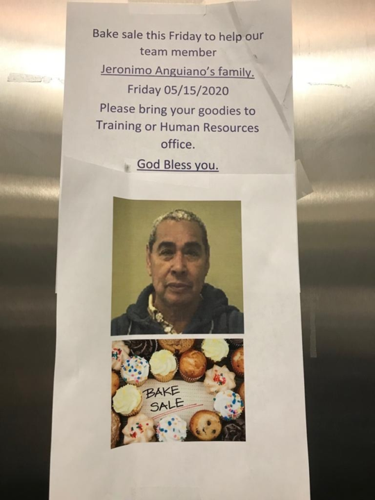
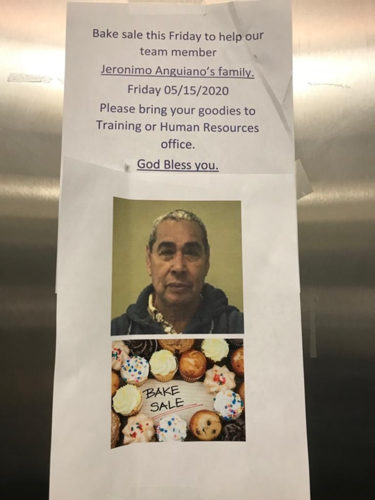


Jeronimo Anguiano had two families in Nashville: his church family, and his work family.
The immigrant from Mexico, who died last month after a bout with COVID-19, had no actual family members in Nashville. His wife, whom he saw at least once a year, lived in Mexico.
Instead, he had the Iglesia Lirio de los Valles and his co-workers at the Tyson Foods plant in Goodlettsville.
Every morning, he told his colleagues, “God bless you,” recalls one, also an immigrant from Latin America who asked to remain anonymous. Though they were friends, she called Anguiano — who was 75 years old — Don Jeronimo as a sign of respect.
After Anguiano died, some of his co-workers brought in candy and baked goods to sell, with the proceeds going to his wife. She arrived in town shortly after his death, says Axel Soto, who was Anguiano’s pastor. Soto took Anguiano’s widow to the Tyson facility to retrieve the funds raised by the man’s co-workers, the pastor says.
“The people told us that Jeronimo was like an angel to them,” Soto says.
That description was not a surprise to Soto, who knew Anguiano as a member of the Dickerson Pike church for more than 20 years.
“He did so many good things for us that it’s going to be very hard to forget him,” Soto says. “He was a special support to us and our family.”
Because they couldn’t hold a traditional funeral for Anguiano, the church is commemorating him by putting up photos and singing songs he liked during services.
Anguiano was one of more than 300 workers at the Tyson facility in Goodlettsville who have so contracted COVID-19. He is also one of two workers from the facility who have died, a fact so far not reported publicly by either the company or health officials.
“We are saddened by the loss of any Tyson team member and sympathize with the family at this difficult time,” says Worth Sparkman, a spokesperson for Tyson. “We can confirm that two of our team have passed away. Our top priority is the health and safety of our team members, and we have put in place a host of protective steps at our facilities that meet or exceed CDC and OSHA guidance for preventing COVID-19.”
Those steps include staggered shift changes to reduce the number of people in the building, plastic barriers, symptom screening, face masks and more. Metro Director of Health Michael Caldwell was among the city, state and federal officials who visited the Tyson facility on April 22. He said the company — which has annual sales of more than $40 billion — and health authorities have had a “great partnership” since an early spike in cases drew concern. More than 7,000 Tyson workers have contracted the disease nationwide, according to a Washington Post analysis, and the Midwest Center for Investigative Reporting has identified more than 70 deaths in the U.S. meatpacking industry.
Now, Caldwell says, he’s more worried about Tyson employees catching the disease outside of work, in their homes or communities. Cases at the Goodlettsville plant “have precipitously dropped off,” according to Caldwell.
“I believe that there probably was a risk in March for spread of COVID in this facility,” he says. “Even though somebody may work at Tyson, they can still be exposed in the community. Just because they work there doesn’t mean they got it there.”
Despite the precautions taken at Tyson, which the woman who worked with Anguiano acknowledged, she remains afraid.
“It’s very worrisome, especially knowing that somebody's died as a result, so I have a lot more fear,” she says.
Tyson workers aren’t the only links of the food supply chain worried about the coronavirus. At Hobson Food Service in East Nashville, an employee who asked to remain anonymous said the company has not done enough to protect its workforce. There, too, the workforce is mostly immigrants.
“The work is already risky because you work so much with knives and sharp objects,” the worker says. “But with COVID on top of that, there’s nothing to keep you safe from catching the virus. I want the people I work with to be able to work in safe conditions. I can't imagine how bad it is at some of the larger companies like Tyson, and how they're able to find the workers they need to meet the demand.”
According to the worker, the company has reduced the number of employees on the floor at any given time, but he says it remains impossible to maintain physical distance due to the nature of the work, and having fewer people on the floor makes the job even more difficult. Additionally, the worker said, the company issued each employee just one face mask and has not instituted a vigorous cleaning regimen. Company officials did not respond to a request for comment about precautions at the facility, which processes and distributes meat to local restaurants, and the worker said he was not aware of anyone from the facility contracting the coronavirus.
The COVID-19 pandemic’s Nashville iteration has been in part driven by cases in the city’s immigrant community, where workers in essential roles such as meatpacking cannot work from home, and where institutional and cultural differences like multigenerational households further complicate preventing spread of the disease. The city’s heat map continues to show an outsized number of COVID-19 cases in the area surrounding Antioch, which is home to a disproportionate number of immigrants. Though just 10 percent of the county’s population identifies as Hispanic or Latino, nearly 30 percent of the county’s COVID-19 cases have come from that community, according to the latest data.
Immigrant advocates argue that Caldwell’s decision to share coronavirus patient information with local law enforcement, even after Gov. Bill Lee opted to stop the practice statewide, has exacerbated case growth in the immigrant community because some residents are wary of the practice. Caldwell maintains it’s necessary to protect law enforcement and other first responders.
With the Tennessee General Assembly back in Nashville this month, Republican leaders are working with industry groups to craft coronavirus-specific liability protections for businesses. Supporters argue the exemptions are necessary in order to insulate already-wobbly employers from a deluge of litigation from workers or customers claiming to have caught COVID-19 in businesses.
Though the legislation is expected to include exceptions for “gross negligence,” labor advocates and others worry that reducing liability will further harm essential workers like those at Tyson. TIRRC Votes, the campaign arm of the Tennessee Immigrant and Refugee Rights Coalition, is pushing in the opposite direction: for more workplace safety regulations. The organization is issuing policy recommendations calling on state and local governments to issue workplace regulations that health departments and other agencies have the authority to enforce.
“Thousands of Tennesseans, including many immigrants, have been going to work throughout this pandemic to keep us healthy, safe and fed — where workplace conditions have exposed them to COVID,” says Stephanie Teatro, co-director of TIRRC Votes. “Despite the way workplace outbreaks have contributed to the spread of COVID in our communities, our local, state and federal governments have not implemented any enforceable regulations to protect workers and our communities. In fact, as our cities and states ‘reopen’ their economies, more Tennesseans are being forced to go back to work without assurances they’ll be able to stay safe.”
Anguiano reportedly loved his job and the people he worked with, but it was not always smooth sailing at Tyson. A decade ago, he signed on to a lawsuit with hundreds of co-workers claiming wage theft by the company. The case was ultimately settled with the employees for more than $7 million.
Charles Yezbak, the Nashville attorney who represented Anguiano and the others in the case, was not surprised that Tyson saw coronavirus outbreaks.
“I’ve encountered a lot of employers over 23 years of representing employees,” Yezbak says. “In my opinion, Tyson is one of the worst employers that I’ve encountered. I don’t think they care about their people at all.”



