
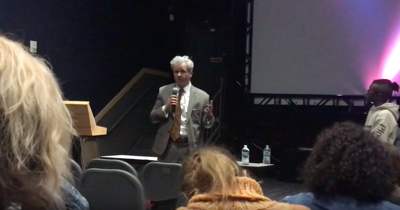

Students at Watkins College of Art, Design and Film met with Belmont University provost Thomas Burns on Wednesday to discuss this week’s announcement that Watkins will begin to transition its operations to Belmont’s campus following the completion of this academic year. Watkins President J. Kline also attended. Among the students’ concerns were faculty requirements, the cost of tuition and room and board, protections from discrimination for LGBTQ students, and the job status of current Watkins faculty.
At the town hall meeting, Watkins students and their representatives asked questions and made requests of the provost for approximately 90 minutes. Some students also called for Kline’s removal as president of the school.
A video of the entire meeting that was posted on YouTube (watch the full thing below) shows Kline seeming to hold back tears as he introduces Burns, saying that moving forward he and the faculty and staff will continue to meet with students on a regular basis to ensure that students “do OK — ’cause that’s all we care about.”
Director of student life Jerrica Mayo began questions she had compiled from students, asking first what policies Belmont has in place to protect LGBTQ students, especial transgender students. Burns replies: “Belmont University’s nondiscrimination policy states that we will not discriminate on the basis of sexual orientation. … Everybody — everybody — is absolutely welcome at Belmont University.” Burns says that he helped the student LGBTQ organization Bridge Builders to become an organization 10 years ago. “We do have trans students on campus who live in residence halls and are well-served,” Burns continues. “So it doesn’t matter to Belmont what sexual orientation, what gender identity you have, we will support you and love you and serve you, and you are welcome.”
In 2010, Belmont made national news when women’s soccer coach Lisa Howe announced to her team that she was a lesbian and would be having a child with her partner, a former assistant coach. According to one student on the team, a parent of another student complained, and Howe was told that if she did not resign, she would be fired. The New York Times reported that according to the team captain, the university’s athletic director Mike Strickland said that “the baby ‘was going to be a problem’ and would conflict with the university’s ‘don’t ask, don’t tell’ approach.”
Still speaking on behalf of students, Mayo asked if Watkins students will be required to take two religious courses, which are general education requirements at Belmont. Burns said that it will depend on the earned credit hours that a student has when the schools merge.
“We are a Christian institution,” says Burns. “We are not about indoctrination. We are not there to convert you. We are Christian. All of our faculty and staff are Christian. So we practice Christian hospitality. We love everybody. We serve everybody regardless of their beliefs. And our religion classes are not about indoctrination. They’re about the academic study of religion. I don’t want you to come in and say, ‘I have to take first-year religion, they’re going to try to convert me to be a Christian,’ That might be the outcome. I don’t know. Maybe that’s happened, but it is not the intent. The intent is to make you familiar with the work of literature that is the Bible and the implications that that has.”
According to the Belmont course catalog, students are required to take one course on Christianity. In addition, they have the option to pursue a handful of other courses about Christianity as well as courses called Spirituality in World Religions and Ethics in World Religions.
When asked whether non-Christian Watkins faculty will be hired, Burns says: “We do not hire people who are not Christian. So the ones who are not Christian will not be eligible to work at Belmont. That’s just part of who we are.” When asked whether current Watkins faculty members will receive severance pay, Burns replied that he does not know.
According to Burns, Watkins students will continue to pay Watkins tuition, and students will continue to receive the same financial aid and scholarships after the merger. Burns says that Watkins students will incur “no added burden” and “no added cost.”
One student raised the issue of censorship, asking Burns if Watkins students will have academic freedom. “We do work with our faculty and our students to talk about appropriate presentations,” says Burns. “As far as I know, we have never been accused of censoring our student work or our faculty work. We do engage in conversation about how we might modify language in productions or plays, for example, to make them appropriate for audiences. We do have children who come to plays, and we want to make sure they’re well-served as well as parents.”
In 2018, two weeks before the theater department was to stage a production of a play called The Wolves, Belmont officials requested that the play’s script be altered to omit the words “goddamn” and “fuck.” But production companies, including universities, can’t make such a change without the express written permission of the playwright. Rather than cancel the play, faculty member and the director of the play Jaclynn Jutting decided to take the production off campus, and the students performed it at Actors Bridge Studio, a longtime partner of the university. Jutting — who was on track for tenure — was told she would not be asked back the following semester, and Belmont ended its 23-year relationship with Actors Bridge Ensemble.
Several students made requests of Belmont at the town hall meeting. One student, who said he was speaking for a collection of students, suggested that Kline should not be allowed a position at Belmont. “As president, [Kline] was meant to oversee the financial future of our school,” says that student. “Our school is closing — it is merging. Not good. He was to raise funds from donors, grants and foundations and decide the budget. He failed in his role, and it is his failure that has led to this closure.”
Kline goes on to address concerns about his role in the merger. “The decision to make this move came after a couple months of consideration by the board of trustees,” says Kline. “I was only aware of this possible option in the relatively near past.” When pressed, Kline says that he learned of the merger in early fall. “As you may have known,” Kline continues, “I spent the last year going around through the Nashville community with corporations, former donors, politicians doing everything I could to generate the funding that was required to keep the school intact as it was. Watkins’ main challenge was never in what we do or how we execute our programs, but that we were never able to raise an endowment. … There was no will on the part of the trustees to commit to raising an endowment.”
According to Kline, the board of trustees hired a consulting firm to conduct a review of the college and compared it to national trends. The firm concluded, according to Kline, that the college was well-managed but “terribly understaffed,” putting a strain on faculty and staff. The firm recommended that the college create an endowment that would “spin off revenue to provide more scholarships to students,” says Kline, which would solve the college’s “enrollment problem.” Kline says that the board of trustees determined that a merger would be in the best interest of the institution.
Watch a video of the meeting below.
Text notes from the meeting are here:
https://docs.google.com/document/d/1Ol_WqdJpT04aMFq80v4si6Yku6soqodeo-Heo_XExfw
Update, 2/2/20: The New York Times now reports: "Facing a backlash and the potential exodus of faculty, J. Kline, the president of Watkins, sent an email to employees on Saturday announcing an abrupt shift in policy. Mr. Kline wrote that non-Christian faculty and staff members would, in fact, be considered for employment at Belmont."



