
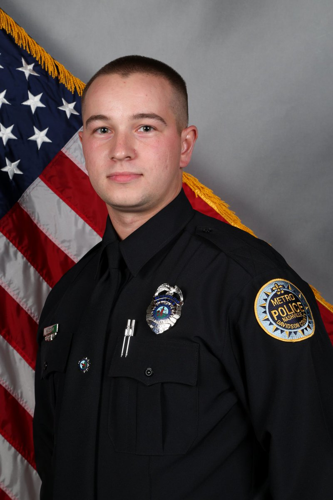
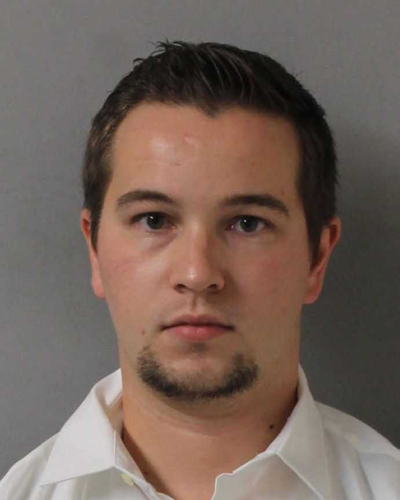


Officer Andrew Delke
The white Nashville police officer who shot and killed a black man fleeing a traffic stop in July has been charged with criminal homicide.
Davidson County District Attorney Glenn Funk filed the charges against Metro Officer Andrew Delke Thursday following the Tennessee Bureau of Investigation's inquiry into the shooting. After a night court magistrate denied the request earlier this morning, General Sessions Judge Michael Mondelli signed off on a warrant for Delke's arrest, saying he found probable cause to charge him in the shooting death of Daniel Hambrick.
A video of the incident shows Delke firing on Hambrick as he runs away. Hambrick was struck twice in the back and once in the back of the head. Immediately following the shooting, the Metro Nashville Police Department tweeted a photo of a handgun they said Hambrick was carrying. Delke subsequently told investigators that he saw the weapon in Hambrick's hand during the foot chase.
In a statement released to media after the charges were filed, Funk highlighted the fact that he had not brought the matter to a grand jury, thereby allowing the case to be more open to the public.
"This morning I requested a warrant charging officer Andrew Delke with criminal homicide," Funk said in the written statement. "The decision to institute charges by warrant as opposed to presenting the matter directly to a Grand Jury allows this case to be presented in open court in as transparent a manner as possible, because Grand Jury proceedings are secret and not open to the public. As this is a pending criminal case, I will have no further extrajudicial comments."
Mayor David Briley called the charges "a necessary step toward" justice for Hambrick.
"In August, I spoke with Daniel Hambrick’s mother to express my condolences for her loss," Briley said. "I assured her that we would show respect for the life of her son, because his life mattered. At that time, Ms. Hambrick asked for justice for Daniel. The District Attorney’s decision to file charges in this case is a necessary step toward that end.
"I don’t control what happens in individual criminal cases, but I will continue to work toward creating a fair, open and transparent criminal justice system," Briley continued. "This does not mean that every time an officer is charged with a crime or accused of misconduct, the officer will be found guilty. Metro-Nashville Police Officers put their lives on the line every day. It is an incredibly difficult job. I fully support our Police. However, officers will be required to account for their actions when they have been accused of misconduct. Put simply, we must have laws that are fairly, equally and transparently applied."
The development comes a little more than a month ahead of a citywide referendum on whether to create a community oversight board for the Metro police department. That effort was kicked off in large part by the police shooting of Jocques Clemmons in February 2017. Funk did not press charges against the officer in that case.
The MNPD released a written statement from Chief Steve Anderson Thursday afternoon:
The July 26th death of Daniel Hambrick was a tragedy. I have publicly expressed my condolences to his mother. Certainly, no parent should have to grieve the loss of a son or daughter.The events of July 26th have also forever impacted Officer Andrew Delke and his family. Our community and this police department have been lastingly affected as well.
It is not proper for me at this time to discuss the events of July 26th. The Metropolitan Nashville Police Department has deferred to the District Attorney and the TBI all aspects of this investigation. Therefore, this department’s administrative investigation into the fatal shooting of Daniel Hambrick is open but on hold. As we learn more, the administrative investigation will proceed.
Because of today’s action, Officer Delke, who has been working a desk job, has, by protocol, been decommissioned.
I have long had great respect for, and confidence in, the justice system in Davidson County and the State of Tennessee. That respect and confidence remains. It has been my experience that as the justice process proceeds, all of the facts and circumstances concerning an investigation will become known.
Community Oversight Now, the coalition advocating for civilian oversight of the police, also released a statement on the charges against Delke, which reads in part:
While the news is encouraging in regards to this decision, Community Oversight Now reinstates its insistence there be independent oversight of policing in Nashville. There has long been a call for more transparency in the investigations, training and misconduct of Nashville police officers. There has been a tone-deaf response by all departments of local government involved regarding police actions. The video footage of Delke’s execution of Hambrick was horrifying. Shooting a man in the back who is unarmed and in the process of running away from an officer is entirely unacceptable.The February 10, 2017 shooting of Jocques Clemmons reignited a call for independent oversight of policing when Officer Joshua Lippert fired three shots into the back of Mr. Clemmons as he ran from a traffic stop. This came on the heels of eight disciplinaries that found Lippert had been written up for overly aggressive responses to citizens when detaining them. In the case of Andrew Delke there are equally egregious documented violations where he went well beyond any reasonable response when seeking to detain persons.
In a written statement, Delke's attorneys David Raybin and John M.L. Brown emphasized that the affidavit released as part of the arrest warrant contained new information, including that Hambrick "was holding his gun before he was shot" and that Delke "gave Mr. Hambrick repeated verbal commands to stop and drop his weapon."
"Tennessee law permits a police officer to use deadly force when there is a danger to others," the attorneys said. "The police department rules and regulations require an officer to act even when there is personal risk. Officer Delke was following the law and his training. Most people run from danger. Police officers run towards danger. Officer Delke was protecting himself, his backup officers and the public."



Post a comment as anonymous
Report
Watch this discussion.
(0) comments
Welcome to the discussion.
Log In
Welcome to the discussion.
Keep it clean. Please avoid obscene, vulgar, lewd, racist or otherwise abusive language. Comments featuring hate speech or threatening or violent content will not be tolerated.
PLEASE TURN OFF YOUR CAPS LOCK.
Be truthful. Don't knowingly lie or mislead.
Be proactive. Use the “report” link on any comment that violates our comment policy.
Share with us. We'd love to hear your feedback.