
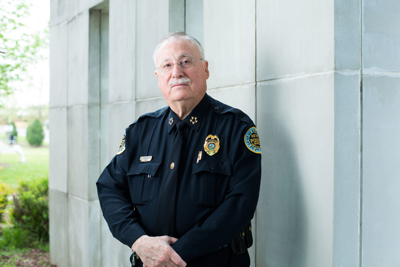


Metro Police Chief Steve Anderson
In the Aug. 10 edition the Metro Nashville Police Department’s employee newsletter, Chief Steve Anderson wrote, “the past couple of weeks have been tough for our department.”
He went on (emphasis his):
As we await the findings of the District Attorney’s investigation into the July 26th officer-involved shooting, in which the [Tennessee Bureau of Investigation] is assisting, I want all of you remember this: citizens across Nashville support you and the work that this police department is doing. I am hearing this through messages left at my office and from persons I encounter on the street. I expect many of you are hearing the same. Do not let criticism from anyone dissuade you from continuing to work smartly and closely with your neighborhoods and communities. As a Vanderbilt poll reminded us, 84 % of Nashvillians approve of the work this police department does. Thank you for your commitment to public service in this great city. I and the vast majority of the public deeply appreciate your dedication and sacrifices.
The defensive posture and apparent lack of reflection in the chief’s remarks caught the attention of at least one Metro official, who shared the newsletter with the Scene. And whatever messages are being left at Anderson’s office, a different sentiment is being expressed outside the MNPD’s walls.
In the wake of the July 26 police shooting death of Daniel Hambrick — the second black man to be shot and killed by a white Nashville police officer while fleeing a traffic stop in 18 months — some prominent community groups and Metro Council members are calling for Anderson to go. Asked by the Scene where they stood on the chief and whether they too thought it was time for a change at the MNPD, several Metro Council members representing districts across the city bluntly say yes.
“That would be my preference,” At-Large Councilmember Bob Mendes tells the Scene. “I would prefer that we transition to new leadership in the police department.
The chief, who has led the MNPD since 2010, has been defiant in the face of those calls, increasing the pressure on Mayor David Briley — the only person who can fire Anderson.
In a written statement to the Scene, through a spokesperson, the mayor stood by Anderson, who has been a Nashville cop for more than 40 years.
“The Chief has expressed his willingness to help improve policing strategies and the culture of policing,” says Briley. “I have his commitment to see this through and I intend to hold him accountable to that.”
But the calls for Anderson’s ouster are louder now than they have been at any time in his tenure, the culmination of several years of public tension between the MNPD’s leadership and Nashville’s African-American community. (Or, at least, tension that has become more visible to the rest of the city.) And these calls come just months ahead of a public referendum on the creation of a community oversight board which he has strongly opposed.
Vice Mayoral candidate Sheri Weiner was the first elected official to call on Anderson to resign following the release of surveillance video that appeared to show Officer Andrew Delke shooting Hambrick in the back multiple times as Hambrick ran away. After standing with Briley at a press conference ahead of the video’s release, North Nashville state Rep. Harold Love expressed disappointment at the mayor’s response to what the footage showed.
“It is time for the Mayor’s office to take a top-down approach within MNPD to acknowledging, addressing, and acting on brutality, discrimination, and unlawful deaths,” Love said in the written statement. “MNPD leadership must be re-evaluated and much-needed changes have to be made.”
That call was amplified when the prominent coalition of activist, community and faith groups Nashville Organized for Action and Hope (NOAH) demanded that the mayor “immediately terminate” Anderson, who they said had “fundamentally failed the community.” Their indictment of the chief cited, among other things: the findings of the 2016 Driving While Black report, which showed significant racial disparities in traffic stops and searches, and Anderson’s defense of MNPD practices in the face of it; his handling of the 2017 police shooting of Jocques Clemmons, including MNPD’s internal investigation, in which Davidson County District Attorney Glenn Funk found evidence of bias; and allegations that Anderson has stood in the way of progress on the deployment of body and dashboard cameras.
“In the wake of the homicide of Mr. Hambrick, Chief Anderson has lost the public trust,” NOAH said.
When NOAH representatives held a press conference on the courthouse steps outlining their demands, At-Large Metro Councilmember Erica Gilmore and her mother, state Rep. Brenda Gilmore, were on the steps with them.
They are not alone among Nashville elected officials.
“If the chief isn’t willing or doesn’t have the capacity to be more sensitive to the policing practices, particularly in the black community, then as a city we need to begin looking for his replacement,” Antioch-area Councilmember Tanaka Vercher says. “It’s just too serious for us to continue policing the way we’ve been policing. We know it doesn’t work. We know it cost lives.”
It’s the city’s shame, Vercher says, that leadership in the MNPD and in Metro generally did not learn from the 2017 death of Jocques Clemmons, who was also shot as he attempted to flee a traffic stop.
“The shame is that here we are again, with another officer-involved shooting, with another death of a black man in the community,” Vercher says. “We haven’t learned.”
Bellevue-area Councilmeber Dave Rosenberg also suggests it’s time for Anderson to go.
"We need MNPD leadership that has the confidence of both the rank-and-file and concerned communities,” Rosenberg says. “I don’t know that he has either.”
In an email to the Scene, MNPD spokesperson Don Aaron reiterated that the chief is unmoved.
“Chief Anderson is not retiring in response to criticism from NOAH and others,” Aaron says. “Chief Anderson is just as committed today to the stable, thoughtful leadership of the MNPD as he has been since becoming chief in 2010.”
Aaron also quibbled with several of NOAH’s specific criticisms, such as their reference to Anderson’s response to the Driving While Black report, in which the chief claimed “that the authors were morally disingenuous.” Finely parsing the chief’s words, Aaron claimed to the Scene that the chief had not been calling the authors “morally disingenuous,” but rather saying it would be “morally disingenuous” to use their data as proof of racial profiling without accounting for the fact that the department deploys more officers in areas where there are more crimes and thus more victims of crime. (That seems mostly like a distinction without a difference, as the chief seemed to suggest that’s what the people behind the report were guilty of doing. But you can read Anderson’s response to the report for yourself here.)
Aaron also said that NOAH and others are wrong about the department’s traffic-stop policies.
“There is no policy, formal or informal, requiring traffic stops or citations,” Aaron says. “In fact, traffic stops are down 21 percent since 2010, and in 2017, 74.5 percent of all stops resulted in a warning only.”
Still, Anderson’s response to the Driving While Black report stands out to some as evidence of his unwillingness to reflect seriously on the department’s policies and whether they need to change.
Councilmember Freddie O’Connell — whose district includes the part of North Nashville where the Hambrick shooting occurred — cites Anderson’s reaction to the report, along with the department’s handling of the Clemmons shooting, as reasons his confidence in the department’s leadership has declined since he took office in 2015. He says he wants to see what the TBI and the DA’s office decide about the Hambrick shooting before rendering a judgment on Anderson and the department. But he does note that, contrary to the 84 percent approval rating Anderson regularly cites from the Vanderbilt poll, surveys in marginalized communities paint a much different picture.
“I need the department to be able to understand that, process that and figure out how to work toward a better system of engaging that community,” O’Connell says.
In particular, the community he refers to is that of the Napier Place and Sudekum Apartments, which are also in his district. A recent survey conducted by the Metro Development and Housing Agency as part of the Envision Napier and Sudekum process included a question about residents’ feelings about the police. The number of residents who expressed confidence in the department, O’Connell says, was just 20 percent.



