
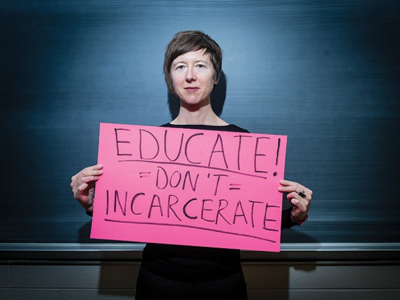


For this year's People Issue, I
sat down with Dr. Lisa Guenther, a Vanderbilt professor who attracted the attention of mostly conservative media last year for a course she's currently teaching called Police Violence and Mass Incarceration. Here's more from our conversation, including some discussion of local policing and another People Issue subject, Metro Police Chief Steve Anderson.
How did you get interested in these subjects? Prison, law enforcement, incarceration. They’re sort of having a moment now, we’re all thinking about them, but you’ve been working on it for a while.
I guess the key moment was when Angela Davis came in 2008. She spent a month in our department doing an intensive graduate seminar on slavery. And she started with the Thirteenth Amendment, which abolishes slavery except for those who have been duly convicted of a crime. And I was just like whaaat? Slavery has not been completely abolished in the U.S. That blew my mind.
And I had just moved here a year before that in 2007. I moved here from New Zealand but I grew up in Canada. I did my PhD in Toronto. Even just moving to the U.S. I noticed right away the racial and class segregation, much more extreme inequality than any other place I had lived. And Angela Davis’ critique of the prison industrial complex just helped to make sense of that. The legacies, the sort of unprocessed legacies of slavery.
So it was back in 2008 that I started reading about the prison system, and at that point it was kind of at its peak in terms of the prison population in the U.S. It had reached its highest level ever, 2.2 million at that point. So I just started to think about prisons as a way of understanding where I was here in Nashville.
What was it like to be noticed by Fox News, The Daily Caller, all these places for the course you’re teaching now?
That actually did come as a surprise because I’ve been teaching courses on mass incarceration for a number of years, and I teach them, usually, either as a section in a course on social philosophy, maybe — this contemporary philosophy class that I teach, I do a different topic every year. So, one year it was biopolitics, and we looked at slavery, mass incarceration, and torture. These are not uncontroversial issues. It was the word ‘police’ against the word ‘violence’ in this moment that just really set people off.
It was...annoying? But interesting, too. Because I got all kinds of emails, unsolicited emails from people calling me a ‘cop-hater’ and telling me what I need to know about them, without them knowing anything about me or, really, about the course, just the title.
And something that was really interesting, a lot of the cops, they’d send me emails from gmail addresses and sometime say where they were from, sometimes not, but kind of identify themselves as cops. And they would use some of the language of feminist epistemology, not knowingly I don’t think. But there’s this theory in feminism, Standpoint Theory, that women of color developed to make a claim on their capacity as knowers to talk about their own situation. So, ‘don’t talk about us, we are the experts in our own experience and we have a voice and that voice needs to be heard.’ And that’s exactly the kind of argument that the cops were making. They were like ‘until you walk a mile in my shoes, you can’t say anything about me and I need to be there.’ Lots of cops just invited [themselves], or tried to intimidate me into letting them come in to class and tell the students what the real truth is. As if one couldn’t have a critical perspective on policing without being a police officer.
Have you had police officers in the class?
I had a former police officer in the class and he was great. He’s now a student in the divinity school, and he has a wealth of knowledge on policing practices and on police culture. He had a really interesting critical perspective on the way, when one person is attacked the way everyone kind of circles around that person to protect them.
It is very interesting how it seemed like everyone was saying the same thing about themselves. You had African American folks saying ‘look, you’re saying that this one person was a criminal so now we all have to apologize for them’ and then the police were saying ‘well, you’re saying that one cop was bad so we’re all bad’ and it very quickly divided...
Except this is also where a political analysis of the situation is key, because there’s a difference between generalizing on the basis of one example and engaging in systemic critique or analyzing the system. So when people critique policing practices and have a systemic critique, that’s not the same as saying ‘oh one cop did this, therefore all cops are bad.’ Because it’s not looking at the individual level, it’s not even looking at the collective of cops as 4,000 people and a statistical average about them. It’s looking at what are the norms of policing and what are the practices of policing that when you are a police officer you get trained in. What are the social conditions for the kind of homicidal police violence that we’re seeing a lot of these days but has been going on for decades and that black radicals organized themselves against this in the 60s and 70s. So what’s going on on a systems level.
That’s where the course is focused. There’s nothing in the course that says ‘all cops are like this.’ I’m not actually interested in cops as individuals. I think they might be interesting people, but I would not ever give a course on ‘this is what all cops are like.’ And I think that’s how the course was perceived, that I’m gonna go talk shit about a bunch of people that I don’t even know. It’s not about those individuals. It’s about what are the norms and practices that we as the public accept as what is necessary to keep us safe. Who is being kept safe by that and, really, is anyone well-served by that.
The pattern that I think is problematic is extreme reaction to and escalation of situations that might otherwise be dealt with through deescalation and less extreme reaction.
Some of the criticism, reading through some of the snark that was in there, seemed to be — and I’m curious whether you think this is a straw man or not — ‘this is a bunch of privileged white kids, with their liberal, white professor, at a rich school and they’re going to get together and talk about things that don’t really affect them and that they don’t know about and sort of wax philosophical about it and then go on with their day.’ Do you think there’s anything fair in that somewhere or is that…
No [laughs]
What do you make of that, I guess
Well, for one thing, they don’t know anything about the class. And nobody ever actually talked to me in a way that would — the guy from The Tennessean, Adam Tambourin, talked to me. None of the other bloggers talked to me and asked, who is in the class? It’s half people of color. Not everyone at Vanderbilt is there — it is a private university, it is totally a site of privilege and that creates it’s own weird little dynamics.
But there are lots of students who are not coming from that background and who are directly affected, both by virtue of family members or themselves being stopped by police or possibly even arrested. There’s one student whose father is a cop, who’s a person of color. There’s another student who has family members who have been incarcerated. They’re deeply affected by this. Not everyone in the class is, but even on campus we have this Vanderbilt police force that sends out alerts about ‘black man suspect just committed this or that offense’ and students who are black on campus will get stopped as potential suspects, who belong there. So these are issues that everyone on every level of society needs to address and I think, at an elite university like Vanderbilt we’re not exempted from that kind of responsibility to analyze the issues even if we are not directly affected by them that are structuring our communities.
We all live in the most intensely incarcerated country in the world. All of us. So, some of us are affected by that really negatively, like by being locked away for life, others, we are living in that society that is the country that has incarcerated the most — we have the highest number of prisoners and the highest incarceration rate of any country in the history of the world. It’s everyone’s issue. So yeah, to just spout off in abstract ways about an issue without actually engaging with the perspectives of people who are directly affected by that issue would be irresponsible. But that’s not what we’re doing in the class. It’s not what I do in my life.
For the last three years I’ve been volunteering at a maximum security prison facilitating a philosophy discussion group, I’ve organized numerous teach-ins on mass incarceration and the death penalty here in Nashville, one at the public library, and I run a website for Tennessee Students and Educators for Social Justice, which deals with any social justice issue, but it is about generating public discourse around social justice issues. So this isn’t an ivory tower.
Perhaps hypocritically, the other part of the criticism that I felt like I gathered was the activism. So in one way it was saying you’re in your ivory tower, on the other hand it was saying you’re secretly an activist. I know in your syllabus, one of the things that stuck out to me was the line about making philosophy something that doesn’t just interpret the world but changes the world, affects the world. It’s an active thing. You just said talked about things that you do personally and what that looks like, but I thought that was interesting. We saw demonstrations here and the police got a lot of positive press nationally. Do you think that was warranted?
Well, I participated in those protests and I appreciated not being tear gassed [laughs]. But that should be our standard, that should not be above and beyond like ‘oh my God, the police protected the right of citizens to free speech.’ It was great that they shut down the highway so that we didn’t have to do that. That was all very nice. But I think, again, a broader systematic look at what is going on is warranted.
Someone that I work with a lot who’s a phD student in the graduate department of religion, Andrew Krinks, wrote a great critique of Anderson and of those who celebrate him as kind of like, I don’t know, the white knight, America’s best police commissioner — I think he is good, up to a point, and he was exemplary in those situations protecting protesters’ right to free speech. But there are other areas, like the enforcement of city ordinances against homelessness — not explicitly against homelessness, but against sleeping in public, trespassing and loitering and that kind of thing. A disproportionate number of the homeless, poor people, and especially people of color who are poor end up in jail over nothing. Because they are poor in public. That’s where Andrew focused his critique of Anderson and I think that is warranted. So, all of these situations are complex and to have heroes or demons, there’s always something wrong or incomplete about that picture.
But about activism in the classroom, I just want to make it clear. I see that there would be a danger in teaching a class and expecting that somehow you’re going to tell students what they should think and then they have to parrot that back to you and if they’re not toeing the ideological line of the professor, their grades suffer. That would be not a very good way to teach. And that’s not the way I approach the course.
The course focuses on developing critical thinking skills. I refuse to approach this issue as a black-white, angel-demon kind of way, as if it’s like cops versus poor people and people of color. But rather were looking at a number of different theoretical lenses through which you can interpret and analyze the situation we’re in right now, which is a situation of fairly intense police violence and very intense massive incarceration. I am motivated by an activists desire not merely to stay within an ivory tower and simply teach philosophy in a very abstract way, but to connect philosophical ideas and theories and tools to concrete social and historical situations. But I don’t expect students in the classroom to become activists or to agree with my analysis of the issues.
What else are you interested in right now?
Well, the other course I’m teaching is phenomenology which is very challenging. It’s not abstract in a way, because it’s about starting with your lived experience and reflecting on the structures that make that experience possible and meaningful.
In terms of my research, I’m working on lethal injection. I facilitate this discussion group with men who are on death row. And so, I’ve been researching all of the weird and twisted tensions between states that want to execute people, pharmaceutical companies banning the use of their products in execution, and the way that these issues are going through the courts. And some of the ethical and political issues around the death penalty.
And I’m interested in reproductive justice and the situation of women who give birth behind bars, many of whom are shackled. Davidson County, thankfully, doesn’t do this anymore, but that’s only because of a lawsuit.



