
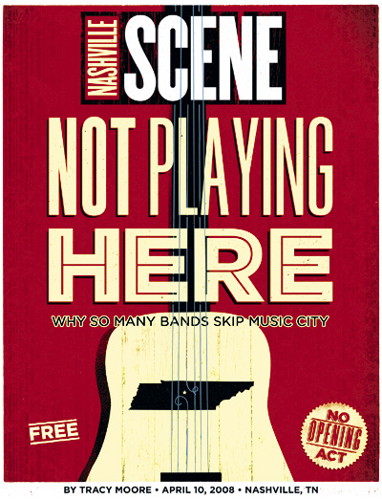
Good news, folks: Radiohead, one of the biggest bands in the history of the universe, have just announced tour dates. Hot off the success of last year’s In Rainbows, they’ll be gracing select amphitheaters with their textured rock, sending fans into a proggy electronic coma. But guess what? They won’t be playing Nashville.
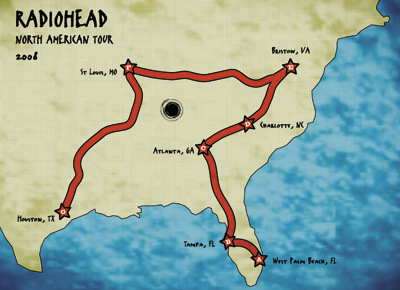
Just take a look at their tour dates, which begin in West Palm Beach, Fla. Next they crawl toward sunny Tampa and then to Atlanta, Ga., where suddenly a curious thing happens. From Atlanta, the Brits head northeast, shooting straight over to Charlotte, N.C.—population 695,995—and then on to Bristow, Va. Then it’s off to Maryland Heights, Mo.—population under 30,000—before kicking it over to The Woodlands, Texas. Then it’s Dallas, and then Ireland.
Visually, it’s almost a cartographer’s cruel joke. Rather than drive the three hours, 54 minutes from Atlanta to Music City—the third coast, a major music hub, the Athens of the South—their tour itinerary instead forms a shadowy tent of mockery over our fair city. No offense, but what do Tampa, Atlanta, Charlotte, Bristow, Maryland Heights, The Woodlands and Dallas all have that we don’t? One word: amphitheaters. And more importantly, outdoor amphitheaters that seat nearly 20,000 people.
But hey, maybe epic rock and big crowds aren’t your scene anyway, and you prefer seeing scrappy garage rockers like, say, Brooklyn’s The Hold Steady, who’d be perfect at the Exit/In or Mercy Lounge’s under 500-capacity space. But this 2007 critical standout played Tallahassee, Birmingham and Memphis before trekking over to Indianapolis in January of last year when they toured with The Thermals.
In fact, once you start looking at all the acts that either don’t play Nashville at all, or worse, play once and don’t come back—Ray Davies, Slint, Queens of the Stone Age, the reunited My Bloody Valentine, Battles, LCD Soundsystem, Mogwai, Hot Chip, !!!, Swervedriver, Jens Lekman, and the list goes on—it kind of makes you feel like you got picked last for dodgeball. Except in this case, you didn’t get picked at all. It almost knocks the “music” right out of Music City.

Rick Whetsel
“Hey, did you like that Arcade Fire show we never had?” booker and promoter Rick Whetsel asks with a sarcastic laugh, referring to the grandiose, brooding band’s 2007 tour dates, which hit Louisville, Atlanta, Asheville, N.C., and then D.C., with Nashville curiously absent. “Odd, given that the band prefers the unique venues that our Ryman fits perfectly.”
Whetsel’s been in the business for 15 years, and he currently runs Great Big Shows, his booking and promotions company with an ownership interest in City Hall, one of only a handful of Nashville’s 1,000-plus capacity venues. And even he doesn’t always understand why certain bands just won’t play this market.
“There’s just a million reasons why bands skip Nashville,” Whetsel says. “Sometimes artists just don’t find a venue they like in this market. Sometimes they want 700 seats in a theater. And sometimes you’ll have someone who wants 3,000, standing room. Sometimes an artist is just going out playing 14 dates, and they really want to chase certain markets—and we aren’t one of them.”
It’s true—Nashville’s a second-tier market. With a Metro Davidson County population of just over 600,000, our market ranking, as measured by TV viewership or Soundscan sales, puts us right at the bottom of the top 30 markets—meaning that of 210 designated market areas or DMAs, we’re in the game, but we’re not calling the shots. But Nashville’s market status is only one answer to the riddle of why so many bands drive right on by, particularly given the cities for which we are often passed over.
“We aren’t known as one of the most successful markets out there,” Whetsel says. “A lot of shows have come in to Nashville after selling good tickets in other markets, and they come in here and fail. A lot of times it’s a tour where the agent or management is saying, ‘We don’t want to go in a room and have it be half full. The artist only wants to play full rooms or rooms that sell out.’ And Nashville is not a slam-dunk market.”
Nashvillians may bristle at the concept. Judging from the giant guitar-pick signs used around town to designate significant venues, we’re a city that wears our industry affiliations proudly on our sleeve. Surely a city branded as a music town and bulging with musicians and industry types would have a keener interest in up-and-coming bands. At least more than fans in lower-market-ranked cities such as Memphis, Birmingham or Louisville, which consistently attract the eyes of more bookers, agents and promoters.
“Hey, listen—you really wanna frustrate yourself?” Whetsel says. “Look at Louisville. Louisville gets better shows than Nashville. Louisville’s a very good music market. People love to go to shows, they support shows, they support the music scene. If you compare three cities—Nashville, Louisville and Birmingham—Nashville is right in the middle. Birmingham is the worst. If you compare it to Memphis, we’re better than Memphis.”
Tell that to The Hold Steady. The larger picture of what attracts or repels acts to Nashville depends on more than how many people live here and how many records we buy. It’s also about who we are and what other people think about us. It’s about the places we go to see live music and how often we’re willing to drop $20 on a cover charge. And the overarching force behind all those intersecting factors is the economics of booking. And booking operates on three principles: warm bodies, location and cold, hard cash.
“If it’s a 10-hour drive to Nashville from the band’s last date, it’s probably not gonna happen,” says John Bruton, who books the Mercy Lounge. “But people will always say, ‘Well, why didn’t you bring this band here?’ And if you look at their schedule, they have a day off, but they’re coming from Chicago to Atlanta, and there’s just no date in between for us.”
But say a band plans on stopping here, and the booker and agent negotiate available dates. That’s only the beginning of the process.
“Sometimes they can’t get the venue they want on the date they want,” Whetsel explains. “Sometimes the money isn’t there, and it doesn’t make sense to do it. Maybe an artist is coming through and wants a guarantee that is going to be something that no one really feels is worth it. So they say, ‘I can go to the major markets and get that money,’ and so they go to the major markets. We’ll lose a show or not get a show that’s playing Atlanta, because Atlanta can do a higher ticket price and do a better gross.”
But say the stars are aligned just right, and the booker and the agent find that blissfully perfect venue on that blissfully perfect date.
“Then it’s hashing out the numbers,” Whetsel continues. “And that brings a lot of anecdotal evidence on things like ticket price. You look at past attendance for their shows. Have they ever played the market before? Do they have a record? What’s the buzz like? You get on the phone and you start talking to people.”
Most bands, unless they’re small-time and unsigned, are able to negotiate a guarantee—a set amount of money they’ll pocket after the show, whether five or 500 people show up. And that’s a tricky number, because predicting show attendance in Nashville is like predicting the outcome of a frog race.
Offers are pitched back and forth, and the details of the show begin to emerge. But for Nashville, finding that perfect venue may pose the biggest problem. We have dozens of clubs with under 500-capacity, but we’re missing the larger venues that cities like Atlanta—with easily five times our population and 15 or 20 over-1,000 capacity venues—can attract and, more importantly, fill.
“There’s some holes in the venue situation here,” Whetsel says. “Of course, we don’t have an amphitheater—we don’t even have a small amphitheater. So a lot of the tours going out this summer who don’t want to necessarily play arenas, they’re bypassing us. Even a small amphitheater that holds 6,000 would be great.”
But Nashville is littered with a glut of small venues competing for the same small-time shows. “There’s definitely enough clubs here—it’s not like your band wouldn’t have a place to play,” Bruton says. “We’ve got The Basement and The End, which are comparable in size at under 150. Then you have the next level, the 12th & Porters and the Rutledges, which have maybe 250 capacity. And then us and the Exit/In have a 400 to 500 cap, and from there on to Cannery and City Hall.”
Right about now, you might be wondering what happened to Starwood, our long-lost nearly 18,000-capacity outdoor amphitheater that opened in 1985 and brought us Lollapalooza, the Warped Tour and other high-ticket acts such as Tom Petty, Aerosmith, Coldplay, Counting Crows and other performers who could sell 20,000 tickets.
But let’s face it: Starwood kinda sucked. And if anybody missed the hour’s wait in traffic, the jacked-up ticket and concessions prices or the rednecks passed out face down in the grass seats, it was a mercifully brief mourning period. LiveNation sold the 65 acres in 2006, and it meant fewer big names gracing a local stage. But in Starwood’s twilight years, those big names looked a lot less like Petty and a lot more like Korn.
“As far as the amphitheater goes, as far as Starwood, I don’t think people miss it at all,” says Jay Williams, an agent who’s been at William Morris for 11 years, and up until recently handled the Southeast club market. “If you had a couple of beers at the show, it’s a nightmare to get home—it’s not like you could just jump in a cab to get home to Nashville.”
Nothing like the threat of a DUI to make you pack it in with a six-pack and Netflix. It’s enough to make you gladly kiss the Radioheads and U2s goodbye. But don’t wait up—it will be years before another amphitheater comes along to draw them back. What keeps Nashville in the minor leagues are those missing, critical 1,000-and-up venues. We’ve got seven: City Hall, the Cannery Ballroom, The Ryman, War Memorial Auditorium, Wildhorse Saloon, Municipal Auditorium and Sommet. But only the first three of those see any regular action, and they all pose their own limitations—from design to location, to parking, to production fees.
Chances are, if you’re dropping over $20 on a show, it’s booked at City Hall, the Cannery or the Ryman. The Ryman exists in rarefied air because its prestige draws artists purely for the bragging rights. “Not to sound cocky, but the Ryman plays a big part in bringing these top-level artists to Nashville,” says general manager G. Scott Walden. “If it weren’t here, we might see some of these artists skip Nashville.”
But that cachet comes with a hefty price tag: The high production costs make it crucial to pack the pews just to open the doors. Meanwhile, both the War Memorial Auditorium and Wildhorse Saloon have made efforts to bring more left-of-center shows to town—in recent years, the Yeah Yeah Yeahs and Death Cab for Cutie have played the former, and acts such as Louis XIV and Editors have played the latter.
Even so, they’re both underutilized, and they suffer for their downtown locations—still an area of town that’s viewed more as a destination for tourists than locals, despite what condo builders would have you believe.
With War Memorial, lack of awareness, parking concerns and the technical limitations of working in an old building all get in the way. The Wildhorse may be a state-of-the-art venue, but it’s still called The Wildhorse. Potential showgoers are bound to wonder how long the line for the mechanical bull will be. Not exactly the place to go to shore up your indie cred. They’re trying to shed their twangy past, but it’s an awkward adolescence, especially when they’ve fallen into the unfortunate habit of booking the likes of Rick Springfield and Scrap Metal, Gunnar Nelson’s glory-days hair-metal supergroup. But they’re getting the right idea—both The Bravery and The Hives have upcoming show dates.
“They’re getting different bands, they’re selling tickets, and it’s a really wide variety,” Williams says. “And if you’ve been down there lately, it’s a little less of a cowboy feel. That is, if you skip the lunchtime line-dancing classes.”
All of these venues are a tough sell in their own right, but they’re nothing compared to Nashville crowds, who are among the country’s most notoriously fickle and complacent. Nothing leaves a bad taste in the mouth of a hungry band like an indifferent room—or worse, an empty one.
“Because we’re an industry town, that’s always going to be a tougher sell for shows,” says Jason Moon Wilkins, who has been booking and promoting in Nashville since 1995 and organizes the rock festival Next Big Nashville. “ ’Cause people are used to getting into shows free, but also because they’re more critical and less forgiving. You can be a half-assed band in Birmingham or Chattanooga and pack the place out, but around here? Take Feist. It was an amazing show, and it sells out, and that’s great. But if you’re Feist-lite, or you’re the band that’s kinda like Spoon? There are a lot of critics in town and a lot of people who assess talent for a living, and they’re just less likely to go out and support those C-level bands that can succeed in other markets.”
But it hasn’t stopped music fans from wondering why more and cooler bands don’t play our city. It’s certainly a chronic question on the Scene’s music blog, Nashville Cream.
“I’m sick of Nashville being passed up by good tours,” a commenter called TobintheGnome wrote in February of this year. “I want to go to more shows. Destroyer, Malkmus and Caribou are a pretty good place to start, but the venues need to step up.”
Sorry, Gnome, but it’s not the venues that need to step up—it’s us. Maybe if we sucked it up and went out in support of the Feist-lites and the Zach Braff soundtrack rejects, agents and bookers might think we’re dumb and eager enough to shell out our dough for their acts, and maybe that’s not such a bad thing. But we’re not there yet.
“It’s still very real,” Whetsel says of Nashville’s reputation as a tough crowd. “People come to Nashville expecting a crowd to just sit there and stare at them.”
Or worse, never to show up at all. When Irish electro-pop duo Oppenheimer showed up to play Exit/In in October 2006, there was literally no one waiting to get in. Local Outtheother.com blogger Janet Timmons attended a Snowden show that same year at The Basement to find herself among a crowd of five for the buzzed-about Atlanta band. “Speaking for two of those five people, our faces were rocked off too,” Timmons wrote. “Snowden put on a phenomenal show last night—it just makes me ridiculously sad that no one else was there to see it. So what’s with Nashville and our notoriously underattended shows, anyway? Is there just too much to choose from, is everyone immune to Internet buzz, have they just not heard of these bands, or do people only go out to see local bands?”
Actually, she’s nearly spot-on. “Nashville is a tough crowd,” says Mike Grimes, who owns Nashville’s premier indie record store, Grimey’s, as well as The Basement downstairs. “People don’t get up and go crazy at shows here. I think music fans here show their appreciation in more reserved ways.”
Moon Wilkins theorizes that we fancy ourselves above the hype. “There’s only so many hipsters. And they only have so much money. So if 10 great shows are coming through, some of them are going to suffer.”
Nashville may feel like a desert outpost on the cultural map, but the rainy season inevitably finds us unprepared. “Last year, we had a series of shows, like Spoon had played and TV on the Radio, and you basically had this barrage of really good shows,” says Bruton. “And so another band will come through right on the tail end of that, and people have already come to all these good shows, and no one comes.”
Or rather, we just don’t go enough. Time and time again, bands that have ignited heat online and gotten critical press locally and nationally play Nashville—and 50 people show up, if they’re lucky. Take No Age, an exuberant L.A. noise-punk band that enjoyed coastal buzz and nationwide critical attention. They played Mercy Lounge last year and drew maybe 60 people. If they came to Nashville blissfully naive, they surely left unpleasantly enlightened.
“That’s not the kind of band that’s gonna do well here for the most part,” Moon Wilkins says. “Nashville should be called Song City instead of Music City. Song-based bands do great here. Iron & Wine is gonna sell out, but No Age isn’t. Look at Be Your Own Pet—they’ve done well, but they’ll never do as well here as Kings of Leon. People love them because they’re a song-based band.”
It would be easy to claim ignorance, to say that fans just may not have heard of these bands. But that requires a generous suspension of disbelief in this blogged-out, plugged-in town of armchair critics. Increasingly in the last decade, local press, bloggers, radio and stores like Grimey’s have made a full-steam effort to educate readers, listeners and viewers about new bands.
“I think we have an amazing group of people who live here that do a great job telling people about bands,” says Whetsel. “There’s more media than ever on new bands. I don’t get it. I truly don’t get it.”
It isn’t as if bookers such as Whetsel, Bruton and others around town aren’t tapped in to the shifting trends in music nationally. But all the gospel preaching and trend watching won’t change the perception of Nashville as an incredibly humbling place for artists to play.
And nothing spreads faster than a bad reputation, so Nashville often still finds itself on the booker’s bathroom wall as the number not to call.
“If a band is touring the U.S., to hit Nashville means diving into an area that could eat up a few extra days with low-paying shows,” says one booker who works for a major player in the agency world and represents several bands who don’t play Nashville. “It’s generally better to just sort of make a circle (or oval) around the country.”
But take a look at local club listings for any night of the week, and there are dozens and dozens of shows here every night, in every genre. Surely some of them will bring home the bacon—they just may not be the sort of bands we’re over the moon about.
“If you’re a Grey’s Anatomy band, you will sell out Nashville,” says Moon Wilkins. “We have a long history of songwriters here, and we also have a big Christian contingent, and they love that. Like Coldplay, and more mainstream stuff that also reflects what a lot of Christian musicians based here are trying to do musically. British bands always do well, and the song-based bands always do well. Ray LaMontagne or people like that always do well here.”
But even then, no matter who’s playing, anything from too much hype to inclement weather might keep people at home. For promoters, there’s no such thing as a sure thing.
“Costs have gone up and attendance has gone down,” says Exit/In owner Josh Billue. “The long and short of it? Venues walk a fine line with profitability. We need shows, but we also need strong attendance and bar sales to remain open. Each show is like gambling. All in all, it is a very good way to lose some sleep at night.”
After all, Music City isn’t really a music town—it’s an industry town. And maybe live music in Music City just isn’t quite the priority we imagine it to be. With the influx of restaurants and bars and the addition of pro sports, more and more cultural options are competing for our disposable dollars.
“Live music has never been one of the top three or four ways to spend your money in Nashville,” says Whetsel. “It’s weird, when I go to Austin or New Orleans and I am with my friends in those places and we start to think about what we’re gonna do tonight, even in other markets people are like, ‘Who’s playing?’ People who aren’t in the industry will say, ‘Hey let’s go see a show.’ But if I’m in Nashville, no one ever says, ‘Who’s playing?’ ”
Maybe Nashville just isn’t that cool yet. Maybe we’re missing that critical professional, creative class that supports healthier touring scenes in cities like Chicago, Atlanta, New York, Boston, and L.A. After all, the typical show-going demographic—twentysomethings with disposable income and an eye toward the next big thing—are also usually college students or young professionals with the social life of college kids. And though Nashville has Belmont, Vanderbilt, TSU, Fisk and a host of smaller universities, they don’t quite bring the heat to the club scene the way they do in a comparable city like Austin, which has a similar population but twice the venues.
“A lot of it is numbers,” says Moon Wilkins. “We’ve grown in population…. But a big thing—and I will probably get stoned for this—is Vanderbilt. People are going to play Austin because UT gets out the vote, so to speak. Those kids go out to those shows…. There’s a big creative contingent. Vandy doesn’t have that. It’s not what they’re known for, that’s not who goes there. I don’t want to be unfair and say it’s all just daddy’s money. But there’s a lot of daddy’s money there. And those folks for the most part aren’t the kind of folks who are going to support indie bands. A lot of their social interaction is on campus. It’s a thing I’ve still never wrapped my head around even though I’ve been here 15 years—why Vanderbilt is closed off to the rest of the world.”
Oddly enough, Vanderbilt is responsible for the city’s one multi-genre festival: Rites of Spring, its two-day concert held in April that this year features acts ranging from Feist to Old Crow Medicine Show to Lil Jon. But that Vanderbilt bubble—this notion that Vandy kids are an insular bunch who don’t support the live music scene—comes up in conversations over and over again with bookers and promoters when you mention club crowds. Stories like the fifth-year Vandy grad student who says, “Oh, East Nashville—I’ve never been there.” The prestigious university has some 12,000 students enrolled, compared to Austin’s University of Texas, which has nearly 50,000. Even Murfreesboro’s MTSU, Tennessee’s second-largest state school, has just over 20,000. But were it not for that critical late-night 45-minute drive home, they might make up for what Vanderbilt lacks in sinking dollars into our club economy.
“MTSU is too far away for drinking,” Moon Wilkins says. “The fact of the matter is, people go out, they’re gonna drink and they don’t want to drive 45 minutes back. And it’s a state school, so a lot of them don’t have as much money. I’ve always said, from a pure music perspective, it would be a lot more fun to go to shows if MTSU was in Nashville. We’d have this built-in group of people. We have an older audience that goes out to these shows. It’s interesting because, unlike other cities where people my age don’t go out as much, there’s a lot of thirtysomethings who go out in Nashville, because it’s an industry town.”
For now, without enough critical twentysomething club goers, Nashville may just have to settle for Grey’s Anatomy bands and the occasional indie-rock gem they read about on Pitchfork or Idolator. Still, in the last five years, most bookers, promoters and agents agree that things have improved—vastly. We continue to battle the country stigma in the rock world, and national and international press attention for bands such as Paramore, Kings of Leon, Be Your Own Pet and even the White Stripes and Raconteurs continues to turn heads our way. And attention and awareness are two big components that will divert bands to the 615.
Our proximity to Austin helps—we see an influx of touring acts stop through Nashville in March on their way to SXSW. And even though Bonnaroo has a radius clause in their artist contracts for bigger acts—meaning bands who play Bonnaroo in June are forbidden to play clubs in a 300-mile radius for 15 days before or after Bonnaroo—it’s still a music fan’s dream. And it’s less than an hour away.
“All negative stuff aside, I’m really happy and impressed with the shows we’ve been getting,” says Moon Wilkins, who adds that for the first time this year, he hasn’t had to sell industry types on Nashville when promoting his festival. “We never would have had Sufjan Stevens, we never would have had Iron & Wine, all these things that have come through and done great. Like Belle and Sebastian. It’s well worth investigating what’s wrong, but it’s also exciting to see us coming out of this funk we were in for a long time too.”
Williams points to the increase in rock exports, and the import of transplants from the coasts as a sign of the recent sea change. “I feel like Nashville is way less of a country town now than five years ago,” he says. “And you have a lot of music business people moving here from L.A. or New York, because the quality of life is great.”
A healthy dose of national perspective is in order here—Music City we are, but Atlanta or Chicago we ain’t. “Nashville has always thought of itself as being bigger than it actually is,” Moon Wilkins says. “We always look at ourselves and compare ourselves to Atlanta. We’re not Atlanta—we’re not half the size of Atlanta. If people can get over this idea of looking over our shoulders all the time and looking at what everybody else is doing, and see what we’ve got, I think we would be further along at addressing the needs we do have.”
Maybe this embarrassment of riches has turned us all into a culture of critics with a sense of entitlement—we’ll never be a major market, no matter how much we stretch and flex. It’s caused Mike Grimes to focus his booking at The Basement on local acts almost exclusively, because he’s realized there are simply too many local artists worth elevating to keep chasing tour buses.
“I wish that level of talent that people take for granted could basically be taken away for two weeks,” Grimes says. “Have like, well, not a strike, but have nobody play music in town for two weeks. And let people get shocked back into appreciating what they have. I mean, you can’t blame anybody. If you’re constantly surrounded by brilliance, sometimes you don’t see how brilliant it really is. I mean, you can pay no cover charge to go downtown and see shows. You can walk into a place and see a guitar player blow anybody away in any town you’ve ever seen—and you’ll have never even heard of him. The average person has become desensitized to the level of talent that’s here.”
So cheer up and take a look around. The future is brighter, with big-city acts such as M.I.A., British Sea Power and Lou Reed heading this way in the coming months. Maybe Radiohead won’t be stopping by anytime soon, but if you keep waiting for them to get here, you’re likely to miss a national sensation in the making. Hell, they’re probably playing somewhere in town tonight. Got 5 bucks?




