
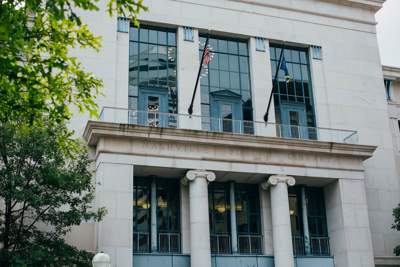


The Nashville Public Library downtown
The nation’s summer of protest has revealed a paradigm shift among the general populace. Salient calls for defunding the police and honoring Black trans lives have surged nationwide and indeed throughout our community here in Nashville. Yet another shift, albeit a quieter one, is also taking place. Some of Nashville’s libraries and librarians — in school, academic and public alike — are departing from the neutrality that has traditionally defined them by participating in social justice conversations.
On June 4, the Nashville Public Library issued a statement acknowledging the death of George Floyd and other Black people at the hands of law enforcement. In the message, the library pledged to “continue conversations about contemporary human rights issues.” But when asked if Black Lives Matter groups would be able to utilize public library meeting rooms on a “people of color only” basis — as they were banned from doing in 2016 — a library representative referred to the branch meeting-room policy. According to these guidelines: “All meetings in branch libraries must be open to the general public and news media for the entire duration of the room booking. No private events are allowed.” Private gatherings, such as those in which organizers wish to limit access to people of color only, must be held in one of the downtown public library’s rooms — at a cost, which may present a challenge for some marginalized groups.
Academic libraries are also taking up the equity gauntlet, despite controversial beginnings.
In February, the Twitter account for Vanderbilt University’s libraries posted an image of a banner reading, “Libraries don’t take sides.” The post proved contentious, with disapproving replies ranging from messages like “neutrality doesn’t equal objectivity” to “disappointed to see this as a former library worker at Vandy.” The social media whirlwind surrounding the post may have inspired some internal dialogue about values, as in June the library released a statement on racial injustice that expressed a commitment to anti-racist work — a statement that was, effectively, taking a side. The release was buttressed by an exhaustive resource guide — what’s known as a LibGuide in the library world — on Black Lives Matter, including links to Nashville and regional bail funds.
Nashville State Community College’s John E. Mayfield Library experienced an ordeal that was quite different. That library’s “Black Lives Matter LibGuide” was created in response to a library Facebook group discussion. Some members felt that posts were waxing too political, while others expressed that they were a part of the group just to see memes. But Dean of Learning Resources Faye Jones saw the library’s responsibility through a different lens.
“By their very nature, good libraries can’t help but getting involved in such discussions [as Black Lives Matter],” says Jones. “They inform what books we buy.” Jones was then approached by three of her library assistants — Jessie Angel, Sonja Humphries and Lauren Turner — about producing a LibGuide to address the community’s burgeoning social justice information needs.
“I reached out to the staff about creating this LibGuide in June when I saw that the public conversation around race was prompting lots of folks to speak about books and other resources engaging with anti-racism,” says Turner. “The interest I saw in my own community for educating oneself and being willing to learn was all the impetus I needed to start the conversation with staff.”
With Jones’ support, the team constructed the comprehensive three-tier “Black Lives Matter LibGuide,” with sections labeled “Community Resources,” “Books and Films” and “Readings and Videos.” “It was the perfect idea — since physical materials weren’t the easiest way to reach folks, we could then incorporate films, articles and other online resources too,” says Turner.
When asked if she discerns a recent shift in the role of libraries, Jones says: “I do think that there has been a more conscious effort in the past few years. But I know many libraries have always been aware of the need to provide a safe place for its patrons, both physically and in its collections.”
This sentiment was echoed by Kate Pritchard, middle and high school librarian at the University School of Nashville’s Hassenfeld Library. “More librarians are becoming more aware of persistent racial inequities, including inside our own profession,” she says, “and are feeling the need to make changes in terms of our policies (and how they are applied), our own internal biases, and our collections.”
Pritchard created the “Resources on Racism & Antiracism LibGuide” following the police killings of George Floyd and Breonna Taylor. Pritchard saw the same few books being shared and knew that parents with children of various ages would also be looking for materials to help them navigate the tough conversations ahead. She believes libraries can also promote equity by eliminating fines for overdue items and developing programs that foster open dialogue between patrons. She sees libraries as centers for news and media literacy, which is especially pertinent in the face of the upcoming election.
“Our role has always been to support our communities,” Pritchard says. “That hasn’t changed, but I think ideas about what that support can and should look like are changing.”



