
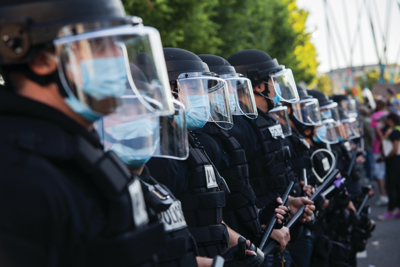


Metro police in riot gear during the “I Will Breathe” rally on May 30
Earlier this month, the Metro Council experienced what At-Large Metro Councilmember Bob Mendes would later describe as a “slow-speed, peaceful protest.”
So many people showed up — both in person and remotely — to speak as part of the council’s public hearing on Mayor John Cooper’s proposed budget that the meeting didn’t end until dawn. The overwhelming message was clear: Defund the police.
That phrase has emerged as one of the primary banners under which hundreds of thousands of Americans are protesting following the police killing of a black man named George Floyd in Minneapolis. Many people expressing support for the idea advocate something short of what those words imply — they want a reduced police force that takes a dramatically different approach to law enforcement. But the origins of the phrase, and the heart of the movement pushing it, are in abolitionist philosophies that have been largely developed by Black women. In many ways they’ve argued that the idea of abolishing prisons and the police seem so radical only because we’ve lost sight of the radical nature of the status quo — a status quo in which enormous police departments have military weapons and equipment, and many of our states incarcerate people at a higher rate than any other country in the world.
The extraordinary turnout at the Metro Council meeting was largely driven by the work of the Nashville People’s Budget Coalition, which includes Black Lives Matter; Gideon’s Army; Music City Riders United; No Exceptions Prison Collective; Free Hearts; People’s Alliance for Transit, Housing and Equity; Southerners on New Ground Nashville; and Workers’ Dignity. The group recently released a report on the mayor’s proposed budget, highlighting disparities between spending on the criminal legal system — police, jails, courts — and public goods that they argue could create a safer society.
“True public safety is built on people having access to and control of the public and social goods — housing, health care, transportation, jobs, libraries, community centers — that truly foster healthy communities,” reads a section of the report’s introduction.
The coalition’s materials do not use the word “abolition,” but some of its members do see that as a long-term goal.
“Policing is a system that can’t be reformed,” says Dawn Harrington, a formerly incarcerated Black woman who is now the executive director of Free Hearts. “Its origins are from slave-catching from the beginning. A lot of us, myself included, have stared down the barrel of police officers. So it’s not a radical idea to us, except to say ‘radical’ as meaning getting to the root of the issue.”
Cecilia Prado, a co-director at Workers’ Dignity, says her experience as a survivor of domestic violence taught her that the police are not effective at handling even the situations in which many think they are most needed.
“Right now the police are given too many tasks that perhaps they’re not really equipped to do,” Prado says. “Perhaps in some scenarios they are tasked with keeping the peace, and they actually do the opposite.”
Prado identifies as an abolitionist, although she emphasizes that the fundamental goal of the People’s Budget is to increase engagement from community members and advocate for what they want. The coalition is currently soliciting input through an online survey.
Harrington says she knows a society without police won’t be achieved overnight. But she says the path to that goal begins with divesting from police and jails and investing in community resources — like social workers and anti-violence work, like the violence interrupters deployed in North Nashville by Gideon’s Army.
There are examples of alternatives to police, at least in some situations. In Eugene, Ore., an organization called CAHOOTS was started in 1989. Twenty years later, they handle almost 20 percent of the area’s public safety calls, including those for mental health crises and public intoxication. They can also respond to de-escalate personal disputes. Several other cities are considered adopting similar programs.
A theme of the speakers at the council’s public hearing last week was a plea for an about-face in regard to Metro’s spending.
“As a native Nashvillian, granddaughter of Tennessee educators and a Black woman, I am strongly opposed to the allocation of even one more taxpayer dollar to fund a public safety system that does not and has not kept our community safe,” said Phoebe Moore, speaking at the lectern in the council chambers. “Instead, I strongly support the funding of public services, namely education, affordable housing and public health. Tennessee has historically ranked in the bottom 25 states in education, while the incarceration rate in the state continues to increase, especially among Black and brown people.”
Gicola Lane, who is part of the People’s Budget Coalition and was one of the leaders of the successful campaign to create the city’s Community Oversight Board, says some recent police actions have made the pitch relatively easy.
“People seeing the police [at the Teens for Equality march] when we were with the young organizers, in riot gear,” Lane recalls. “Being able to say, ‘Our tax money is paying for that riot gear to meet high-schoolers with during a protest.’ ”
On Monday, Cooper made a surprise announcement that the long-delayed deployment of body cameras will begin next month.
Though it’s nowhere near the shift called for by scores of Nashvillians during the council’s record-setting meeting, there was a small sign of change less than a week later. The mayor’s proposed spending plan kept the Metro Nashville Public Schools budget relatively flat, while giving the Metro Nashville Police Department operating budget a $2.6 million dollar boost. When Mendes, who chairs the council’s Budget and Finance Committee, released his proposed substitute budget, he’d flipped those two. Mendes’ plan would give MNPS an additional $12.5 million and eliminate MNPD’s budget increase.



