
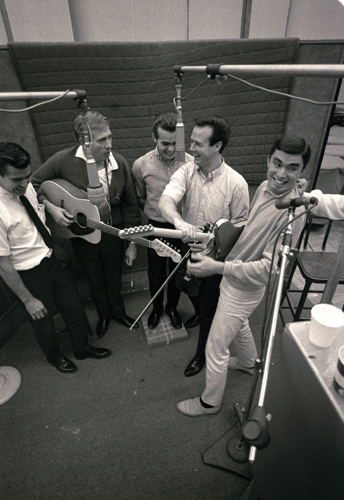
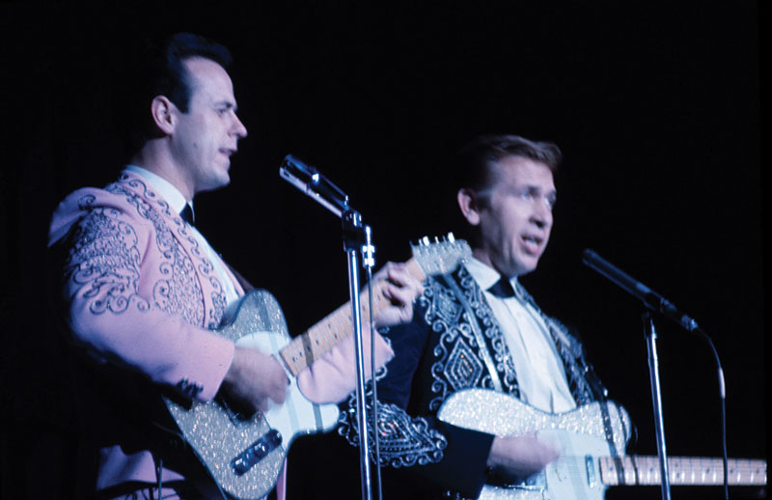
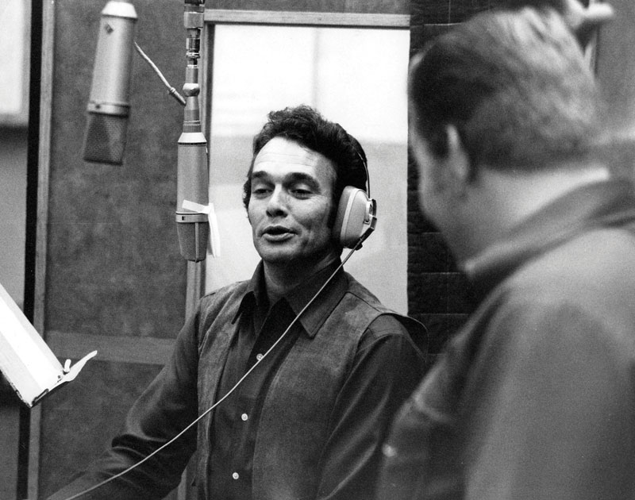
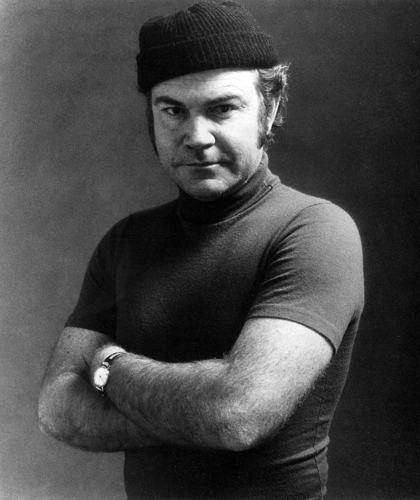
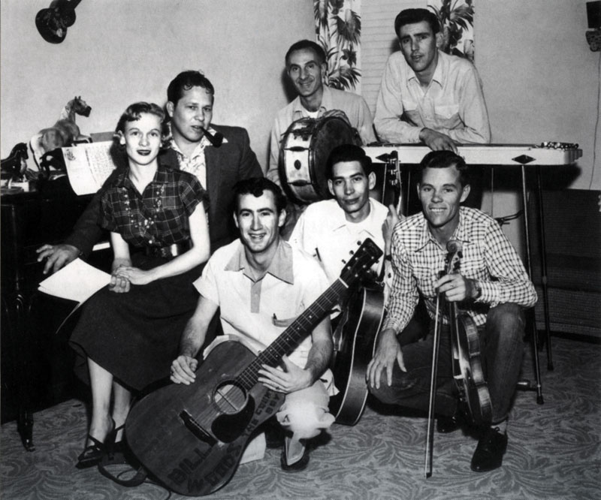
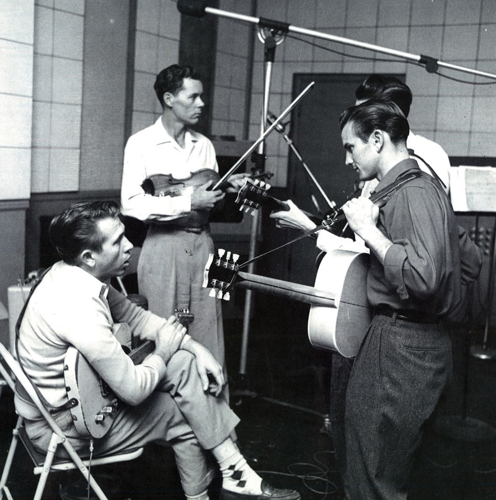
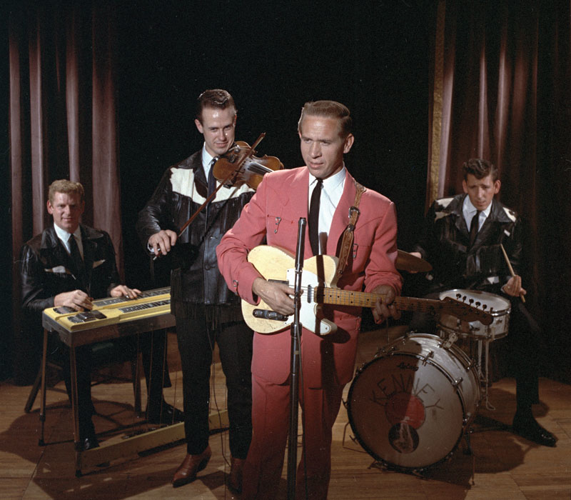

Buck Owens and the Buckaroos circa 1963. L-R, Jay McDonald, Don Rich, Owens, Moose Stone
For anyone who loves country music, "The Bakersfield Sound" are three words that carry a tremendous amount of meaning. In its heyday of the 1960s and early '70s, many fans considered it one side in a war for country's very soul. To proponents of the Bakersfield Sound, it was the anti-Nashville — tough, lean and mean honky-tonk music. It stood in sharp contrast to the records being recorded on Music Row, its admirers felt, where "the industry" was drowning country's soul in a sea of strings and vocal choruses.
On the other side, many in Music City considered the Bakersfield Sound nothing but a marketing term. Hardcore honky-tonk and traditional country could still be found in Nashville alongside the softer sounds. Pop-oriented country was just as common on the West Coast, and the hits that were coming out of Bakersfield, the Nashville cats argued, were no more than variations on they'd already done.
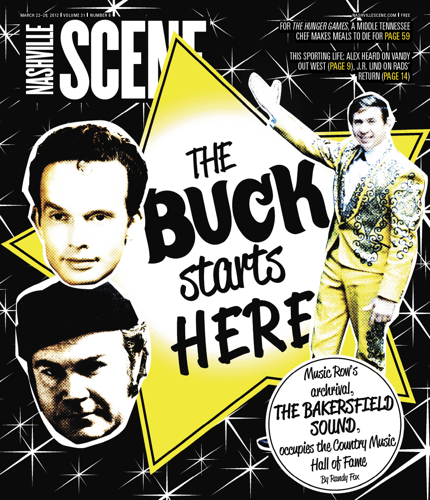
As is usually the case, the truth is somewhere in between. Finding that truth is what the exhibit The Bakersfield Sound: Buck Owens, Merle Haggard and California Country, opening this week at the Country Music Hall of Fame and Museum, sets out to do. The story is told through a combination of artifacts, pictures, music, video and some of the most amazing stage costumes and guitars that one could ever hope to see.
The tale of Bakersfield country music — or perhaps more properly, the story of country music in California — begins with the great Dust Bowl migration. Between 1935 and 1940, more than 200,000 migrants from Oklahoma, Texas, Kansas and a variety of Southern states streamed into California. A great many of them settled in the San Joaquin Valley, a region that stretches from just south of Sacramento to the Tehachapis Mountains just north of Los Angeles.
To these hardscrabble refugees, it seemed a literal land of opportunity. Relocated to some of the most productive agricultural land and oil fields in the world, migrants to the region soon found that the cheap labor they provided was welcome on the farms and oil fields. But that same welcome didn't apply in the communities where they tried to settle. This was the vineyard that produced the bitter fruit of John Steinbeck's The Grapes of Wrath.
And yet the prejudice directed at "Okies" by longtime residents would result in a tight-knit community and sense of camaraderie among the transplants that carried over into the post-war music scene. The Hall of Fame exhibit tells the story of this time in powerful images of the migration, the work and life the migrants found in the supposed "promised land," and the music they brought with them.
The exhibit then moves on to the California country act that most influenced the developing Bakersfield music scene — The Maddox Brothers and Rose. They were based north of Bakersfield, in Modesto, Calif., but their popular radio shows, barnstorming tours up and down the West Coast, and brand of rowdy and outrageous hillbilly music made them superstars in the Bakersfield area. And their over-the-top stage wear — designed by Hollywood tailor Nathan Turk at his flashiest — more than confirmed their claim of being the "Most Colorful Hillbilly Band in America." The exhibit includes a full set of their eye-popping outfits and previously unseen color footage of the group performing in 1953.
The Maddox Brothers and Rose may have set the tone and clothing style for Bakersfield musicians, but the other main element that influenced the developing Bakersfield Sound would be more "solid" in nature. The post-World War II years ushered in innovations in the sound of guitars, spearheaded by several new California-based manufacturers. Although some of the first solid-body guitars were custom-designed by Paul Bigsby, it was Leo Fender's introduction of the mass-produced Telecaster in 1949 that changed the sound of honky-tonk music forever. The Telecaster produced the amplification needed to cut through the loudest of barrooms — and perhaps even more important, it was durable enough to survive all but the most violent bar fights.
For guitar lovers, The Bakersfield Sound is a trove of rare and spectacular guitars. Here on eye-popping display are custom-built Bigsbys, all manner of rare Fenders, and even what has been referred to as "The Great White Whale" for guitar collectors: Speedy West's original, custom-built Bigsby pedal steel guitar — if not the first, certainly one of the earliest pedal steels ever made. It's a treasure that was thought lost for many years, but which was recently discovered by the museum's staff in a Bakersfield warehouse owned by the Buck Owens estate.
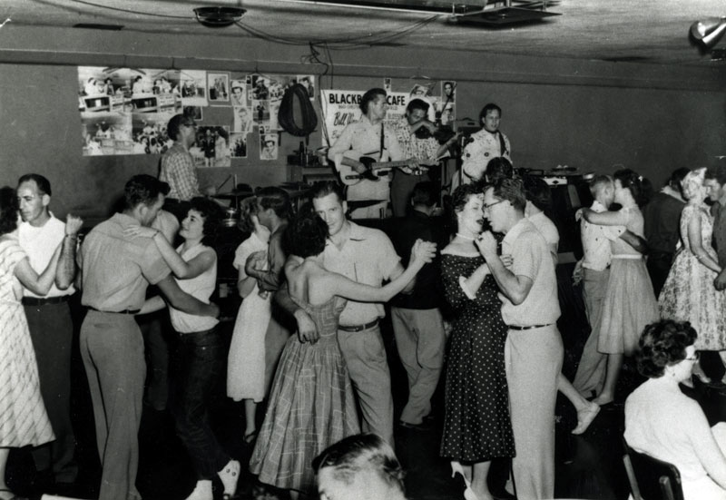
The guitar sound, a boisterous style and flashy stage wear all came together in the rough and often dangerous honky-tonks that sprang up around Bakersfield in the decade after World War II. The Bakersfield economy exploded, and many of the former Okies found their income rising. With hard work and more money came the desire to blow off steam, and relief was found in the many dance halls and bars.
This scene was best described by guitar ace Joe Maphis, a West Coast transplant from Virginia. The first time Maphis heard Bill Woods' band play at the Blackboard Cafe in 1951, he said they were "the loudest band I ever heard." That experience inspired him to write the honky-tonk classic "Dim Lights, Thick Smoke (and Loud, Loud Music)."
If any one figure emerges from the exhibit as the true godfather of the Bakersfield music scene, it's California honky-tonk pioneer Woods. As co-curator Michael Gray says, "Woods was so central to everything that was going on. He was a radio DJ, owned record labels, and was the bandleader at the Blackboard Cafe, the main cultural center and honky-tonk for the Bakersfield scene." Woods gave many up-and-coming musicians their first professional gigs, and he was also one of the first Bakersfield musicians to regularly make the 100-mile trip south to Los Angeles to play session work for Capitol Records.
But what ultimately made Bakersfield world famous, and more than just another country music talent pool like Dallas, Knoxville or Cincinnati, was the rise of the two stars who embodied the yin-yang of the Bakersfield Sound. Both incredibly talented and influential, Buck Owens and Merle Haggard took the basic up-tempo, electric sound of Bakersfield in different directions. And the majority of the exhibit space is devoted to these two musical titans.
According to a story related by exhibit narrator Dwight Yoakam, one of Bakersfield's proudest disciples, the pivotal moment in Buck Owens' life was when he had to share one toothbrush with his brother and sisters. The shame Owens felt from that poverty instilled in him a determination to succeed in life. Fortunately for the young Owens, he soon discovered he had a great talent for music. He pursued that course with dogged determination to fame and financial security.
A consummate showman, Owens fine-tuned the nascent Bakersfield Sound by taking elements from the country music styles that had arisen during the 1950s and fusing them together into an aggressive, straight-forward form of honky-tonk. It drew equally from the instrumental prowess of bluegrass and the high energy of rockabilly — emphasizing the hot picking of Telecasters and the pedal steel guitar. The formula would pay off in an astounding run of hits.
[page]
But Owens wasn't just a music innovator. He knew that talent might make you money, but it wouldn't keep it for you: that took a good head for business. Owens had the rare combination of musical talent and good financial sense. This enabled him to build a support system for his growing fortune, and also provided opportunities for his fellow Bakersfield-based musicians through his local ownership of radio stations, booking agencies, song publishing, studios, and the most famous Bakersfield nightclub, the Crystal Palace.
With the cooperation of the Owens estate, the museum was able to gain access to an astonishing display of instruments, stage costumes, artifacts of all varieties, photos, and video, including clips from the seldom seen 1965 Buck Owens Ranch Show. These items tell the story not only of Owens' rise and success, but also of how he was able to create and spread the image of the Bakersfield Sound.
Merle Haggard, on the other hand, came to his life's calling down a much longer and rockier road. The idea of being a musician appealed to the young Haggard because it meant he "didn't have to pick cotton or go to school." But unfortunately for Haggard and the nerves of his long-suffering mother, he would not truly find his calling until after several scrapes with the law landed him in a solitary confinement cell in San Quentin.
The career and legend that Haggard created through his music is not only country music's greatest redemption story — convicted felon to poet laureate of the common man — but also the tale of one of America's greatest songwriters and performers. Haggard started with the same base of up-tempo, electric-guitar honky-tonk as Owens, but freely mixed in elements from blues and Western swing. He constructed lyrics built around poetic images of poverty and self-pride with such depth and complexity that during the 1960s he was a hero to both the right and the left — audiences that sometimes heard the same song (such as "Okie from Muskogee") in drastically different ways.
For the very different career of Haggard, the museum chose to focus on his music and songwriting accomplishments through a multimedia theater in the round. But even though Haggard was not the archivist that Buck Owens was, that doesn't mean there aren't wonders to behold. The exhibit features many original song manuscripts that were preserved by his then-wife, transcriptionist and collaborator, Buck's ex Bonnie Owens. Among the most illuminating: rare documentary footage of Haggard and Owens working their way through the writing of a song, and previously unseen archival footage from Haggard's return visit to San Quentin in 1971 with his band.
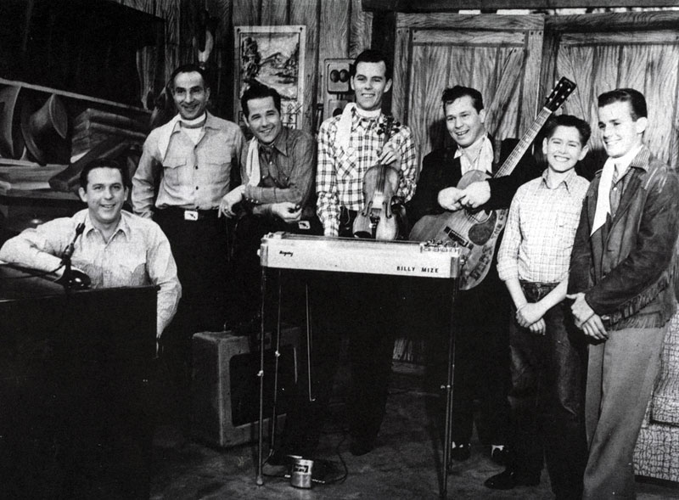
Even with the main focus on Buck Owens and Merle Haggard, the exhibit also pays proper tribute to other stars and important personalities that emerged from the Bakersfield scene, such as Tommy Collins, Ferlin Husky, Jean Shepard, Fuzzy Owen, Lewis Tally, Wynn Stewart, Red Simpson, Billy Mize and many others.
One of the greatest impressions left by the exhibit is the strong sense of community and the close ties shared by the people who made the Bakersfield Sound. Their bonds originated in those early days of migrants banding together to survive hard times, and they remain today in a local music scene that is still active. As Red Simpson prepared to make the trek to Nashville for the exhibit's opening, his hometown threw him a tribute and party in celebration.
Ultimately, Bakersfield failed to unseat Nashville from its country music throne. But in retrospect, what was happening in country music in both cities wasn't so much a battle between opposites as a case of parallel evolution. Many of the same elements that were shaping country music in Nashville during the decades after World War II went into the musical scene in Bakersfield. They just emerged in different and unique forms.
But if Bakersfield did indeed "lose the war," the music produced by the city certainly won the hearts and minds of country music fans in ways that resonate to this day. That was the case for Dwight Yoakam when he began playing his own brand of the Bakersfield Sound in punk clubs in Los Angeles in the 1980s. It's still that way today for country music traditionalists on both sides of the line between mainstream country and Americana.
So it's highly likely that sometime during the next few months, some young visitor to the Country Music Hall of Fame will see the costumes and the instruments, hear that hot Telecaster sound, and say to themselves, "Now that's great country music!" And they'll be exactly right.
Email editor@nashvillescene.com.
Dim Lights, Thick Smoke and Loud, Loud Music: Five records that define The Bakersfield Sound
"A Dear John Letter," Jean Shepard and Ferlin Husky (Capitol 1953)
This massive 1953 hit not only established the careers of Jean Shepard (who played Bakersfield frequently) and Ferlin Husky (who was a DJ in Bakersfield), but it was the keystone in building the Bakersfield legend. Written by Billy Barton, it was originally recorded by Fuzzy Owen and Bonnie Owens (after her separation from Buck Owens, while she was dating Fuzzy, but before her marriage to Merle Haggard — it's complicated ...). For Shepard's and Husky's version, the backing musicians were almost all Bakersfield personnel, including Fuzzy Owen, Lewis Talley, Tommy Collins and Bill Woods. Owen and Talley reportedly traded a 1947 Kaiser automobile to Barton for the publishing rights; they used their profits to launch Talley Records, which would release Merle Haggard's first recordings.
"Big, Big Love," Wynn Stewart (Challenge 1961)
If Bill Woods was the godfather of the Bakersfield Sound, then Wynn Stewart was its obstetrician (or something like that). Although Stewart was never based in Bakersfield, he frequently played there, and the majority of his backing band was recruited from the Bakersfield talent pool (and would eventually evolve into Merle Haggard's band The Strangers). This 1961 hit for Stewart has all the classic Bakersfield Sound elements that Buck Owens would soon transform into a hit factory: a driving beat, soaring pedal steel, and a Telecaster lead.
"My Heart Skips a Beat," Buck Owens (Capitol 1964)
Though not as well-known today as "Tiger by the Tail" or "Act Naturally" (thank you, Ringo!), this 1964 mega-hit gets my vote as the quintessential Buck Owens song. The a cappella wind-up at the beginning, the trademark "freight train" rhythm, Don Rich's harmony vocals and his killer Telecaster solo, and spot-on perfect drum fills from guest drummer Mel Taylor — big-beat keeper for The Ventures — all add up to a perfect example of Owens' honky-tonk genius.
"Little Pink Mack," Kay Adams (Tower 1965)
This slice of Bakersfield big-rig feminism spunk was Kay Adams' only hit. But even though her career was short, she made some great records that are well worth seeking out. If actual hostilities had ever broken out between Nashville and Bakersfield, I have a vision of an epic catfight between Kay and Loretta Lynn, but perhaps we best not go there ...
"Mama Tried," Merle Haggard (Capitol 1968)
An astonishing record in every way — from the foundation of acoustic finger-picking on the dobro by James Burton to Roy Nichols' precision electric guitar lead — Haggard truly found his songwriting muse in this classic. He mixes autobiography with just the right amount of legend to create a Bakersfield masterpiece. (He did indeed "turn 21 in prison," but certainly not "doing life without parole.") RANDY FOX



