
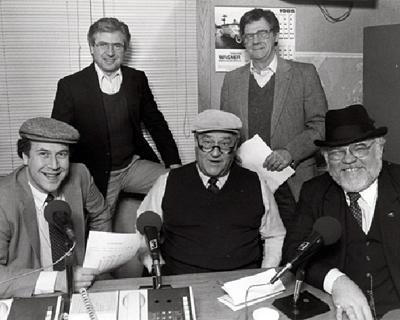


The first Round Table cast: Bart, Dave Nichols, Boyce Hawkins, John Bibb and Wayne Oldham
For nearly twenty years, beginning on WLAC-AM in 1986 and ending in 2005 at 1160 AM, Teddy Bart’s Round Table was Nashville’s version of Meet the Press. Every weekday, from 7 to 9 am, politicians and journalists sparred politely among themselves and with co-hosts, Teddy Bart and Karlen Evins.
Bart passed away over the weekend at 78. Pith reached out to a number of former Round Table contributors for their memories of the show and Bart.
Punching above its weight
By Henry Walker
The radio audience was small. We never knew how small because Teddy didn’t pay to subscribe to a ratings service. He also didn’t pay his guests, but they came anyway, whenever he called, because it was an opportunity to influence public opinion outside the local newspapers, a chance to talk in more than sound bites.
The audience was small but it mattered. If you were driving to work to lobby a bill at Capitol Hill or the Metro Council, if you were promoting a candidate or a cause, or if you were just a political or journalism junkie, you didn’t want to miss hearing the Round Table that morning. Campaigns were launched — and sometimes crashed — during those discussions. If you wanted to play in the game, you listened to the show.
Teddy was never rude or loud. He didn’t talk over his guests. He let the guests talk. The show was about them, not about the hosts. That was the difference between the Round Table and everyone else.
The show went off the air, abruptly, after board members Ted Welch, Orrin Ingram, Ned Ray McWherter, Jim Ayers and Mark Tipps decided the red ink was too deep. Occasionally people talked about bringing it — or something like it — back to the air. But it wouldn’t be the same without Teddy. He is greatly missed by those of us who were lucky enough occasionally to share his microphone.
Walker formerly wrote “Desperately Seeking The News” for the Scene and is an attorney.
Teddy’s Rules
By Larry D. Woods
Like so many successful entrepreneurs, Teddy made his own rules.
The unwritten guidelines for the much sought-after and coveted invitation to appear on his show seem to have been that he had interviewed you in his past; that you had been one of his lead stories when he was a TV news anchor; or that you had been on the front page of The Tennessean or the Nashville Banner in the political news. Once you were a guest on Round Table, Teddy would sometimes ask for recommendations of new guests to invite. But once you had been on the air with Teddy, you were not going to be invited back if, by his standards, your talk had been rude or you had yelled at anyone or yelled about anything or if most of what you had to say simply followed the line of the political party media machines.
Teddy’s rules worked very well to maintain the even keeled nature of the Round Table. He tried to always have two guests where he would select one liberal and one conservative (and not caring whether they were a Republican or Democrat). Very few actual officeholders ever got invited because they did not measure up to his high standards.
The guests never had any advance warning about the topics to be discussed on the air but if you got there early, Teddy would give you clues in his conversation of what was coming. If you were a rookie or a newbie and concerned about your performance, you could sit down across the table from Teddy and read his note cards upside down and see where had clipped news items and issues about the topics he would ask the guests.
Round Table secured an intensely loyal audience because it was the only place in Nashville where, five days a week, you could hear a calm, serious conversation about public policy and politics, especially after the daily, often vicious, front page political battles between the newspapers ceased. The show maintained its status for twenty years as the must-listen-to political show for every policy wonk and every aspirant to Who’s Who in Nashville (self- selected or earned).
A place on the radio where you could hear rational thinking and civil conversation about the important issues in our community? Hard to believe now, but those were Teddy’s rules.
Woods is a longtime Democratic activist and attorney
And I Mean the Left
By Bruce Barry
Growing up in New York I fed an early nerdy talk-radio addiction using a bedside clock radio to catch the pompous erudition of the great Barry Farber, the offbeat weirdness of Long John Nebel, and even occasionally (yes I’ll admit it) the original semi-unhinged conservative radio mouthpiece Bob Grant. Whatever the politics and eccentricities of a particular host, the appeal was (mostly) civilized conversation about ideas with smart people for a loyal radio audience.
Each place I’ve lived after leaving the northeast for college always brought me in short order to cruising the radio dial for good local talk — surely I can find a version of this conversation almost anywhere. Landing on planet Nashville in the early 1990s I happened upon this Teddy Bart guy and his morning Round Table of … what, exactly? It felt like an odd mix: one minute serious journalists are kicking around city and state politics, the next minute Teddy is tickling the ivories of an electric piano in the studio and pivoting into sports and weather. So this is Nashville, I thought: You get a talk show only if you can play an instrument and sing.
Once I’d been spewing opinions in outlets like the Scene for a while, Teddy invited me to be on the Round Table from time to time as a panelist “on the left” (“and I mean the left,” he would always add with a smile). It was great fun, as it would be for any card-carrying political junkie, to chew the fat on issues of the day with other smart humans of diverse viewpoints. But it was serious fun: it was a great privilege to be part of conversations that were informed and constructive, that mattered (without taking themselves too seriously), and that were heard.
The show in its later years may have aired on obscure AM radio stations with obscure cable-access replay — hard to find unless you were looking for it, but it turns out a lot of people were looking for it. Almost nobody turned down an invitation to be on the show, and nine years after it ended I still run into people who recall my minor involvement and lament that Nashville has had no similar outlet for regular meaningful civic dialogue ever since.
He was plenty good with that keyboard, but thoughtful, civilized discourse turned out to be the instrument Teddy Bart played virtuoso.
Barry is a professor at Vanderbilt and Scene contributor
A Few Words on Words
By Mary Mancini
Words matter.
Teddy Bart knew it and, if you were a guest on Round Table, he wanted you to know it too.
I first met Teddy and Karlen while working on the Round Table website. At the time Teddy didn’t know that I had my own radio show or that I was involved in progressive politics. Once he found out he was quick to pick up the phone and offer me a place at Round Table. You could see it in Teddy’s eyes that morning — he wanted me to be comfortable and have a successful debut. But when I uttered a phrase that he knew to be loaded he said simply, “Words matter.” I would be surprised if he missed the enormous flash of understanding in my eyes but just in case I made sure he knew years later that with those two simple words he taught me a life-changing lesson: the words you choose to express a thought are as important as the thought itself.
“Words matter.” Which is why Teddy Bart’s Round Table, just a small part of the legacy of Teddy Bart the man, is missed by so many. The culture of the Round Table, so carefully cultivated by Teddy himself, was one where issues were thoroughly debated using accurate words and ideas. It was not the place you went to score political points by stridently asserting your questionable position. Those of us who are grieving the loss of Teddy are no doubt reliving the grief we felt the day Round Table was unceremoniously yanked from the air.
Words matter. “Unceremoniously yanked” after more than 20 years of broadcasting is accurate. What a loss to a community that was so used to having our minds expanded every Monday through Friday by such a talented man, his equally talented co-host, and the guests he conscientiously harvested from every corner of Tennessee.
“Words matter” wasn’t the only lesson I learned from Teddy but it was the first and the most important.
Words matter. And because they do here are just a few to describe the Teddy Bart I was honored to have as a mentor and friend: trailblazing, hospitable, generous, insightful, and determined. Thanks for the life lessons, Teddy, I am forever grateful.
Mancini is currently a candidate for chair of the state Democratic party
Uniquely Nashville
By Forrest Shoaf
If you've been here for any length of time, you'll have noticed that hardly anybody who lives here was born here. Nashville has become a cosmopolitan city by accident, the product of what the Irish call "Blow Ins." Most of us come from somewhere else, take a job, and the next thing you know, you've been here 30 years.
Thus, we rely on institutions to preserve the city we fell in love with.
Teddy Bart was one of those institutions. He had many roles during his years here (including playing piano in Printer's Alley, where he serenaded Jimmy Hoffa, among others). But his true calling was talk radio. His Round Table, for years, was required listening for Nashville's cognoscenti, and this was at a time when the genre was in its infancy.
But, just as it was original, the Round Table was uniquely Nashville. Its format was just what the name implies, five people sitting around a table during Drive Time discussing both national and local issue, usually politics, but boxing and music crept into the discussion also. (After all, Teddy was an accomplished musician and a student of the Sweet Science.)
But what really made the Round Table unique was its civility. Teddy encouraged debate, but he allowed no rudeness. The quickest way to get disinvited was to breach this protocol. Teddy (and his co-host Karlen Evins) wanted guests who could disagree without being disagreeable. And that expectation was observed by all. I was fortunate to be a frequent guest on the show and was always The Lone Conservative. In the course of ten years, i crossed swords with some of Nashville's most liberal public figures. At times the discourse was heated, but we never strayed into invective. To paraphrase James Brown, Teddy didn't put up with no mess.
I enjoyed the show, and I hope and trust that Teddy's listeners did too.
And now, his voice is stilled, but, while it was vibrant, he helped keep our city together.
Resquiat in Pace, Teddy.
Shoaf is an investor and the former CFO of Cracker Barrel
A Civilized Forum
By David Ewing
“David it’s your cousin Jana” I would hear on the other end of the phone. Jana Ewing Bart always started the call when she asked me to appear on her husband’s show. The opportunity to sit at the table across from Teddy, his co-host Karlen Evins and two other very opinionated guests was always accepted. You knew what was said on this show would be discussed by mayors, CEO’s, lawyers and leaders later that day.
Unlike most programs where people give talking points, the Round Table was different. Teddy prepared every morning for the show and that meant you better prepare too. My morning ritual before an appearance was to read The Tennessean (there was always lots of local discussion), The New York Times (Teddy would ask you about the latest war or national story) and USA Today (Teddy loved pop culture and expect to comment about whatever Britany Spears had done.)
The real magic of the show was Teddy who loved Nashville and the people that made it great. Daily those individuals would sit around the table with Teddy for two hours. From the corner of 6th and Church in his studio at the Cumberland all that mattered and should matter in Nashville was discussed live on the radio with Teddy asking the questions.
An up-and-coming politician or governor would appear on Teddy’s show, sometimes without the call from Jana. Just blocks away from the Capitol, it was not uncommon that Governor Bredesen or legislators would be walking by and would take the seat of one of the featured guests to talk to Teddy. We were all drawn to Teddy.
Besides few famous blow ups on the air from the guests — not Teddy — this was a very civilized forum to discuss what Nashville needed before we were “It City.” The most knowledgeable passionate people debated issues like “Who should run the city?” “Do we need a convention center or professional sports?” Teddy was always interested in every word you said.
After the show you were always guaranteed to receive telephone calls immediately about what you said or didn’t say. Even your voice would be recognized later in the grocery store. One of my favorite segments was Teddy’s gossipy section he called “Whaddya Hear?” where guests were expected to bring an interesting story which had not been in the news. Teddy would seem disappointed if a guest did not bring something new. I never came on the show without a story.
We always thought we would have Teddy forever. His famous signoff everyday was he would be back “Lord willing and if the creek don’t rise.” Fans of the Round Table would know that “The bricks on Church Street are sad” with Teddy gone.
Ewing is a historian and attorney



