
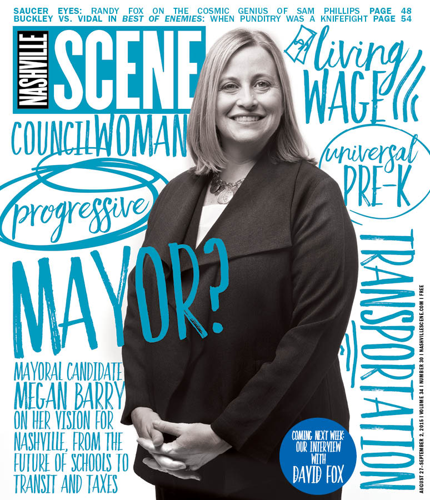
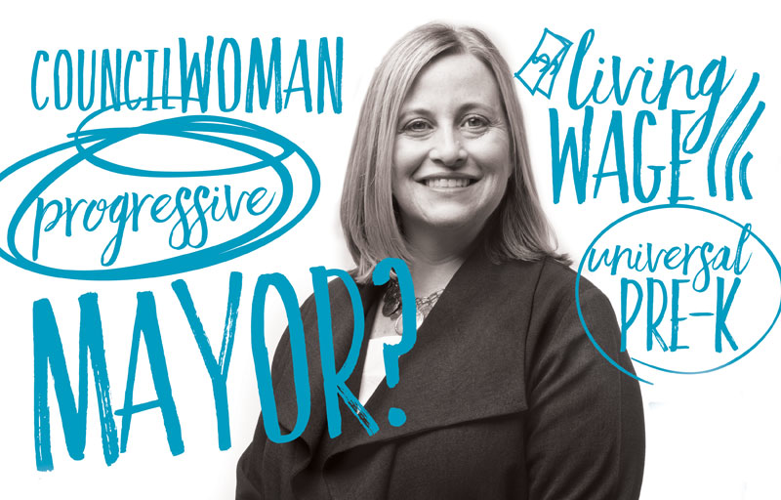

The three weeks since she finished as top vote-getter in the Aug. 6 mayoral election, sending her to a runoff against David Fox, have been pretty good for Megan Barry.
She has secured public endorsements from former Nashville Mayor and Democratic Gov. Phil Bredesen (a man once hailed in these pages as “a profile in moral gutlessness” by her husband, longtime Scene contributor Bruce Barry), along with more than 35 former, current and recently elected Metro Council members, and her former opponent Charles Robert Bone. For endorsement junkies, it’s worth noting she has also received the backing of, among others, Nashville’s firefighters and the Nashville Fairgrounds Vendors Association.
Eight years after she went from being largely a political unknown to holding a Metro Council at-large seat, Barry is very close to becoming mayor of Nashville. She has only ever run countywide, and only ever succeeded. But first there’s just this one more election to win. And if she pulls it off, she will become the first woman to occupy the corner office at the Metro Courthouse.
Her chances will be significantly increased if a recent batch of endorsements proves a bellwether. On the first Monday of early voting, Barry attended a prayer breakfast at Jefferson Street Baptist Church, whose politically active pastor, the Rev. James “Tex” Thomas, had previously supported Bone. She went to collect the blessings of prominent African-American pastors and community leaders, many of them representing areas where she (and Fox) fared poorly in the August election.
The event ended with Barry at the center of a tightly huddled crowd, a hand on her head and several on each of her shoulders, as a rousing prayer was punctuated with “Amens,” and the candidate agreed out loud with each line as it was sung: “Yes. Yes. Yes.”
Somewhat less affirmative have been the two former rivals who performed best in the areas where Barry performed worst. Howard Gentry attended the breakfast Monday, but has yet to publicly endorse either candidate. Bill Freeman told The Tennessean recently that he had planned to support Barry, but changed his mind after meeting with her. Both Barry and Freeman declined to explain in interviews with the Scene, but on Wednesday the Nashville Business Journal confirmed a floating rumor that the two clashed over Freeman’s asking her to commit jobs for his former backers when she took office.
All this plays out as the Fox campaign seeks to paint Barry as a member of the “far left,” which strikes many political observers as a bit like painting a hammer-and-sickle on a Target handbag. Her council record has been a source of interest and irritation, depending on the point of view, precisely because of the ways it has not matched that description. The irony of Fox’s attack is that ever since she was elected in 2007 as a pro-neighborhoods progressive fighter, her harshest criticism and skepticism has come from people on the left, worried that political ambition and calculation were pulling Barry to the center.
As has been chewed over many times by now, her council tenure included sponsorship of a nondiscrimination ordinance and a living wage for Metro workers — 14 of them. But she also provided a reliable yes vote for the corporate tax incentives and big downtown development projects that have bothered, among others, some of the neighborhood activists and progressives who would be Barry’s natural constituency.
Quoted in a 2011 profile of Barry in The City Paper, Jay Voorhees, himself a progressive neighborhood activist, described the newly re-elected councilwoman as “hard to pin down,” citing a tension between her reputation as a liberal progressive and her coziness with the mayor and Chamber of Commerce. The same piece also quoted then-Councilman Mike Jameson, a fellow progressive, who said he hoped her second term would be “guided more by her gut than by any political calculations.” It should be noted that Jameson is among the group of former and current council members supporting Barry now.
Last week, Voorhees — now pastor at Madison’s City Road Chapel United Methodist Church — weighed in on Barry again, in a blog post expressing his nervousness about supporting her candidacy. In a chat with the Scene, Voorhees stresses that as a pastor, he does not make endorsements, and indeed he followed up his post on Barry with one expressing similar skepticism about Fox.
But his anxiety about Barry is notable because of the ways he would otherwise be likely to support her. Though Barry is typically identified as a “liberal” or “progressive,” Voorhees expresses concern about similarities between her and Bredesen and Mayor Karl Dean — a mayor he says has been successful for rich people downtown, but much less so for the poor, the marginalized or those living outside Briley Parkway.
”So the concern becomes, how do either of these candidates define themselves differently from Mayor Dean,” he tells the Scene.
Barry has fully embraced her record over the past eight years and countered Fox’s attacks by declaring herself the obvious centrist in the race — a comment one can imagine being interpreted as an insult by some of her supporters at one time. As for being another Bredesen, or another Dean, it’s not hard to imagine the campaign’s reply: They both won. —Steven Hale
Megan Barry spoke with SouthComm staff Aug. 21. Present were Nashville Scene reporters Steven Hale and Andrea Zelinski, editor Jim Ridley, and NashvillePost editor Geert de Lombaerde. Barry was accompanied by communications director Sean Braisted. This interview has been edited for length and clarity; a longer version will appear on the Scene’s blog Pith in the Wind.
So I think the first thing we wanted to kind of start off with is you and David Fox have overlapping social circles.
Sure. We are. We are indeed.
What’s this campaign been like, running for mayor in a small town with overlapping social circles? Has that been a strain on you?
Well, personally, I will just tell you that, you know, when there were seven candidates in the race, there’s always going to be overlapping social circles -—
Sure. —
and that was fine. I think as we move into two of us with overlapping circles, we both have to live here at the end of this race. So I think that the hope is that one campaign doesn’t decide to attack, to make it more difficult for us to have those overlapping social circles as we move forward.
What happens when the race is over?
Well, my vision for Nashville is to keep it moving forward, and that means bringing everybody along. I don’t want to see this be divisive. ... For me, it really is just about running a campaign that’s focused on issues. It’s not about letting the race be defined by out-of-state money and Super PACs.
Speaking of issues, one that’s been coming up, at every forum and in every interview, is affordable housing. It’s a term that everyone sort of uses, along with gentrification, but that isn’t often defined. Can you define the affordable housing problem for us and what the contours of the problem are as you see them?
Sure. So it’s multifaceted. I mean, I think that when we get these 60 seconds to talk on the campaign trail, you say “affordability,” and then you have to leave it at that. But if you look at it in different layers, you have low-income housing. I mean, I serve on the homelessness commission, so we have a population right now that needs to be housed. And on any given night in Nashville, there are lots of folks on our streets. We just had a groundbreaking this morning for some veteran homeless housing. So you’ve got that piece. That piece is always going to be with us. It’s always been with us.
There’s the next piece of people who are low-income, where you need low-income housing. The [Envision Cayce] project, again, a solution that we are moving forward on [creating a master plan for revitalizing public housing at Cayce Place]. And then you’ve got the housing for millennials, and creatives, and firefighters, and police officers, and teachers, and that’s this piece here, and the cost burden that they have about, can Nashville stay affordable for them to stay here and live.
And then you move over here to seniors. Seniors want to age in place. And because the property values are increasing in Davidson County — which, by the way, everybody wants — you have to find those opportunities to help them stay in their homes. So you have this whole spectrum. There’s different solutions for different groups. And actually — and I want to be really clear about this — these are problems and issues that we’ve been working on for eight years. There is nothing here that hasn’t been put into motion. I talked about the veteran housing this morning, the Cayce re-envision — these are projects trying to address our housing issues that we’ve comprehensively looked at over the last eight years, and have made progress on moving forward.
We’ve also heard a lot about the Barnes Fund for Affordable Housing and how there needs to be more money there. You’ve been in office for eight years. Do you think it’s fair to hold you accountable that we have not moved that bar further in your term?
Well, we have moved the bar further. I think that that’s the fallacy in my opponent’s conversation. Nashville hasn’t stood still for eight years, and this belief that we haven’t moved Nashville forward under Karl Dean — that somehow Karl’s last eight years in office haven’t produced an incredible economy, incredible growth — it’s mystifying to me. I mean, maybe David needs to walk outside.
But there is a sense that affordable housing, transportation, these things are suddenly a crisis. Not to say that nothing’s been done on those, but there’s a sense we should have done this 10 years ago, and we haven’t.
Again, going back, if you want to go back and look, there were projects proposed along those lines over the last 10 years, and we have actually worked on this. You’ve got the BRT lights that run down several of our pikes. I think when people say we haven’t solved our transit problem, it’s because they look and see that we don’t have a comprehensive system that seems to work. That is our challenge, and that’s going to involve the regional mayors [coming] together, and also Metro, to make sure that that’s happening. That is the next step in this evolution.
Speaking of your council record, in the Aug. 20 mayoral debate David Fox asked you, do you have a vote you regret? I don’t think you said you have no regrets, but it was pretty close to that.
Well, I did. I said I regretted that we hadn’t been able to find firefighters, police officers and teachers more of a raise in the past.
Why don’t you regret the fairgrounds vote?
Because, actually, I look at that vote and I think at the time, when we were looking at the redevelopment of the fairgrounds, that made sense. The voters have spoken on that. My term as a mayor now would be to say, “All right, now how do we take this and make sure that it works for the citizens of Nashville?”
I promise, I don’t want to relitigate the entire fairgrounds ...
Are you sure? [laughter]
... but that was something you talked about. You look back and you see votes, and then you see how they went. That went very poorly with the public. You weren’t alone in it, but —
No. But I also think that, when you talk about votes that you regret, you have to say what was the context of what was going on at that moment. And so that was a vote I took, it’s a vote I stand by, because at the time that’s what I thought was best. Now, when we have the opportunity to say, “All right, we have 117 acres out here, what can we do to upgrade that infrastructure? What can we do to invest in that property, and to make it a place where families want to go?”
I was speaking with some folks yesterday from the Tennessee Fairgrounds who really want to see this be a great fair. That takes money. So then that becomes the conversation about how do you build the revenue streams that you need. We’ve talked a lot over the last couple of years about getting people to stay one more day in Nashville; that’s how we get those tourist dollars. So what can we put out there? What can connect the Adventure Science Center, the baseball stadium, the Ascend, you know, that gets families to stick around, and maybe there’s an opportunity for that.
We’ve had all this activity downtown. There have been some things that have happened in outlying neighborhoods, but there’s a lot of talk in this campaign about giving more attention to development in the neighborhoods ringing the county. Are there things people are clamoring for — specific projects that you hear people say they want? ...
You’d be surprised how many people have projects and ideas [laughter].
Are there some that are good ideas to you?
Well, first of all, I think that the investment that we’ve made over the last eight years has not all been in downtown. We have put police precincts, we’ve put firehouses, we’ve put community centers, we’ve put schools, we’ve put parks, we have made tremendous investments all over Davidson County. You know, in Antioch we did the Global Mall. We did the ice rink. We did the library. We did the community college. We just put a 600-acre park out there. With [Community Health Systems], we just did a deal with them. We got 2,000 jobs.
I think that this perception that only downtown Nashville has benefitted over the last eight years is not completely accurate. I think that there’s been a lot of investment across Davidson County; but clearly there’s more opportunity for investment as we move forward. Today I was with the Madison Chamber of Commerce, and one of the things that they want to see, which is key, would be investment in a Neely’s Bend extension. It would be about a $2.5 million investment, basically to do a complete street, so that you would drive some of that private investment, like you’ve seen in 12South, like you’ve seen the Gulch, like the 28th Avenue connector.
So those are the opportunities I see, and I’ve talked a lot about that. But revitalizing our pikes and corridors all around Davidson County, then we’ll drive that private investment to come in and do that, and that’s what I want to see. Those kinds of projects are the ones I’m interested in.
In the last couple years we’ve put up, ballpark, about $100 million into schools, but we have schools like Tusculum, which still have 20-some-odd classrooms in portables. You see that all throughout the district. Do you plan on putting more money into that?
It’s a priority for me.
And how do you do that?
Again, it goes back to, where can we find the money to do that? What’s the borrowing capacity so that we can get the kind of investment that we need in order to make those upgrades? I mean, you’ve got Hillsboro High School, you’ve got Hillwood High School, you’ve got McGavock High School. These are places where we need to make investments so that we can keep people in the system, and we can serve the kids that we have in the system.
You’ve talked about the decision you guys made with your son to switch from a public school to a private school.
He spent 10 out of his 13 years in public school.
Right. And you explained at length kind of why you came to that decision. You didn’t think it was working where he was. What do you say to parents who find themselves in the same spot who don’t have the income to go to a private school? What do they do?
Well, the mayor’s role in this is to make sure that every school, regardless of a child’s zip code, is an excellent school, so that those parents can have the opportunity to send their kid to a great school. Every parent wants their child to get the best education. I’ve never met a parent yet that didn’t want their child to have an excellent chance and an excellent education. So that’s what I’m focused on. I’m focused on how do we make that happen for everybody.
It starts, for me, with universal pre-K, and then it ends with a graduation from high school and post-secondary experience. And I want to see us be much more focused on, are our kids reading by third grade? What’s their ACT score when they’re being tested? And then are they graduating from that post-secondary experience or not? Those are the three benchmarks that I’d love to see us put a lot more energy and measurement [toward].
You’ve heard a lot about English-language learner issues in schools. What do you do to address that, given that you have a limited role as mayor as to what you can do in the school system? Especially when a lot of those kids are in our most overcrowded schools?
Let’s start with that pre-K, the universal pre-K grant that we got. When we looked at the ability to put kids into that, we left a lot of kids on the wait list. So for me, it’s a funding issue: How do I find the funds, either through grant funding, private funding, public funding? It’s about finding those dollars. And we know that the EL kids that were in the universal pre-K program last year, who are entering into kindergarten this year, are coming in so much better prepared.
We can start there, but there are lots of kids who are coming in who aren’t coming in just as kindergartners. So you’ve got to have the resources available for those EL kids to learn the language and be successful. So for me, it is a resource issue. I’ve worked a lot with folks at MNPS to make sure that we’re going to be able to move that needle with the percentage of folks who are moving here who come with a different language. It’s a gift. I mean, I wish I spoke multiple languages. So how do we capitalize on the fact that these kids are going to be multilingual? That is going to drive so much more of our participation in a global economy.
Schools can easily make an argument that they need more resources. There’s a lot of clamoring for more sidewalks and better transit. And the list of requests goes on and on. Do you expect that you can do this without having to raise taxes?
Well, we’re going to have a reassessment that’s going to come out in 2017. Let’s see what happens with that. The prediction is that the value of our overall real estate in Davidson County is going to be higher. Let’s see what that leaves us with in our general fund.
I think at the end of the day, it really is about trying to find those new revenue sources. This year, the money that we saw that was new into our budget this year came from a lot of the sales tax dollars generated from tourists. Those are the dividends that are going to pay off for us. So how do we use those? When we brought Bridgestone in, we negotiated as part of their deal that they’re putting a significant amount of money into the Music Makes Us program. So where are those opportunities to have those conversations about new funding?
To clarify, though, do you think you can do all this without having to raise new taxes?
Well, I think a tax conversation is one that’s always on the table for any public official. I’m proud to say that in the last eight years, we had a recession, we had a flood, and we only raised taxes one time. That’s the only time that’s ever happened.
They passed that on to you, didn’t they?
Yeah. Well, the good news is that, you know, we were — if you look at our Moody’s rating, one of the things that they talk about is that we have very tight financial controls, and we have a very good financial base. So that’s where we are. Let’s see what the reassessment does and what kind of revenue gets generated.
Speaking of finances, in the debate the other night, you described David’s vision as one of “austerity.” He would dispute that word, and obviously did. But what do you mean by that word?
I’ve spent enough time with David on the stage and in different settings to know that David has a message that is one of anti-growth. David thinks we should put the brakes on. David doesn’t want to see us grow anymore. You know, I think that that’s an austerity message. Cities that aren’t growing are dying. And I don’t see that as Nashville — as the way forward.
He said the other night that he wanted us to keep growing but wanted to kind of tack back on municipal spending. He worried about debt. Isn’t there a difference between those two things? I mean, can’t you limit spending without slashing in the way that the word austerity suggests?
Well, tacking back on municipal spending to me is not investing in schools, it’s not investing in sidewalks, it’s not investing in infrastructure. That’s what “tacking back in municipal” is for me. If you think about what we’ve been able to drive with our private investment, that’s because we’ve had municipal investment, as well. So tacking back to me says you’re not going to get that private investment, because you’re not going to have the ability to have those partners. And that is an austerity message.
When we first talked, when we did our profiles, you talked about subsidizing bus ridership, or ...
We already did that.
... a pilot program. You talked about fully doing it, since we already do it some. I haven’t been at every forum, for sure, but I haven’t heard that come up again. Is that still something that you plan on trying to do?
We already do it downtown. If you want to hop on the connector, you can hop on, you can hop off. We already subsidize ridership for transit. So for me this is about saying, all right, how do we get people to use our buses? We’ve seen ridership go up. So, you know, Steve Bland [CEO of MTA] just launched this program, which they’re doing, and so I want to see the results of that. At the moment, what we’re hearing is that cost isn’t necessarily a factor, but I want to know more about that. In fact, I asked Steve to put that into their surveys that they’re doing so we can figure that out.
But what we are hearing are three things. We’re hearing that people want more frequency; they want more routes; and they want more access rides. So I want to know what are the drivers for people to get on and off transit. And if that happens to be one of them, then I’d sure like to talk about it.
More broadly, most people say we need a regional transit system. What does that mean to you?
Well, I’m not a traffic engineer. So for me it means, how do we find the funding mechanisms to pay for a comprehensive regional transit system? When you go to Denver — it’s a great example, you’ve got light rail that brings people in and out of Denver, and on every place where they’ve built one of those stops, you have incredible private economic investment. So what’s the opportunity there?
We have CSX lines that run all over this region. You know, the federal rail law favors them. So how do we get to work with Congressman [Jim] Cooper to say, hey, look, do we have the option here to maybe have some of their right-of-way? What’s the cheapest and most efficient and effective way to build our infrastructure, whatever that looks like? Somebody said to me the other day, you know, talk to Disney, they build monorails all the time. But I think that’s kind of where we have to say the mayor’s role, and the mayor’s power and influence for these other mayors, is all about how do we fund it. Look, I was at Gov. Haslam’s round table the other day. I didn’t hear any appetite for an increase in the gas tax. So that’s, to me, where the complication and the conversation has to go.
You have to look at where, again, you can generate new revenue. Right now we have a half-cent of sales tax that is unencumbered in Davidson County. Now, that’s just Davidson County. And if we were going to actually take that half-cent of sales tax and have it be a dedicated funding stream for something, maybe transit, it would require a referendum.
So what the next mayor has to do is say, “Here’s my vision. I’ve got to sell this to the public. I’ve got to sell you that you want this to happen. And you have to get excited about it, because if you’re not excited about it, it’s not going to pass.” And I think that’s the biggest challenge for the next mayor is to say this is what we’re going to do. Let’s take the jail; let’s take the police precinct. Those might have been great projects, but there was no conversation or excitement from the community to get behind it, and that’s going to be key for the next mayor.
On transportation, you’ve talked about how [community enthusiasm] was something that was lacking in the end process. How would you avoid the pitfalls that contributed to [the AMP] never getting off the ground?
Well, one of the things that I bring is this deep understanding of how the Metro Council works, and I have the backing of many of the current council members and the ones who are coming in. So the critical first step is actually engaging the community through their elected representatives, and I think that that’s a real opportunity, and that’s how I would be different.
In the news over the past year, we’ve all been seeing these very fraught situations in various cities between African-American communities and police. If you become mayor, what lesson have you taken from the past year of those situations that you would bring into the office with you?
First of all, I think Chief [Steve] Anderson has done a great job — and he’s done a great job because we have fully funded the police. We have put community policing out there. We have invested in putting precincts in neighborhoods. I mean, again, today I was in Madison. They were so excited we have this Madison police precinct, but it’s not just a precinct, it’s also a community center. So they do meetings, they do all kinds of things.
What’s been able to happen with that is that you have strong leadership, but you can’t ever take that for granted. When we came into office eight years ago, one of the things that Karl ran on that we all adopted quickly was this idea of safety. You have to have a safe city in order for people to want to do anything else. And we’ve seen crime go down 28 percent. I mean, we’ve made some demonstrative measures on making Nashville a safer place.
But we saw this with the precinct on Jefferson: The only time that citizens oftentimes get to engage the Metro Council is on a zoning issue or a budget issue. And that night, because there was a zoning issue, folks were able to come up and just say, hey, look, we want to talk about racial profiling. We want to talk about how we feel in our community. So for me, the role of the mayor is to find those opportunities for the community to talk about this, and I’m committed to doing that. It doesn’t have to be the Metro Council zoning committee meetings.
Does that mean being proactive in making those events happen?
Exactly. I mean, look at [Nashville Organized for Action and Hope]. I mean, NOAH has been an excellent conversation driver on key issues for this race, and this is a coalition of lots of different organizations that have a vested interest in making Nashville a great place to live. So it’s about finding those folks to be at the table to make that happen.
Among your contributors were several executives from [Corrections Corporation of America]. Why shouldn’t that concern us?
Because I took money from lots of folks. They’re executives at CCA, but they’re citizens of Nashville, and they get to vote. And so, lots of people gave me money, and I’m thankful.
Well, let me ask you this, then ...
Because I couldn’t write myself a $1.4 million check, that’s why.
The reason I ask is this more broad question, which is: How do you convince folks, when you’re going out to various neighborhoods, that the people who are able to write you a $1,500 check ...
I have lots of people who wrote me $25 checks.
Sure.
And they are just as important.
But how can people trust that their representatives aren’t more responsive to the people who can pony up the checks? What do you say to those people?
I would say to you I have a record I can stand on. I think that my record speaks for itself that I have been able to bring lots of people together. And quite frankly — I know you know [who gives me money], because you looked at my disclosure, and I know who gives me money because I write them thank-yous — beyond that I really don’t know where that money comes from, nor am I beholden to anybody who has given me money any more so than the person who gave me five bucks. I welcome every contribution.
Some people see that, I don’t think wrongly, as a different level of access to someone than they have. There’s a limit on how much they can give you, but an executive at some corporation — at least there is a perception for a lot of people that they have an easier time getting a hold of someone than they do.
What do you think a Super PAC buys you?
That’s a fair question. TV ads, for one.
I wonder what kind of access.
Well, he’s coming in, so we can ask him.
Good. Good.
Would you have any major initiatives along the lines of a Music City Center for your administration?
I really feel like the last eight years, we’ve had the ability to build a lot of really great projects. For me, I really see this as going back into the neighborhoods and giving neighborhoods tools that they need, and drive that growth along those pikes and corridors. I want to see us have complete streets all over Nashville. If I could, if every one of those pole lines could be buried, I would be thrilled. That would be great, and we could have our tree canopy back. But ultimately, I see that as having the complete streets that then drive that public and private investment.
If we can bounce back to an education issue for a minute, when it comes to charters, you made it clear they’re not going anywhere. What kind of role do you see yourself playing with charters? Going out and trying to recruit charters to come here? Just trying to play middleman with the school board, and trying to get everybody to get along?
Well, let me talk about what I see [as] the mayor’s role with the school board. My opponent says he’s going to make the school board accountable. I actually see them as an elected body. They’re accountable to the people who put them in office. I want to work with them. Our biggest hire after this mayor’s race is going to be the next superintendent. And having someone in the mayor’s office who can actually work with the school board is going to be key to bringing that key executive into Nashville. I think in the last hiring process, there was a lot of conversation about, well, we couldn’t get the résumés. And I think that’s probably true, because who wants to go work someplace where you don’t know what the shared vision might be from the person who’s going to give you the budget? I think that that’s critical.
So my role is to work with the school board. They’ve got their own processes in place about how they decide where to put schools and what those delivery models should look like. I want to put that conversation in the rearview mirror. I want it to be about how do we do what’s best for kids, and whatever that looks like.
So it sounds like in terms of recruitment of charter operators, you’re kind of hands-off.
Well, I think there’s a lot of folks who are out there recruiting them. I don’t think I need to have that role.
Is that something you’re going to look for in a finance director — someone who is going to help manage available city assets, or someone who’s actually going to be growing the economy?
Both. I mean, I think you have to have both. I think you’ve got to have somebody who understands where we are and how we need to go forward, but also has a very good understanding of how to take every dollar and stretch it. One of the things that we were very proud about in our campaign is we did raise all of our money, except for a loan that Bruce [Barry, the candidate’s husband] and I made to the campaign. If you look at how much it cost to run the campaign — and I think you guys maybe did the calculation on votes — my competitors spent double. And I think that’s something you should think about, because when entrusted with other people’s money, I’m going to make sure I find the best way to do it that is the most efficient and successful.
Bill Freeman recently told THE TENNESSEAN he was planning on endorsing you, he met with you, and then decided not to. What happened in that meeting?
Well, you know, Bill and I are friends, and I really appreciate everything that Bill talked about on the campaign trail. You know —
What did you say to him?
I thanked him for his participation in the race, and —
Well, what did you say to piss him off is what I mean.
[laughter] I know. But I think Bill, you know, he just decided to — that, yeah ... ask Bill.
At this point, Barry communication director Sean Braisted interjects: “Private conversation.” Barry repeats, “Ask Bill.”
Going forward into the race, both you and David didn’t fare very well in traditionally African-American neighborhoods. Why do you think that was?
Well, I think that there were other candidates in the race that fared better. Now that there are two choices, I think we’ll fare well.
Why?
Because we actually have deep roots in the African-American community, and have been doing a lot of things there for the last eight years, and also have a lot of key supporters in the African-American community, so I think that will be helpful.
What concerns are they bringing to you?
Same. I mean, it’s funny, the one thing that I have grown to have a deep appreciation of over the last eight years is, communities aren’t monolithic.
Sure.
They actually come with — you know, if you’re a middle-class person, you’ve got these issues. If you are a low-income person, you’ve got these issues. And everybody I talked to has the same concerns around public education, affordability, and transit, and I don’t care where you live in Nashville.
Circle back to education a little more: workforce development. You talked about post-secondary.
Yep.
Are there specific areas that you think the city can do a better job in terms of preparing people who aren’t going either into two-year or four-year programs to get them ready to contribute to the workforce?
Sure. I really believe that we need our kids to have some kind of post-secondary experience, and it doesn’t have to be a traditional college experience. Although, honestly, a traditional college experience we know, over the life of any of us, you’re going to have a better income. But we have the opportunity, I think, to create more vocational training that will help in the construction jobs that we have. I think there’s a lot of that opportunity, but it still requires a two-year investment to get the kind of training that you need.
On the workforce topic, Amendment 3 [requiring contractors on Metro-funded projects over $100,000 to hire out 40 percent of construction hours to Nashville workers] has come up, obviously, the past few times you and David have been on the same stage together, and I think both times you’ve said he was wrong about how he was describing it. He talked about the idea that it doesn’t apply to out-of-state workers. Why is he wrong on it?
Because it doesn’t.
I genuinely don’t understand what he’s wrong about. Can you explain to me what the law does and how he’s mistaken?
What has to happen next, is the Metro Council has to pass enacting legislation that can address all of these issues, and the devil’s going to be in those details about how this goes forward. There’s a lot of opportunity to create waivers if developers cannot meet the demand because the workforce doesn’t exist. Like I said, the devil’s in the details. So when he comes out and says this does not apply to out-of-state companies, he’s just wrong. I mean, the enabling legislation will craft what this applies to.
And there’s a scenario where it’s possible for a company to bring in only workers from outside the state and to circumvent any kind of requirement if there are no Davidson County residents working on the project at all?
No. Again, you have to create the enacting legislation that’s going to have the underpinnings of this. So those details are all in the workout piece with working with the next Metro Council.
Ok.
And you definitely want somebody sitting in the mayor’s office who can work with the Metro Council on this enacting legislation. And, by the way, that would be me. [laughter]
So you’ve been running for a while now, and, you know, obviously, long days, long hours.
[laughter] A little.
What’s something that you’ve learned in this process about yourself?
What I’ve learned that has been really fabulous — and it has more to do with my team — is how wonderful the folks who are 19 to 32 are in this town. I’ve got this really young team, and they’re extraordinary. I mean, they’re smart, they are motivated, they are passionate, and I think that when we think about all the young talent we have in this town, it’s pretty exciting. That’s been a great revelation for me — to say, “My gosh, you know, the world’s actually going to be OK.” [laughter] It’s all right.
Have you learned anything in this process that surprised you? You’ve been a council member for a long time. You’ve charted a lot of this territory before. But is there anything that’s happened that’s shocked you, or woke you up a little bit?
Probably the most shocking thing is — you know, I think it’s totally appropriate to be in a conversation with your folks that you’re running against, and to have that contrast to say, “Hey, look, I’m the clear choice if you want X, here’s the clear choice if you want Y.” I think how this race is different, and what has surprised me, is what I would call the back conversations that are so — that are false, and you wonder, like, how did that even start? I’ll give you an example. My faith has been a huge back-channel conversation. So let me just put it on the record: I am Christian. I’m a practicing Christian now. I’m Catholic. I cannot tell you the — I mean, I can show you these emails that get forwarded around about how I don’t say “under God” when we say the pledge of allegiance. [Addressing reporter:] I mean, how many times have we stood at council together?
I would say I stand close to you. I haven’t noticed that, but I’ll be on the lookout.
Sean Braisted interjects, “Too late,” meaning Barry’s council tenure has ended.
Yeah. Exactly. Cameras aren’t here. They don’t cover that part. But that’s been the surprising thing to me is just ... the litany of things that people are willing to say, instead of just saying, “Hey, look, I disagree with your vision.” I’d say that’s fine. I mean, that’s the contrast.
Why do I get the feeling you’ve been reading the scene’s comments section?
[laughter] I actually haven’t. I get these emails forwarded to me — no, I don’t read your comments section. Bruce is like, “I’m really proud of you. You have really thick skin.” I’m like, “Yeah, it just doesn’t bother me.” But that’s the kind of stuff that you go, “Wow, who sat around and thought this was going to be a good thing?”
Braisted interjects, “I have theories.”
I know. I mean, there was a live call that went out — what was it, two days, three days ago? Oh, about a week ago into the predominantly African-American community, calling people and telling them I was an atheist. That’s the kind of stuff that surprises me. Anyway, it’s not true.
What does that say about Nashville transitioning from the old machine-centered city of the 1960s and everything, into this new place where all these different cultures are commingling, and we’re going to have a completely different majority in 20 years? What kind of conflicts are you seeing that will probably arise during your term?
Well, again, the opportunity is that, because so many folks are coming here and they bring an entrepreneurial spirit and a creative spirit that is really good for our economy, I think it’s fabulous. I see it as an opportunity. I do think, though, that you have to continue what Karl’s done. I love the New Americans Academy, where you get leaders in these different communities absolutely engaged right out of the box, so that they have a voice and that they are then able to go back to their own communities and feel part of Nashville. That’s been critical.
And so I think there’s a lot of really good in Nashville. I think that one of the themes that I want my campaign to continue to focus on has been, this is a great place to live. It’s a good place to live. We are good people. And I don’t want to see it become a divisive conversation. We decided it was going to be a nonpartisan race. And I’m afraid David’s made it partisan. I mean, he had a mail piece that said he was the most conservative person in this race, and now he’s decided that he’s a centrist. I’ve always been who I am. And I care deeply about Nashville, and I care deeply about the people here. And I think that’s the kind of place that we are, and it’s the kind of place that I want to see us be in 20 years.
I think that does it. I think we’re about due to let you out.
Out, like, does the door magically unlock?
You’re free.
I’m free. Anything else, you guys?
I don’t think so.
Well, let me know. Obviously, you know how to find us if you have additional questions. And I know that some of you live in Davidson County, and early voting started today [Aug. 21], so don’t forget to vote.
Well, since you asked, let me actually ask you one last thing about David making it partisan. All these state-level Democrats have been coming out to support you. You’re not nonpartisan in that way, right?
Well, let’s be clear. The people who are supporting me are people who are elected in Davidson County. That includes council members, it includes state reps. But at the end of the day, it’s about defining who we are. And I think that by saying, “Hey, look, here’s Megan and here’s all the rest of us” — all the rest of us are unions, teachers, firefighters, the business coalition, you know. And so, I think it’s kind of a false dichotomy. If anybody’s a centrist in this race, it’s me, and I’ve got the track record to prove it.



