
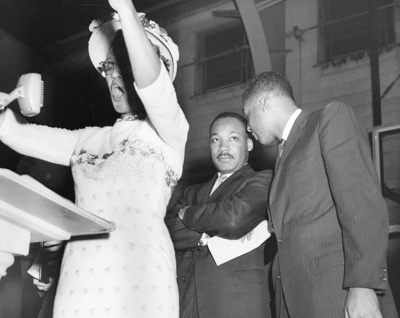
History remembers the Rev. Kelly Miller Smith Sr. as the “moral conscience of Nashville,” the steady hand behind the lunch counter sit-ins and the theological engine of the city’s desegregation.
A recent piece in the Nashville Scene features a powerful image of Dr. Smith alongside Dr. Martin Luther King Jr. at Fisk University. The photo was taken in the wake of the bombing of Z. Alexander Looby’s home, a moment of profound crisis when Dr. King declared, “I came to Nashville not to bring inspiration, but to gain inspiration,” describing the city’s sit-ins as “an epic known all over the nation” and urging Nashville to become an open city.

It turns out local legend the Rev. Kelly Miller Smith served as an FBI 'informant.' But signs indicate that he knew exactly what he was doing.
The article also highlights a less-discussed side of this era: Smith’s complex interactions with federal authorities. By revisiting these moments, we gain a vital opportunity to study his legacy not just as a preacher, but as a strategist who knew how to navigate the most treacherous halls of power. He practiced strategic engagement under conditions where the margin for error was nonexistent.
Today’s social justice advocates face a landscape that feels increasingly volatile, marked by digital surveillance, institutional gridlock, and a polarized public square. Rev. Smith navigated at a time when monitoring and harassment of Black leaders was standard practice, not because they posed a threat to safety, but because they were effective. That reality offers sobering parallels to the scrutiny many activists experience today.
For Smith, engaging with federal authorities was not a sign of submission. It was a deliberate and disciplined maneuver. He was neither naïve nor a collaborator. He understood the landscape, asserted expectations rather than pleading for protection, and navigated power without surrendering the movement’s moral center. That required strength, clarity, and endurance. It reflected a leader who understood that changing a system sometimes requires sitting across the table from those who represent it, while never forgetting who you represent.
This strategic discipline remains relevant. We live in a time of high-volume activism, where a viral post can spark a moment, but sustained and thoughtful action builds movements. The ongoing fight for voter access, institutional accountability, and community self-determination echoes the goals of 1960, even as the systems we seek to reform have grown more complex.
Rev. Smith believed that moral conviction must be paired with rigorous preparation. He knew that passion without a plan is easily neutralized. He championed voter registration long before it was fashionable and long after it was dangerous, grounded in the belief that the ballot is a tool of collective responsibility.
His example challenges us to think beyond spectacle and toward substance. Beyond momentary outrage and toward long-term organization. Beyond reaction and toward readiness.
The Nashville Scene’s reflection on Dr. Smith’s life reminds us that leadership is rarely a straight line. It is a series of calculated and courageous steps through difficult terrain. It invites us to move beyond false binaries and instead appreciate the nuanced work of navigating power.
Rev. Kelly Miller Smith Sr. did not just dream of a better world. He engineered the path toward it. As we face the unfinished work of justice today, we would do well to trade simple labels for his strategic depth. By prioritizing preparation and strategy, we ensure that the legacy that once inspired Dr. King continues to guide the pursuit of an open city.
Malika Anderson is president of the Kelly Miller Smith Foundation Board.



Post a comment as anonymous
Report
Watch this discussion.
(0) comments
Welcome to the discussion.
Log In
Welcome to the discussion.
Keep it clean. Please avoid obscene, vulgar, lewd, racist or otherwise abusive language. Comments featuring hate speech or threatening or violent content will not be tolerated.
PLEASE TURN OFF YOUR CAPS LOCK.
Be truthful. Don't knowingly lie or mislead.
Be proactive. Use the “report” link on any comment that violates our comment policy.
Share with us. We'd love to hear your feedback.