
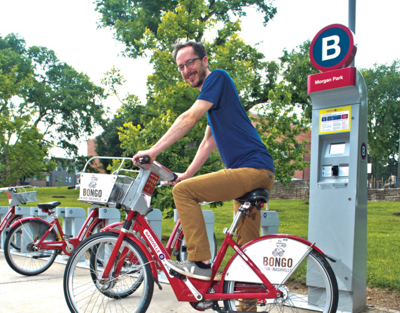


Metro Councilmember Freddie O'Connell
Few people have been as involved in Nashville’s discussions about transit over the years as Metro Councilmember Freddie O’Connell. His many years on the board of Walk/Bike Nashville overlapped with seven years as a Metro Transit Authority board member, including three years as board chair. Now, as he represents downtown and parts of North Nashville on the council, he tells the Scene why he’s supporting the transit plan that will be put to voters on May 1.
You’ve been involved in advocating for transit for years, but you didn’t seem like an automatic “yes” on this plan. What made you decide to support it?
I heard Mayor [David] Briley say [this] out loud at this Nashville Business Journal panel this past week, and my hope is that voters go through this same reckoning as this comes front and center for them, and we really prepare to go to the polls. ... No plan is perfect, but ultimately this is Nashville’s single best opportunity that we’ve ever had to secure dedicated funding for transit. It will provide unprecedented levels of mobility freedom for Nashvillians. It is directly tied to a regional network of plans. It offers things way beyond just the heavy-vehicle-type of scenario for transit, down into improved sidewalks and bikeways. And ultimately, now that we’ve got a Transit and Affordability Task Force, it’s tied pretty tightly to our prospects of increasing the number of affordable housing units at a rate greater than we displace them. So if I really sit down, look at all the details, look at the map, look at the funding mechanism and all of those things and add it up — I mean, sure, I can find things to be critical of, but at the end of the day this is the plan before us, and if I am weighing between this and the status quo, this is an easy yes.
Can you elaborate on what you think this plan does beyond the light rail piece?
I think probably any plan catches people’s eye across headlines at those more capital-intensive bits. In this plan, for instance, it incorporates multiple light rail routes. Those attract attention, they can attract scrutiny, and ultimately I think that’s probably worthwhile — that ought to be given serious consideration. But it’s the frequent-transit network. … If we secure dedicated funding first and foremost, but then we immediately begin implementation of a frequent transit network and within five years we have six-day-a-week, 20-hour-a-day bus service that is operating at more than an hour after peak service windows in terms of how often a bus is coming — that’s a huge deal, and if you look carefully at the map, this is the way that we expand. That’s what’s remarkable to me. So much of the opposition’s argument is couched in this idea that, “Well, we ought to just do buses.” This plan is chock-full of traditional bus service, and the improvements start to arrive immediately.
Why are you confident that the task force will be able to make sure the plan isn’t damaging to affordability along those routes?
I think the work that the task force did is meaningful. We’ve chewed on it, and my pointed question to the administration was, “How many of these recommendations are going to be adopted if this thing passes?” And the city’s COO, Rich Riebeling, got up there and said, “I hope all of them.” So now I think that is that moment of accountability, where we look to this over the long haul and we really try to make sure it is all of them. … Again, the race here is always to make sure that you are creating affordable housing units at a rate greater than you are displacing them. ... Honestly, being intentional about it is a huge step in its own right, because certainly not every transit plan in this country, and certainly not every transit plan developed in Nashville, has been as fully intentional as this one has been about how to deliver any kind of measurable count of affordable housing units.
Are there concerns or criticisms that you’ve heard from the opposition that are most compelling to you?
Sure. I’m having an ongoing conversation with one of my constituents who is ready to vote for the plan [if it weren’t] for the light rail components. I think he has done personal analysis of the cost-effectiveness of light rail in other markets and ridership targets and density and all those types of things. And I think he is in a camp that would say we should swap those out for full-implementation bus rapid transit lines, and then he is ready to go for the plan. I have a feeling that for people who are actually giving this serious consideration — not the paid spokespeople for [political action committee] No Tax 4 Tracks, but the actual Nashvillians that are giving this their serious consideration — I think that’s a big piece of it. Because you go dig in there and you look at the charts of capital costs, light rail consumes a lot.
This is the hard part. You’ve got to make sure you’re talking about it on the basis of why this is a public good. Ultimately, light rail moves people more efficiently than any of the other modes. Now, you might not ultimately — always, across every route, during every hour of service — be moving the capacity necessary to be hitting all the offsets you’d be hitting on bus rapid transit and so forth, but I think that’s the trick. For some people, light rail is clearly the thing that makes them celebrate the plan, and for another audience that is way more hawkish on cost-benefit, it’s the piece that makes them skeptical. And how to get both of those groups of people that are ultimately in favor of a robust transit system in Nashville to agree and link arms, I think that’s really gonna be one of the cruxes of whether or not this thing passes on May 1.
Another thing connected to discussions of affordability is the concern about the sales tax increase and who that lands on. What’s your thinking on that?
I think light rail and sales tax are probably those two chief elements that are getting a higher level of scrutiny than anything else in the plan, and in many ways they’re realistically the most challenging elements of the plan. … Just that psychological moment of, five years after passage of this referendum, we will be up there in the reaches of highest sales taxes in the country for major American cities. There’s that piece of it that, beside the policy pieces, that’s tough. Again, looking at both sides of it, Nashville and Tennessee’s overall tax burden remains remarkably low. It shouldn’t be lost on people that we just last year passed the lowest property tax in Nashville’s history by tax rate. So overall, Nashvillians are still going to enjoy a remarkably light tax burden in exchange for, again, a comparatively high quality of life.
Now this question of the burden, one of the things that the Improve Act did was it lowered the sales tax on food even further than the state already had. Several years ago they had walked down the sales tax on food to, I believe, 6.25 percent. Then Improve dropped it to 4. So when our surcharge kicks in, yes that will creep back up, but you’re still going to have a lower overall tax on food than was there. …
Also, the architects of this plan in looking at sales tax as the major bucket from which to collect revenue recognized that analytically, this actually ensures that we are not making this a purely Nashville burden. By leveraging the sales tax, you actually do collect some regional and tourism dollars in that. So that’s actually a pretty big deal that, yes, Nashvillians will be through consumption funding a good chunk of this, but that something approaching 50 percent of that sales tax revenue is going to be made up from people out of area. …
The mix of access and opportunity is going to be hard to measure. But I think it’s also going to be one of those things that when people realize the new freedoms they have to get to parts of the city that they couldn’t previously imagine getting to or that used to take them two hours; when people for whom a two-hour trip is suddenly cut in half or, even better, cut by 90 percent … I think when people experience what their real mobility choices are, that payoff is going to be clearly recognizable.



