
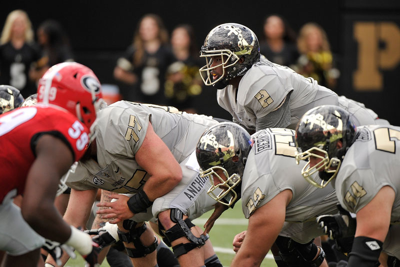

College football's final regular-season weekend is upon us, with its slate of century-old rivalries and outré-folk-art trophies. After all the obscenities and wooden hogs and festooned spittoons and totem poles and other flea-market cast-offs are exchanged, the prime time begins. The de facto national quarterfinals of conference championship games lead into the 40 (yes, that's right) bowl games, culminating in the new-car-fresh pocket-lining festivities of the college football playoff, aptly named the College Football Playoff.
That's all well and good. The most talented teams in the country will square off, and we'll be treated to well-played hours of precision pigskin. It's indeed how the season should end; even curmudgeons like yours truly — who pine for the pre-BCS days when ESPN would spend 45 minutes on New Year's Day breaking down how a half-dozen teams might find themselves as national champions — must admit that the clean finish of the playoff is satisfying. When the calendar flips to January, the NFL will pare its teams from 32 to 12, with the top 11 teams in the league and also the AFC South champion vying for the Super Bowl. The quality of games increases when fall gives way to winter.
But let us remember what's lost when the losers stop playing: the joyous wonder of bad football.
Football, particularly college football, is a coaches' game, and coaches (with perhaps the notable exception of pirate-loving polymath Mike Leach at Washington State) love structure and rhythm with a Prussian devotion. A four-hour game played in four-second segments at four downs apiece on precisely measured fields, a "good" football game is a battle of brains as much as brawn. There is, in well-executed games, no room for randomness.
But the bad games — and to be clear, "bad" doesn't mean a 59-0 blowout but rather a 7-6 stinker or the ever-elusive 11-5 fumblefest — thrive on the unexpected. Sure, Tom Brady throwing a 30-yard laser through diving defensive backs is aesthetically pleasing, and Alabama's Derrick Henry pounding through defenses five yards at a time like John Henry cutting a tunnel is the peak of football ability. But we forget those particular plays in part because we expect Brady to have a missile's precision and Henry to have a steam shovel's efficiency.
Who among us does not still delight, seven years later, in Auburn's 3-2 win against Mississippi State? Legendary Virginia Tech coach Frank Beamer once fist-pumped his way into the GIF Hall of Fame at the end of regulation against Wake Forest when the Hokies and Demon Deacons were knotted at zero.
Living in Middle Tennessee (the home of Cumberland, which of course played maybe the worst college football game ever, losing 222-0 to Georgia Tech way back when), we have the advantage of being the veritable epicenter of bad football. (The state of Iowa is the only other place that could stake a claim — venerable college football blog Every Day Should Be Saturday has aptly dubbed the Iowa-Iowa State rivalry as "El Assico.") Vanderbilt and the Titans — the latter of whom played in the worst Monday Night Football game ever, best remembered for Jets quarterback Mark Sanchez's infamous "butt fumble" — bumble their way around every fall. Who can forget the 1998 Halloween game between the 'Dores and Duke, which included a crucial "illegal batting" call, two fake field goals on third down and Vanderbilt nearly converting a third-and-31 from Duke's 39? Or the 2008 Music City Bowl, a game that has featured many wackadoodle clunkers in its short history, when Vandy beat Boston College and the MVP was the punter (and rightly so)?
While the Titans and Commodores play bad football and fail more often than not, just down I-24 is Middle Tennessee State University. The Blue Raiders are headed to another bowl game this winter, and not because they play Alabama-style good football, but because Rick Stockstill's teams play winning bad football. Play calls are made after throwing a 20-sided die, formations have all the forethought of magnetic poetry.
If Alabama is the London Philharmonic playing note-perfect Beethoven, the Blue Raiders are some weird, Murfreesboro-perfect jam band playing noise-rock covers of New Wave B-sides — chaos-riddled noodlers always on the verge of going off the rails to the simultaneous terror and delight of everyone watching.
When watching high-class teams play nearly perfect games, it's easy to think that the joy of sports comes from seeing well-oiled, talent-heavy teams do battle. But there's more joy in seeing the unexpected and unintended and finding the beauty in the horror. We'll soon forget the score of the SEC Championship Game, but we'll always remember that first 11-5 game, which inevitably will be played in Nashville.



