

Nashville has never been known for sophistication, exactly — at least not the kind that's easily recognized in a superficial glance. To paraphrase Dolly Parton, it takes a lot of savvy to look this unassuming. Our city's appeal doesn't necessarily come from a glamorous or especially high-end place; our strength comes from being real and relatable. And if that doesn't come across as refined, well, don't expect us to take offense. We like things that are authentic, perhaps a little gritty — and people respect that about us.
Take Nashville's rock scene. No one digs Jack White's production or guitar playing because it's slick and modern. His fans like what he does over at Third Man Records because it's got a slightly dirty throwback quality to it, a rawness. Good old-fashioned rock 'n' roll, tweaked just right.
The same goes for our food culture. Chef Tandy Wilson didn't get to be a James Beard nominee by being elitist. The appeal of his City House is, of course, amazing food. But a huge part of the draw of his Germantown restaurant is the communal atmosphere and down-to-earth staff — Wilson cooks in a trucker cap — not to mention the fact that the popular Sunday Suppers have been known to include gourmet mini corn dogs served with yellow mustard and a Grape Nehi chaser. Nothing pretentious about grape drink.
We're not alone in our appreciation for grit (or grape drink).
The February 2012 issue of Bon Appetit, devoted to all foods Southern, included a big, juicy story about how we eat — recipes included. The title: "Nashville: The Coolest, Tastiest City in the South." This comes not long after Rolling Stone magazine declared that Nashville has the country's "Best Music Scene." (Not country's best, the country's best.) National media from Travel + Leisure to Forbes have recently shot Nashville a big thumbs-up as a city where big things are happening.
Even the hyper-fickle fashion crowd is taking note. Harper's Bazaar, GQ, Glamour, Nylon, Details, Elle (which ran a story of mine, on Nashville's modern fashion sense, in its March issue), and several international editions of Vogue have featured Nashville-centric photo shoots or run stories about our burgeoning style scene.
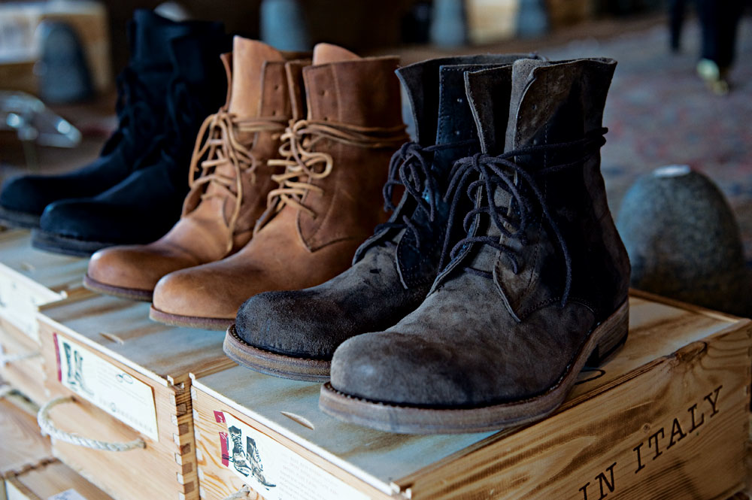
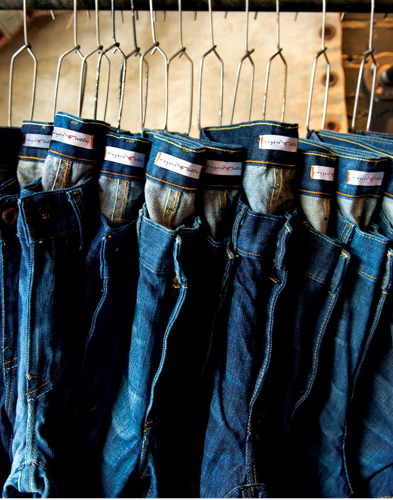
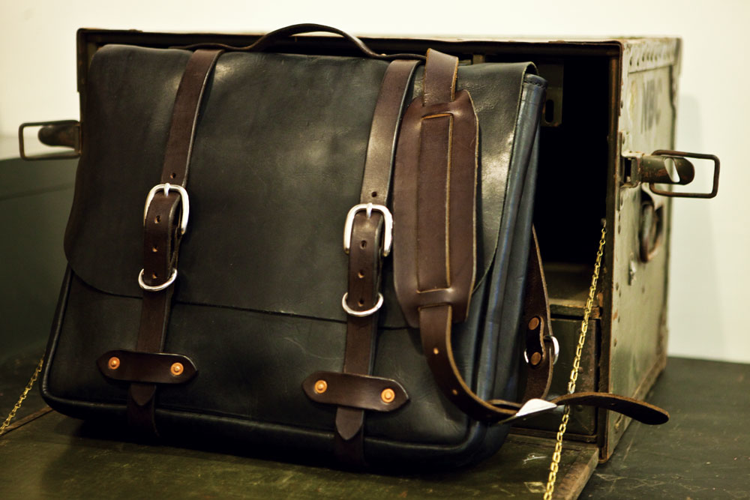
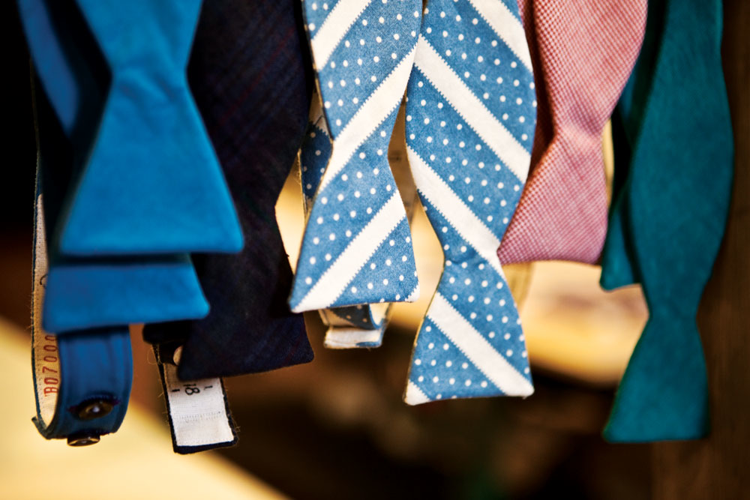
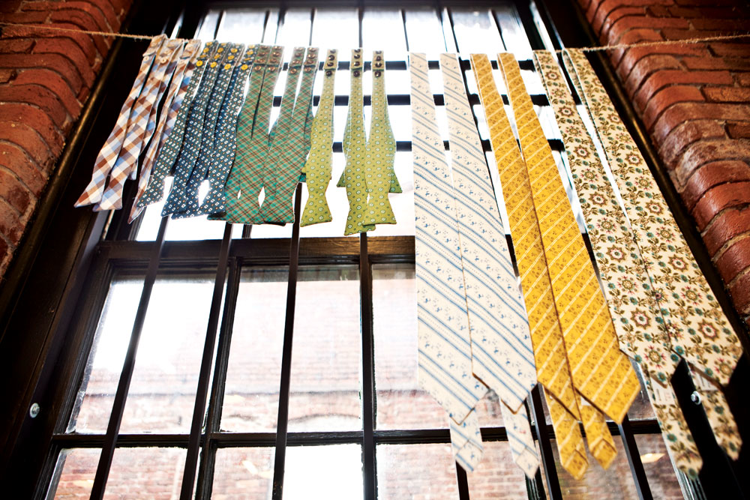
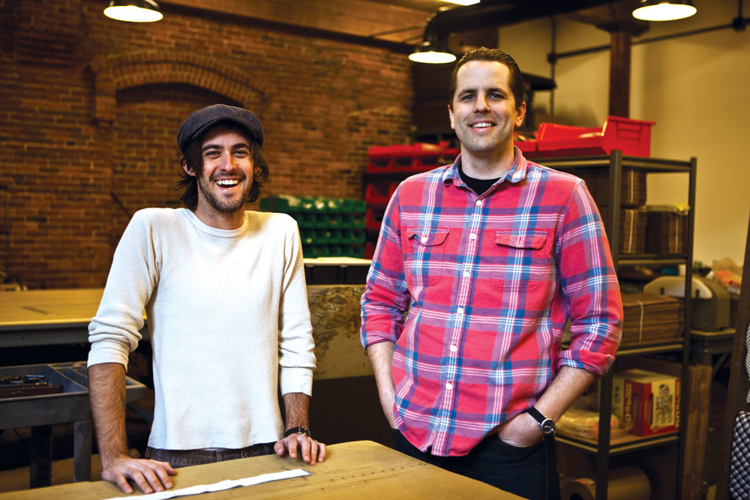
And why not? Nashville has an impressive roster of local brands that are making national headlines in their respective fields. Among them: bootery Peter Nappi; tie and hat creator Otis James; leather accessory designer Emil Erwin; and denim experts Imogene + Willie.
These companies specialize in different areas, but each of them produces goods that aesthetically align with the straightforward, slightly throwback style known, for better or worse, as "Americana." (More on this later.) They share a certain ethos: They trade in the personal, making pieces that look like you've had them forever, used them every day, and loved them just as long.
They value quality over quantity (small-batch production, which allows plenty of hands-on time with each piece being made, is common), concentrate on keeping production lean and local when they can, and operate largely on a direct-to-market business model. (Nappi's an exception: His boots are made in Italy, where he learned the craft of shoemaking, though he identifies as a local designer.)
Indeed, the production systems in place at Nappi, James, et al are the antithesis of the fast-fashion model that zips out the racks of clothes you see in chain stores at the mall or big-box stores like Target, something that makes them very attractive to the national fashion media, always looking for the next big trend.
Lucky for us: Right now, the big trend is small companies.
Anne Slowey, Elle's fashion news director, says style watchers in fashion capitals like New York are "just now catching on to things that people in small towns already think about a lot. At the root of it is the idea of homegrown style, which Nashville obviously has plenty of."
She believes the fashion industry is getting too top-heavy; consumers are tired of trying to keep up with the ever-expanding international luxury market currently preoccupied by Eastern expansion (hello, China!). Because of this, Slowey says, "A lot of people are feeling like they want to be a part of something more personal and intimate, so they're seeking smaller labels to support. And with the job growth finally having a turnaround, and this being an election year, I also think there is a renewed consciousness about buying products that are made in America."
All this adds up to put Nashville in place to be the new "It" town for fashion.
But it's more than just a revived interest in small labels and respect for the Made in the U.S.A. movement fueling the sudden interest in our fashion sense. A big tip of an Otis James cap goes to Nashville's creative class, many of whom endeavor to wear local designers' goods on a regular basis, making them into unofficial poster children for our sartorial scene. That some of them have Grammys and Oscars on their mantles only helps with exposure.
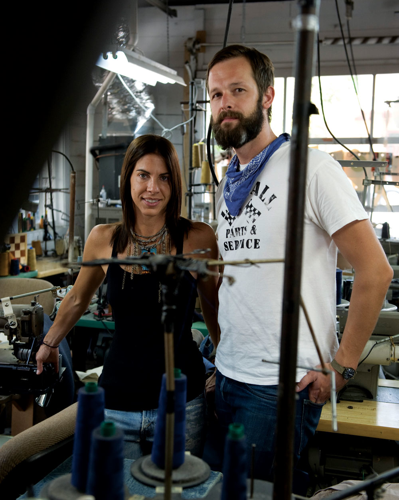
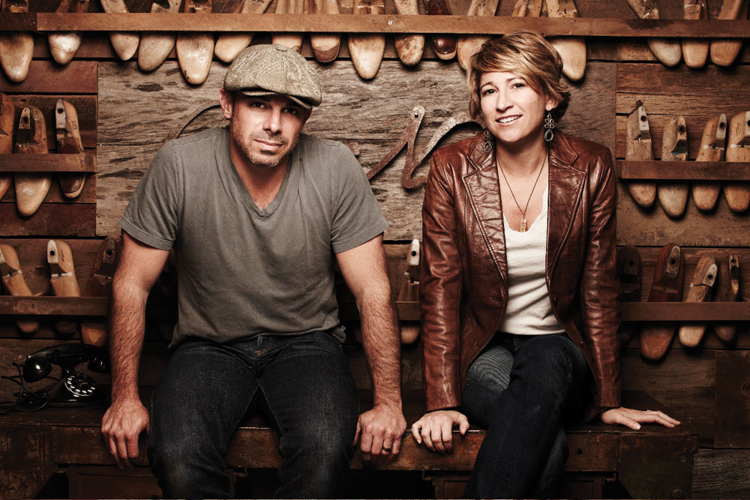
"Music has a lot to do with Nashville's image," says Phillip Nappi, who with his wife Dana runs Peter Nappi out of an artfully under-renovated section of the former Neuhoff Meat Packing Plant near Germantown. "Three of the biggest forces in rock music are living in Nashville right now: Jack White, The Black Keys and Kings of Leon."
Nappi points out that his examples aren't slaves to the trend machine. "Those guys don't care a lot about fashion, but they do care about personal style," he explains. "And because of that, Nashville designers like me and Matt and Carrie sometimes end up playing a part in how they look."
"Matt and Carrie" are Matt and Carrie Eddmenson, the husband-and-wife owners of Imogene + Willie. (Total disclosure: They're also my full-time employers.) The company, which operates out of a retrofitted 1950s gas station on 12th Avenue South, specializes in making blue jeans and has been a player on the Nashville style scene ever since opening in the summer of 2009. Since then, I+W has garnered quite a bit of national buzz, thanks not only to a solid product line, but also an early collaboration with J. Crew. (In a show of local solidarity, the Eddmensons brought Emil Erwin into that golden ticket of a deal with them.) Their admirers include a pretty influential actor and musician clientele — think Gwyneth Paltrow, Reese Witherspoon, Sheryl Crow, Michael Stipe.
The Eddmensons and Nappis launched their businesses here at an exceptional time: the late '00s, when the country was dabbling in "recession chic" — remember that blip in time when conspicuous consumption gave way to conspicuous asceticism? — and on the brink of a massive fashion movement that championed the spare, durable and yes, slightly gritty, workingman's cool that goes by the names "heritage" and "Americana."
Certainly, Nashville isn't the only city where you can find a strong heritage scene. It's embraced in hipster enclaves from Brooklyn to Portland, Ore., and from Austin, Texas, back up through the midsection of the country to Madison, Wis., and Minneapolis, where there is a wellspring of small, independent fashion movements similar to ours. As for where and when Americana was born, well, this isn't a new trend by any means. "There's this huge resurgence in New York and other cities right now, where kids are walking around dressed like they're from Alabama," says Matt Eddmenson. "But the reality is that the whole work wear look originally came from out West, and before that you can trace it back East, and then back to Britain."
Indeed, heritage is all about reappropriation. The hallmarks of the look are mostly "borrowed" from our blue-collar granddaddies and great-aunts, middle-class Americans who toiled in factories, on farms, and in heavy-duty warehouses. They may have only had a few clothes, but the ones they had were built to last.
Nostalgia plays a part. It's kind of romantic to know that your neighbor spent time making your computer bag or boots. It's a refreshing change for jaded fashion types tired of buying into the overpriced runway styles designed in laboratories and churned out en masse by large overseas corporations.
Aesthetically, heritage is an attractive alternative for local men and women who are tired of betting on skull-bedecked Ed Hardy tank tops and bedazzled designer jeans only Bret Michaels could love.
The men who embrace Americana (and it is mainly guys who fall head-over-boots for the look, though there are female aficionados as well) favor a uniform of dark, stiff jeans with a hefty cuff to show off the selvage; old-man kicks from an old-school company like White's Boots; worn chambray or cotton shirts; Hanes T-shirts; banged up vintage belts and messenger bags; and bandanas tucked or tied somewhere on their person. When a heritage fellow gets gussied up, he pays homage to his forefathers, suiting up in tweedy streamlined separates and bespoke bow ties.
In Nashville, these pieces often come via the local outpost of Billy Reid, a company whose namesake designer is a dove-hunting, bourbon-drinking country gentleman who excels at the Americana dress-up thing. Billy Reid is where guys like John Paul White of The Civil Wars and Justin Townes Earle get natty.
Reid runs his company down I-65 in tiny Florence, Ala., but his relatively close proximity — and penchant for dropping into town for fittings and to host Whiskey Wednesday parties at his Green Hills store — has led many Nashvillians (including me) to claim him as our own. (His story sets a great example of what the future might hold for Nashville designers, many of whom call Reid a friend and supporter.)
Reid acknowledges that his collections are based on heritage — his own. "The collection is very personal and is built around a gut instinct," he says. "I really never consider it being Southern, but certainly I'm a Southerner and can't change that."
Nor should he. His Southern-ness is what makes him stand out from the fray in New York, where two years ago, Reid's signature hunt-club chic led the members of the Council of Fashion Designers of American to award him their highest honor: the Vogue Fashion Fund prize. That 2010 win not only netted him some major coin, but more importantly, it moved him up several places on Vogue editor Anna Wintour's very packed dance card.
The CFDA win was rather atypical. As good a designer as he is (and his clothes are wicked good), Reid doesn't fit the mold of a typical Fashion Fund winner, who is usually a young insider, an up-and-coming player in the capital-F Fashion world. Reid doesn't play that game. He's succeeded on his own terms, in his own time.
Instead of a claustrophobic micro-office in a Seventh Avenue high-rise, Reid works out of a roomy atelier in his wife's tiny Alabama hometown, where he gets to be a designer during the day and a husband and dad at night. He gets to run carpool for his kids, spend time with his wife and blow off steam by playing in a rock band (called Seersucker, natch) — and he still gets to go to parties at Wintour's house, not to mention do cool collaborations with companies like Levi's and K-Swiss. By summer, he will have opened seven freestanding stores in as many years. But at the end of the day, Reid's mission is simple: to make accessible, durable, wearable clothes. "Folks seem to be responding to things that are real these days, and that's something we value," he says. "I'm not sure why this resonates, but I'm glad it has."
It's not going too far out on a limb to suggest that one of Billy Reid's biggest assets — and potentially that of every Nashville designer in this story, for that matter — is his location. Call it outsider-chic, but instead of alienating him from the New York-centric fashion industry, his physical distance from it has set Reid apart. It's made him even more special.
Not to mention more newsworthy. He's the perfect example of what Slowey calls "homegrown style": The story of a family man in North Alabama who makes classic, comfortable, timeless clothes is far more interesting than that of another struggling avant-garde couturier shaping ball gowns out of Play-Doh on the Lower East Side. In a time when everyone is searching for something authentic to latch onto, whether it's fashion or music or food, real rings true — especially if it's chiming off the radar.
Phillip Nappi recently experienced this firsthand. After taking some meetings with editors in New York a few weeks ago, he had a revelation.
"If I was making boots in New York or L.A., I'd be just another boot maker to them," he says. "But since I'm here, people are automatically intrigued: 'Why is he in Nashville? Wonder what's going on down there. ...' "
Once upon a time, we might have said, "If they only knew." But increasingly, they already do.
Related Stories:
Walk It Out: Thinking big and thinking local simultaneously, Nashville Fashion Week's runway shows hold power and promise
Excursions & Explorations: With a new program of industry panels and a slate of related events across the area, Nashville Fashion Week has picked up the pace
Sparkle or Substance?: In its second year, Nashville Fashion Week aims to be more than just a pretty face
Make It Work: Tim Gunn talks American style, integrity, and the No. 1 crime committed against fashion



