
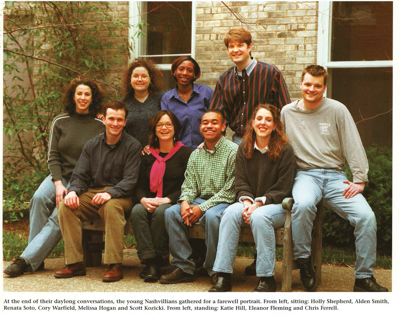
The stories hit the wires on July 10 and 11, 2015: Renata Soto of Nashville had been chosen to chair the National Council of La Raza, the country's largest Latino advocacy organization, and Nashville-born Katie Hill had been named assistant press secretary at the White House. But there was more to the news than the double whammy of women with local connections taking up important national positions on consecutive days.
Soto and Hill were both members of the Nashville Nine.
Fifteen years ago, the late John Egerton and I convened a panel of young people connected to Nashville for a professionally facilitated day of civic imagination. We meant the book we were co-editing, Nashville: An American Self-Portrait, to be an "intentional artifact," documenting the city's remarkable year 2000 through the work of numerous writers, photographers and other contributors (many with long ties to the Scene). Its first 11 main chapters would each cover a theme of Nashville life — music, religion, race, money and power, and so on — with authors charged to engage intensely the past and the present in their assigned fields.
The 12th and final chapter would be about the future. We would ask nine men and women, ranging in age from 17 to 31, to reflect on the city as they had experienced it — and as they expected to experience it later in life. In the day's final session, they would break into groups and produce scenarios that reflected their hopes for themselves and for Nashville in the year 2025.
I suggested Chris Ferrell (then 31), the youngest person ever elected as a Metro councilman-at-large — later a candidate for Congress, today CEO of SouthComm, the Scene's parent company. John mined his connections across Nashville to select the other participants:
• Eleanor Fleming, then 22, a Williamson County native who had been salutatorian of her graduating class at Battle Ground Academy and graduated summa cum laude from Vanderbilt. She is now a dental officer with the Centers for Disease Control and Prevention in the Washington, D.C., area, and she holds the rank of lieutenant commander in the Commissioned Corps of the U.S. Public Health Service.
• Katie Hill, 19, then a freshman at the University of Virginia. She went on to serve as a national board member with the Human Rights Campaign and press secretary for Congressman Jim Cooper before receiving her White House appointment.
• Melissa Hogan, 27, then an attorney at Bass, Berry & Sims. She tells the Scene: "In 2004, I chose to leave a career I was good at in favor of a career I would love. I left the practice of law, not only to raise my children as a very engaged parent, something full-time law practice does not support well, but also to teach and to do consulting work, which I found to be both creative and challenging. However, little did I know how handy all of those skills would become when our youngest son was diagnosed with a rare disease in 2009. But every role I'd played, every connection I'd made, and every skill I'd acquired was then called up not only to advocate for my son, but for the entire community of families who face Hunter Syndrome, as well as the broader rare-disease community."
• Scott Kozicki, 29, was already a successful serial tech entrepreneur in 2000. He is now a managing director at Brentwood Capital Advisors. "Since 2002, I've been a tireless advocate for health reform and sustainability," he says. "A lot of that was influenced by my conversations with Alden Smith at the time. It's my life's mission."
• Holly Shepherd, 30, had returned to her hometown of Nashville from New York in 1995 "to be a full-time artist, rather than a really good waitress who also works onstage." Her acting, singing and dancing career has taken her to stages around the world.
• Alden Smith, 29, who had grown up in Belle Meade, was serving as assistant director of the Mountain School in rural Vermont when the group convened. He has been the school's director for the past 14 years. He and his family visit Nashville several times a year. "Even though I'm out of touch with the city in many ways, I still love it," he says. "I continue to lament the loss of walkable neighborhoods and historic architecture, but I appreciate the arts, the growth of farmer's markets and CSAs, and the remarkable urban parks."
• Renata Soto, 28, a native of Costa Rica, had moved to Nashville in the late 1990s and was expecting her third child at the time the group met. She co-founded and is executive director of the nonprofit Conexión Américas, which promotes the social, economic and civic integration of Latino families in the Nashville area. At Casa Azafrán, the organization's headquarters on Nolensville Road, she hosted a visit from President Barack Obama in December 2014.
• Cory Warfield, 17, was president of the junior class at Martin Luther King High School in 2000. His mother was working the night shift at Aladdin Industries; his father had died the prior year. He graduated from Vanderbilt in 2006 and has carved out a career as a Democratic political operative. At present, he is presidential caucus director for the Nevada Democratic Party, preparing for the "First in the West" presidential nominating contest.
Nashville: An American Self-Portrait went to press in August 2001 and reached stores in late September. It thus became not just a multifaceted portrayal of one of the most news-filled years in our history, but also an exploration in deep detail of an American city in the moment before terrorism transformed the country.
In addition, it stands as a time capsule of the city before its unprecedented — and unexpected — eruption of development and national visibility. To some of the Nine, that growth hasn't altered our essential character.
"While Nashville has evolved, the city at its heart remains a place where people say 'Hello!' when they pass you in the street, hold the door open for you, give you directions, and try to make you feel at home," Fleming tells the Scene. Yet others, such as Warfield, wonder if that prosperity is actually felt, let alone shared, by many Nashvillians.
"While I'm pleased and blessed to have grown up in a town with such rich culture and community, I ponder the city's future, as many Nashvillians do," he tells the Scene. "Does a child growing up in any section of Davidson County have access to great education? Is Nashville providing enough transit options for working families, singles and senior citizens to obtain good jobs? Is the city creating a community that is open to everyone and providing an opportunity for affordable places to live?"
With those goals in mind, it's fascinating to look back at what these nine individuals projected for Nashville's future, free of any awareness of the change that lay ahead — including the specter of terror. But the range of concerns and hopes shows how little our civic needs have changed in some ways, and how urgent many remain today:
Hogan: "In our fantasy future [2025], I am 51 years old. Chris, Cory and I are the advisers to a group called the Nashville Vision Council, which was started in 2001 as an outgrowth of the writing of a book. We are now the advisers because we're too old to be on the Nashville Vision Council. The age limit is 32. Chris is the speaker of the U.S. House, I am a judge on the Sixth Circuit U.S. Court of Appeals, and Cory is the junior senator from the state of Tennessee."
Ferrell: "OK. It's 2025, and Nashville has slowed its growth and has close to 2 million people in its metropolitan statistical area, and we've managed to reverse the effects of sprawl. We've modified our metropolitan government to expand to a regional metropolitan government, with a mayor and council that govern the entire MSA. We now have commuter rail running along five corridors to bring people from outlying areas into the city and vice versa. Every Nashvillian has the opportunity to live in safe, affordable housing. We have it in mixed-income communities, and we have also managed to increase density close to downtown and around the rail stops. We have created opportunities for people to live, work, play and go to school within their communities.
"We have an excellent public school system that features a high degree of choice. In the business community, we have managed to maintain and foster an entrepreneurial environment, where people are founding companies in the city with a diversified economy. We have been able to attract more publicly held company headquarters here, but mostly we've managed to grow our own here. Our biotech sector has emerged as a national leader in that field, growing out of relationships at Vanderbilt and in our cooperative public-private health care sector. We just celebrated the best Olympics of all time right here in Nashville in 2024. We continue to have a very vibrant entertainment district downtown. Replacing the Thermal Transfer Plant with an entertainment district on the river was a phenomenal idea."
Kozicki: "In our parallel Nashville, Renata is 52 years old and is the CEO of the largest and most important regional foundation of the Southeast, which is based in Nashville. Katie is 43 and the first woman governor of Tennessee. I'm 52, and I live on an island after starting a couple of businesses here that have done well. I fly in on weekends in my private plane.
"Years ago, the city went to a localized, neighborhood political zone concept. Each area or political zone is focused around an institutional focal point like a church, a school, or some other civic or social institution. Each political zone is relatively self-sufficient. It includes retail, commercial and residential areas that are established with a neighborhood flavor. Gradually, this zone concept broke down the infrastructure problems we had and the political and socioeconomic barriers we had to break through. Meanwhile, telecommuting and technology drastically reduced the need to drive."
Fleming: "I'm now 46. In listening to the conversation we're having so far, it seems to me that if everyone has decided that education and quality of life are what's most important, then there needs to be some kind of change in our community values. Until we reassess and change our emphasis, not just as a government but as citizens in the voting booths, we'll just be talking around in circles — and in 2025, this same conversation will still be going on. We need to draw on all our community resources to make our public schools our first priority. That means using professional people like lawyers and doctors and engineers. And I don't understand why we're not using retired teachers, who have boundless knowledge but whose gifts we ignore."
Smith: "I'm 53. I don't live in Nashville currently. I live up on the Cumberland Plateau, where I help run a small school. I occasionally get into my very small fuel-cell car and come into Nashville to consult with the public schools about how to build place-based, interdisciplinary initiatives into their programs. In the past 25 years, there has been a groundswell in Nashville to build a culture of creativity. We have a vibrant arts community now. We have found creative ways to celebrate the traditions of Middle Tennessee. The core of the city is now a pedestrian center with local gardens, lots of arts, and places where people walk, meet, and greet. Where people live."



